Journalism of Courage



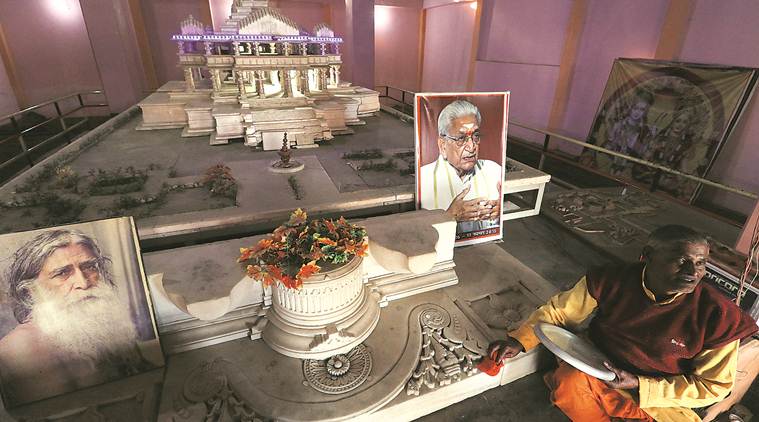 A replica of the proposed Ram Temple at Kar Sevak Puram in Ayodhya. (Express photo: Vishal Srivastav)
Protected by double barricades of yellow and black iron rods, the 67 acres surrounding the 2.77-acre disputed Ram Janmabhoomi-Babri Masjid site in Ayodhya became the talk of the temple town on Tuesday as the Centre moved the Supreme Court seeking permission to lift the status quo on this land.
“Sentiments of crores of Hindus have been insulted. There were Hindu temples on land, which were either demolished in the 1990s or are dilapidated. Whether the court takes a decision or not, we are going to take our decision in two days as we meet for Dharma Sansad at Kumbh,” said Kamal Nayan Das, heir of Mahant Nritya Gopal Das, the chief of Ram Janmabhoomi Nyas. The Nyas was formed to oversee the work of the proposed Ram temple.
“The decision should be taken quickly and land returned to Hindus… and there will be a revolution across the country and the Supreme Court would be responsible for it,” he added.
Standing next to the rows of carved stones at the workshop at Karyasewak Puram, Satyendra Das, chief priest of the makeshift Ram temple, said the move was delayed but required. “It should have happened earlier. But it is a good move, and has given hope that with this kind of initiative of the government, the Ram temple will soon be constructed,” he told The Indian Express.
“There were at least 16 temples (on the land) that were demolished, but there must still be a Kuber ka tilla, and an old Shiva temple. There was also an old tamarind tree, which had historical significance,” said Das. “But only the Supreme Court’s decision will make things final.”
Sharad Sharma, VHP spokesperson in Ayodhya, claimed there were about 40 rooms inside this 67 acre-area, of which 42 acres were taken on lease for 99 years by Ram Janmabhoomi Nyas, but these are also occupied. “The land acquired by the government also included land of some individuals or trusts, but they had taken compensation so they cannot make a claim. As soon as the stay is lifted, work will start on projecting the life of Ram through statues among other proposed structures,” he said.
Sitting under a tin shade with a book of receipts for collecting donations on behalf of Ram Janmabhoomi Nyas was Swadesh Kumar, who shared Tuesday’s news with the pilgrims making donations. “Ram katha kunj, Sanskrit vidayalaya, Gaushala ka sapna sakar hoga,” he said while a pilgrim from Gwalior offered him Rs 101 for a receipt.
Baba Hazari Das, protecting the model of the Ram Janmabhoomi Temple, was impatient, “Enough of the court and its hearings and applications. I came here 30 years ago for karyasewa from a village in Shahjahanpur. Now is the time for action, youths have forgotten about the struggle. Who will fight for Ram temple then? It’s very late.”
A few kilometres away, litigant Iqbal Ansari, standing outside his house, said, “I have no objection to the government filing such an application. We are not concerned with what they do with this undisputed land. We are concerned about the mosque at the disputed site.”

 4 min read