Journalism of Courage



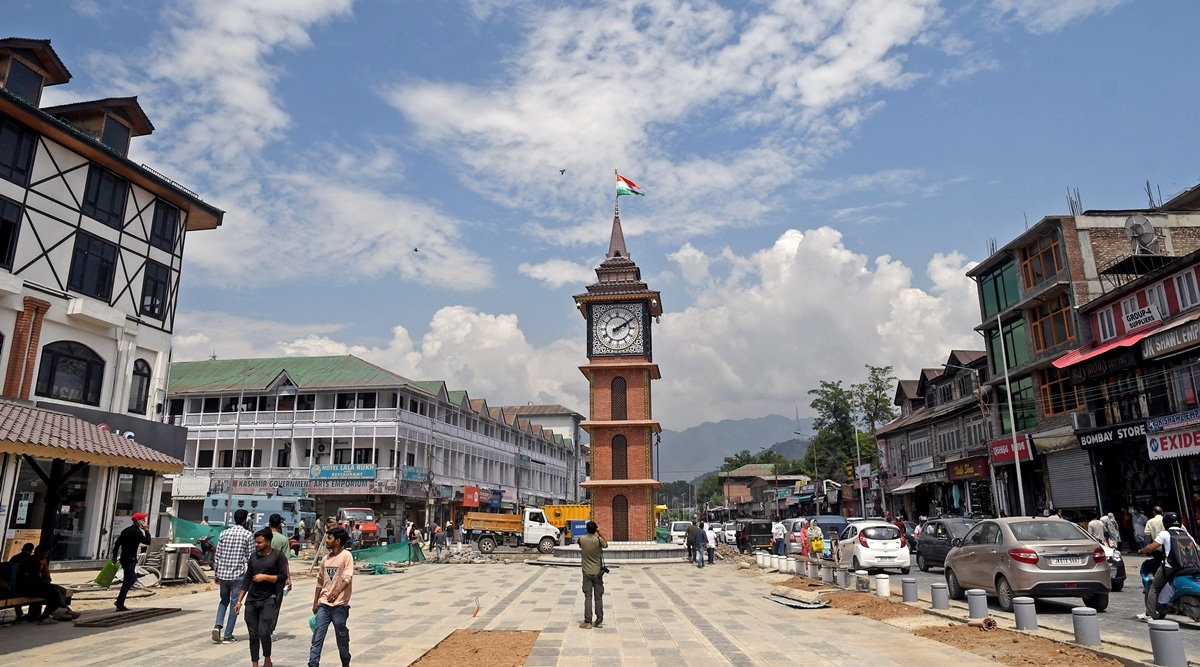 The Tricolour flies atop the clock tower at Lal Chowk in Srinagar, on Thursday. (ANI)
 Transfer of sovereignty to the dominion of India by acceding states, including Jammu and Kashmir, was not conditional but absolute, as is reflected in Article 1 of the Indian Constitution, the Supreme Court said on Thursday.
The court is hearing petitions challenging changes made to Article 370 of the Constitution, which granted special status to the erstwhile state of J&K.
Chief Justice of India D Y Chandrachud, heading a five-judge Constitution Bench hearing the petitions, said The Constitution (Application to Jammu and Kashmir) Second Amendment Order, 1972, which amended Article 248 in relation to its application to J&K “makes it now beyond the pale of doubt that sovereignty vested exclusively in India and, therefore, no vestige of sovereignty was retained post the Instrument of Accession (IoA)”.
Article 248 provides for residuary powers of legislation in respect of all other states.
The CJI said: “One thing which is very clear is that there was no conditional transfer of sovereignty to the dominion of India. The surrender of sovereignty was absolutely complete. Once the sovereignty was unquestionably and fully vested with the dominion of India, the only restraint which would apply would be on the power of Parliament to enact legislation… a few restrictions which remain which…as we have seen subsequently modified.”
Referring to the 1972 order, he said “…it’s a very interesting provision…. Article 248 was amended in relation to its application to the state of Jammu and Kashmir and 248…was substituted. Now it says Parliament has exclusive power to make any law with respect to prevention of activities directed towards disclaiming, questioning or disrupting the sovereignty and territorial integrity of India. Therefore, the 1972 order makes it beyond the pale of doubt that sovereignty vested exclusively in India and, therefore, no vestige of sovereignty was retained post the instrument of accession”.
The court said this as Senior Advocate Zaffar Shah, appearing for J&K Bar Association, contended that only a merger agreement, and not the IoA, can transfer sovereignty.
Shah told the bench, also comprising Justices S K Kaul and Sanjeev Khanna, that the genesis of framing of J&K Constitution is rooted in the nature of IoA as well as 1948 proclamation by the erstwhile maharaja of J&K on the appointment of Sheikh Mohammad Abdullah as J&K Prime Minister.
He argued that there were limitations provided in Article 370 itself regarding the power of Parliament to make laws for J&K. The first limitation on Parliament’s power was that “if you are relating any subject to List I (Union List) or List III (Concurrent List), which is not a subject covered by IoA, then you need concurrence of the state government. That means concurrence of people of the state via the council of ministers,” Shah submitted.
“Why this special treatment for J&K? Simply because there was no merger agreement. Therefore, this autonomy had to be maintained,” Shah said. He said the powers have been chipped away gradually.
Justice Kaul said that if sub-clause 3 to Article 370 envisages a process by which Article 370 can be de-operationalsied, then “to say 370 has such a permanent character in the Constitution that it can never be amended…it’s a very difficult proposition”.
Shah contended that “who can remove 370 is a question…. If you want to completely integrate, then we have to get rid of IoA and 370, and execute a merger agreement, because I was an independent state.”
The hearing will now resume on August 16.

 4 min read