Journalism of Courage



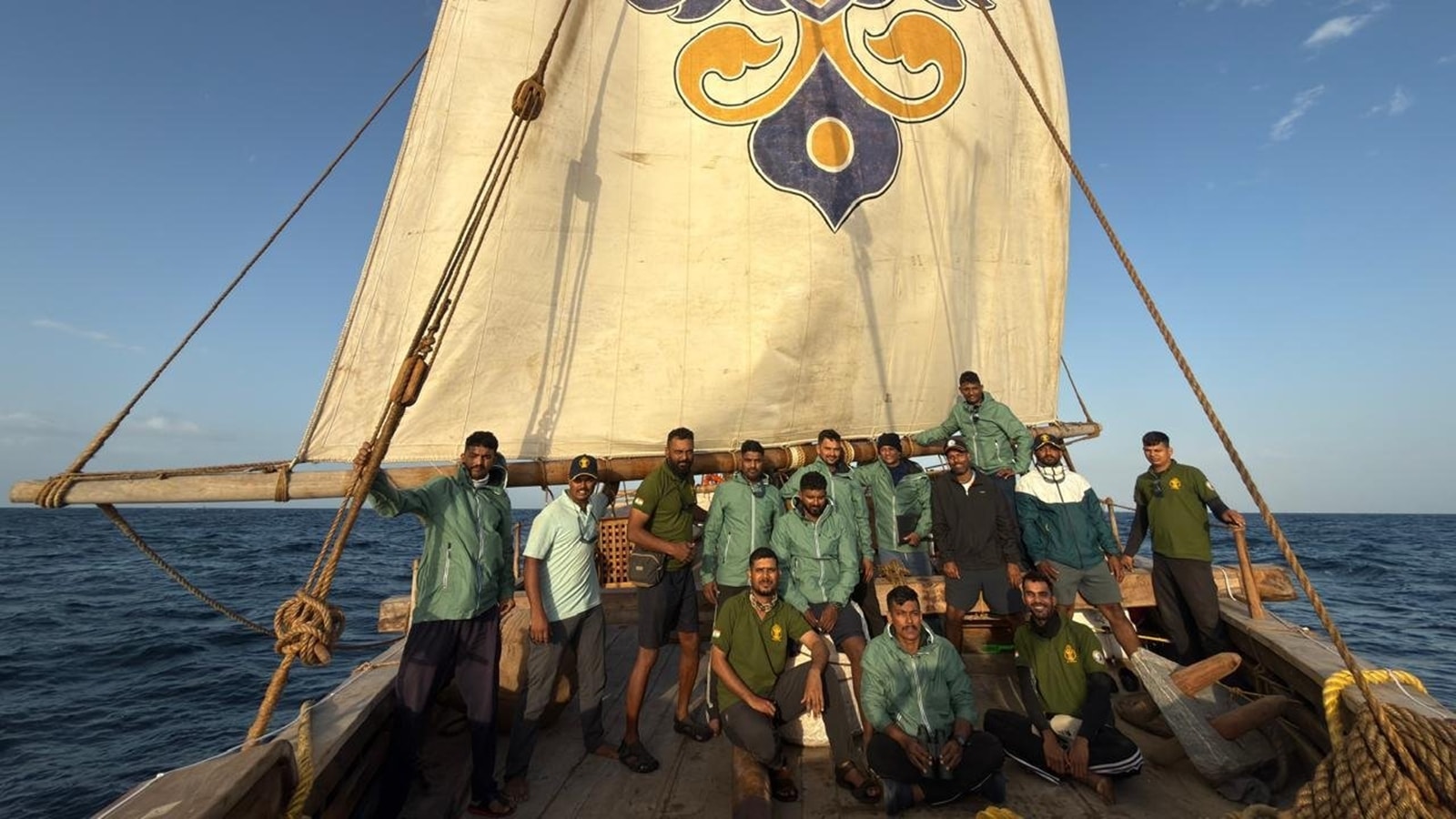 Crew aboard INSV Kaundinya, sailing towards Oman. (Image source: Indian Navy)
Shortly after it left Porbandar, the Indian Navy Sailing Vessel (INSV) Kaundinya’s voyage started on a “challenging note” as “inconducive” winds in the first 48 hours and then tidal currents kept pushing the vessel off-course.
On Thursday, Day 4 of the voyage, the sea calmed, and the “favourable” winds from the northeast set the vessel in the direction of Muscat. The ship has covered over 200 nautical miles (370 km) towards its destination so far. The ‘stitched’ ship — modelled on a fifth-century vessel depicted in a painting in the Ajanta caves — set sail from Porbandar on Monday, embarking on a historic maiden voyage to Muscat in the Sultanate of Oman. The voyage is meant to retrace ancient maritime routes that once connected the western coast of India with Oman, facilitating trade, cultural exchange and sustained civilisational interactions across the Indian Ocean.
Crew members aboard the vessel said that while they took extensive training to sail, they were almost immediately faced with “a sea state ranging 3 to 4, resulting in heavy rolling, sometimes up to 50 degrees”.
“The inconducive winds in the first two days kept us moving north and later (towards) south. Then we had a spell of Westerly winds and tidal currents, which kept us moving towards the Gulf of Kutch. Finally, on day four, we got good winds from the northeast, with which we progressed our voyage in the direction of Muscat,” a crew member told The Indian Express.
When the ship drifted close to Sir Creek, some Indian fishing vessels “followed” Kaundinya for over 90 minutes, till they were satisfied that it was an Indian vessel. The fisherfolk told the crew that they were being “vigilant” since it is a sensitive area. “It was heartening to see the commitment of our fishing community towards the country’s national security and for being our eyes and ears,” said a crew member.
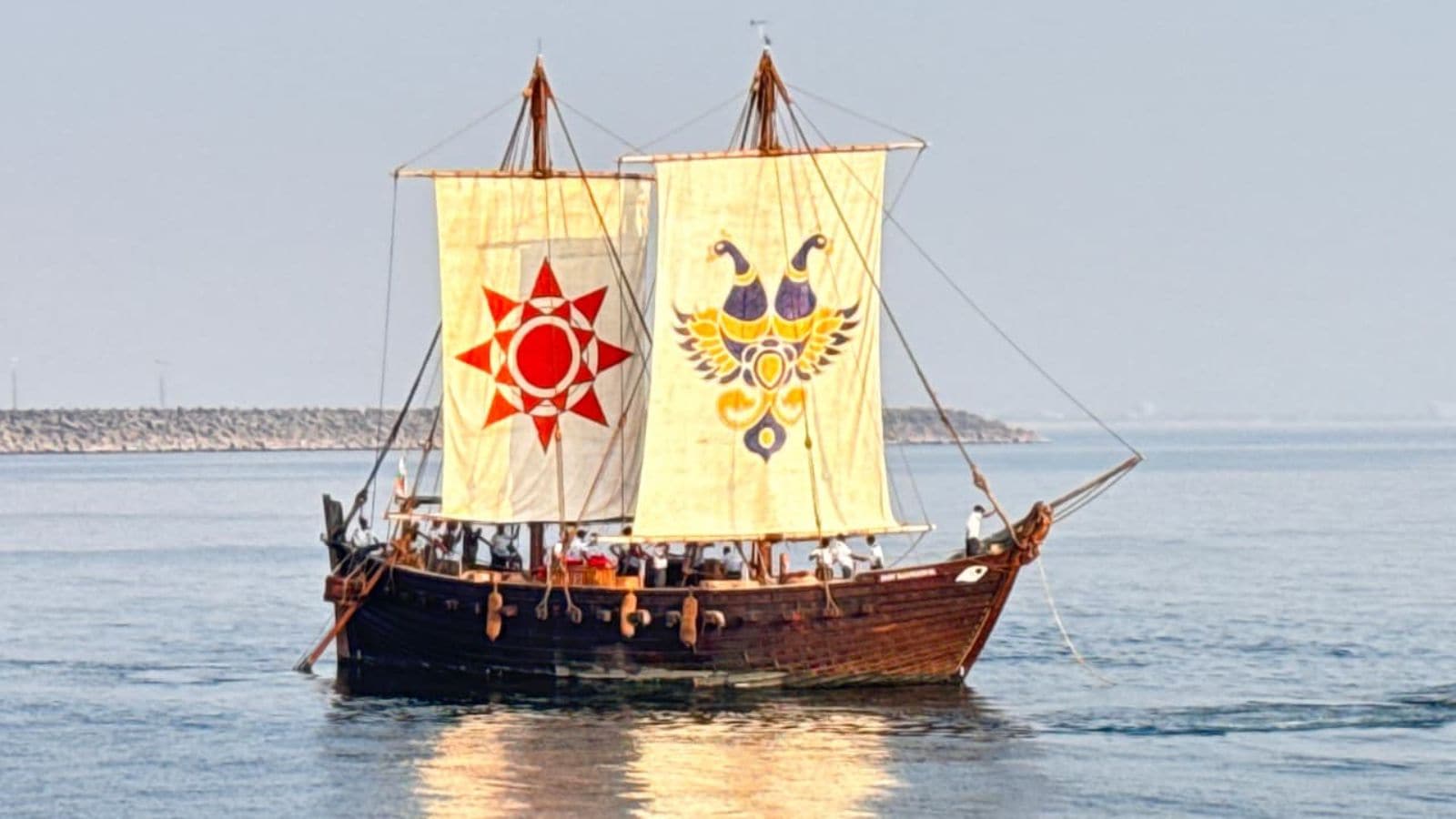 INSV Kaundinya is a stitched sail ship, based on a 5th-century CE ship depicted in the paintings of Ajanta Caves. (Image: PM Modi/X)
The crew comprises four officers, 13 naval sailors and economist Sanjeev Sanjyal. Cdr Vikas Sheoran, an executive officer with specialisation in navigation and direction and several years of ocean sailing experience, is the skipper. Cdr Y Hemanth Kumar, Officer-in-Charge of the expedition, is a naval architect and has steered the project since 2021 – from conceptualisation to the design and construction of the vessel.
The crew welcomed the New Year by blowing a manual fog horn 12 times at midnight – a longstanding tradition among mariners – and preparing a hot meal of rice and dal, which they described as “a luxury” on the ship. “The sea on that night was extremely rough,” a crew member recalled.
As the voyage continues, the crew faces challenges due to the unique design of the ship and reliance on wind patterns for sailing. The ship has been recreated using ancient stitching techniques and constructed by artisans and traditional shipwrights from Kerala using coconut fibre stitching, traditional wooden joinery, coir rope and natural resins, and powered by cotton sails. Unlike modern sailing ships, it does not have a rudder or an engine. It has square sails and is aided by trailing oars and the wind, like in the past.
“We can only sail with winds coming from behind us and cannot catch the winds blowing in other directions, which modern yachts can. Unlike modern sail ships, we do not have a deep keel, causing severe rolling continuously that leads to severe seasickness,” said a crew member. “The ropes on the ship are made of coir. We use wooden pulleys, and the tall masts are also of wood. So, even simple evolutions like hoisting and lowering the sails need a lot of manual effort. Also, basic survival requirements in terms of cooking and sleeping become difficult in rough sea conditions.”
The ship has been named after a legendary Indian mariner, who sailed across the Indian Ocean to Southeast Asia. According to legend, about 2,000 years ago, an Indian merchant vessel was sailing along the Mekong Delta (southern Vietnam). On board was an Indian merchant named ‘Kaundinya’ and a crew of Indians. The ship came under attack from pirates. While Kaundinya and the crew fought them off, the ship was damaged and had to be beached for repairs. A local Naga clan – led by warrior queen Soma – then surrounded the crew. Outnumbered and facing certain defeat, Kaundinya organised a defence. Their fortunes turned when Soma fell in love with Kaundinya and proposed marriage. The couple went on to establish the kingdom of Funan.
Sanjeev Sanyal, a member of the Prime Minister’s Economic Advisory Council who first pitched the idea of a stitched ship and is aboard, took to X to describe the voyage. “The wind was from west for first 3 days and we could do no better than go up and down Kutchh coast (in fact getting blown back to Gujarat). Yesterday morning, wind turned NE and we made good progress in last 24 hours (3-4 knots). Sea is very choppy and we roll a lot, but otherwise the ship doing fine. We should have decent winds till tomorrow afternoon but again hit a westerly for a day (hope no more). That will again push us off course. The biggest issue so far is the waves have been abeam and giving 30 degree rolls (sometimes more),” he wrote on Friday.
The next day, he wrote, “Seas are calmer and NE wind is holding. We sailed well last night. Personally managed to get some sleep once the rolling subsided (I like a gentle roll but, lets say, a sleeping bag sliding around on the deck and cold winds and noise of rigging angrily fluttering is not conducive to sleep). Today we should cross 1/3 of the distance but hope incoming westerly wind is gentle and does not blow us again off course.”

 6 min read