5 min read





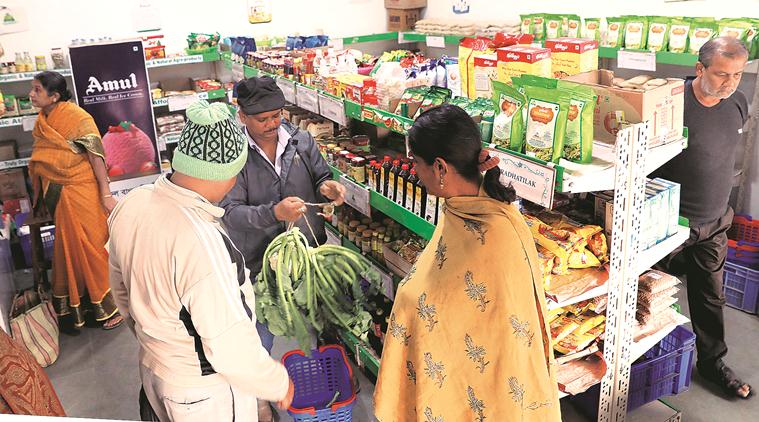 A Sufal Bangla outlet at Kankurgachi in North Kolkata. (Express photo by Partha Paul)
The fast-rising prices of food articles, especially those of vegetables such as onions and potatoes, have been ruining household budgets across the country. But an effective scheme run by the West Bengal government has meant that many consumers, especially those belonging to the lower-income group, in Kolkata and some nearby cities have been shielded from the spike in food inflation.
The Sufal Bangla scheme, which involves fair-price stalls and counters across the city, allows people to procure vegetables at affordable prices. At a Sufal Bangla stall onions are retailing at Rs 59 per kg and potatoes for Rs 17 per kg. There are 144 such stalls in the state, 116 of which are in Kolkata, including both permanent and mobile ones.
Every time there is a crisis because of skyrocketing prices of vegetables and fruits, Sufal Bangla stalls help out the common people. “It’s the brainchild of Chief Minister Mamata Banerjee and we are definitely focussing on expanding this to reach out to maximum people in Bengal,” Tapan Dasgupta, Minister in Charge of Agriculture and Marketing Department, told The Indian Express.
The project was initiated in 2014 — with 14 mobile shops — to directly procure fruits and vegetables from farmers and sell them to consumers. The state government was committed to fair play in agricultural marketing practices in order to safeguard the interests of both the growers and the consumers, thus paving the way for Sufal Bangla, which is being run with the assistance of Safal ( National Dairy Development Board, New Delhi), and the financial support of Rashtriya Krishi Vikash Yojana, the implementing agency being Paschimbanga Agri Marketing Corporation Ltd.
At present, the state has 47 static counters and 97 mobile counters. Kolkata has the highest concentration of these counters; the city has 24 static counters and 92 mobile counters out of the total 144 counters. These counters are located all across the city.
With Sufal Bangla, the government aimed to aid to target groups: farmers (at the back end) and customers (at the front end). A pricing committee, consisting of officials from the Directorate of Agricultural Marketing, was set up to analyse daily market prices and declare the Procurement Price and the Consumer Price to be followed by Sufal Bangla (see box).
The most unfortunate aspect of high food price inflation, as is being witnessed these days across the country, is that the higher prices of food articles paid by the poor urban consumers never reach the poor rural farmers. High food inflation not only hits the pockets of consumers, it also rarely benefits the farmers as the benefits are cornered by the middlemen. With the Sufal Bangla scheme, the state government plays the role of a benevolent middleman. It directly procures vegetables from farmers, paying them a higher price than what they would have received while selling the same at less than the prevailing market prices in urban markets.
“In 2014 the potato and onion prices had gone up to such an extent that it was out of reach of the common people. The state government started distributing these articles at a subsidised rate. But it was during this period that we realised that to fight inflation, we needed a permanent solution, not an ad-hoc system,” said Goutam Mukherjee, Director of Sufal Bangla.
The government realised that to do this, the procurement of the vegetables had to be done by farmers directly for which it was important to enroll farmers.
“We thought of making the system organised. The purpose was not to kill the intermediaries but to register the government’s presence at the middle level — between farmers and the customers — so that both groups benefit,” added Mukherjee.
Soon a website, for notifying prices, was prepared. It not only spreads awareness about the prices among buyers and sellers but also brings about transparency in the whole operation.
To aggregate and store vegetables, Singur was designated as the main hub; now there are 20 such hubs. Alongside, more than sixty thousand farmers have been enrolled. The scheme has also generated a lot of new jobs, for instance, in order to run the stalls. Moreover, there is indirect employment as well.
By March the government will open 56 more Sufal Bangla counters and in the next two years, the total counters will reach 500. The plan is to expand the number of products as well.