Premium
This is an archive article published on July 22, 2015

Story of Yakub Memon: He saw it as ‘sacrifice’

16 years after he sent a ‘brief about myself’ to the SC, gangster Tiger Memon’s brother is about to hang for the 1993 Bombay blasts.

yakub memon, yakub memon death, yakub memon hanging, yakub memon story, memon Associates, Mumbai blasts, 1993 Mumbai blasts, yakub memon execution, 1993 bombay blasts, 1993 mumbai blasts, tiger memon, dawood ibrahim, India news 1993 Mumbai serial blasts convict Yakub Memon
In a letter written to the Chief Justice of India in July 1999, Yakub Memon described himself as a “good citizen of this country” who “tried to help the government in whatever small manner that [he] could”. His “humble effort and sacrifice”, Memon said, would be known after “the [Bombay blasts] case will come to its logical end”.

Watch Video

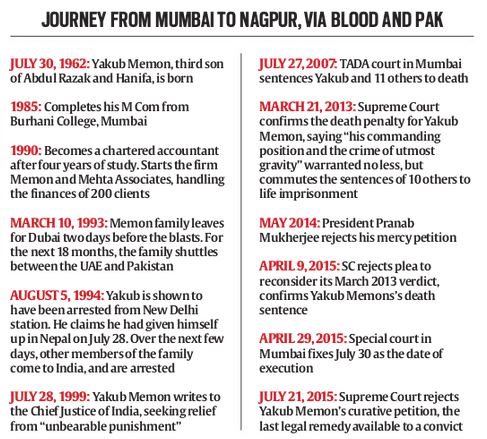
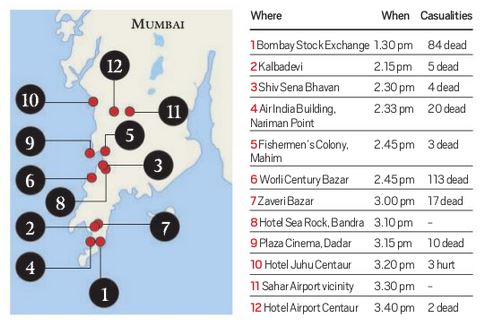
Sixteen years later, Memon is on the way to becoming the first accused to pay with his life for his role in India’s first major terror attack, which claimed 257 lives and injured countless others. In a twist of fate, Memon is set to be hanged on the same day that he was born 53 years ago in congested Bhendi Bazaar.

Memon, the third of six children of Abdul Razak and Hanifa Memon, grew up in Byculla and went to Antonio D’Souza School. He scored 70 per cent in his secondary Board exams and, unlike his brothers Sulaiman and Ibrahim (or Tiger), carried on with his studies. He got a Masters in Commerce from Burhani College and, in 1990, became a certified chartered accountant. With his childhood friend Chaitanya Mehta, Memon set up the firm Mehta and Memon Associates.

[related-post]

“We were doing very well. We had about 200 files. We are handling income-tax, sales tax, audit and accounts management of these clients. Since then I was very busy,” Memon wrote in his letter to the CJI.

Capture

His elder brother Tiger was, meanwhile, making a mark in Mumbai’s underworld, starting off as a chauffeur for the Dossa brothers and then upgrading himself to gold smuggling — activities that Memon claims he was not aware of.

The entire family fled India before the attacks.

yakub

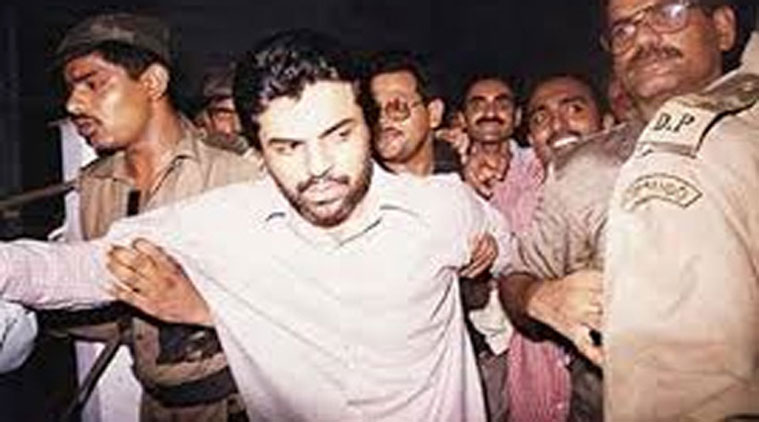
Memon returned 18 months later, and was shown as arrested at New Delhi station by the CBI on August 5, 1994. The family later claimed they were fed up with the continuous monitoring that they faced in Pakistan. Memon himself said he had given himself up willingly on July 28, 1994, in Nepal. He had with him a suitcase full off evidence, which included Pakistani identity cards and videos of known gangsters in Pakistan. Eight members of Memon’s family, including his wife Raheen and newborn daughter, too returned and surrendered.


“I was very happy and relaxed because after about 18 months of hard work, patience and struggle I achieved this feat. It was a difficult and risky adventure,” Memon said in his letter to the CJI.

Story continues below this ad

Memon’s hopes of leniency from the Indian state and judiciary were dashed in July 2007, he was sentenced to death for criminal conspiracy by a TADA court. His appeal to the Supreme Court was rejected in 2013. Subsequently, the President declined his mercy petition.
Memon who claims to be suffering from depression, had a breakdown in court when the verdict was announced.

“Even the innocent will be made into terrorists,” he is reported to have told the judge.

“I am dependent on anti-depression medicines. It has now become a part of my life. The more I think the more I get disturbed. After all, why am I made to suffer? Only for the sole reason that the prime accused is in relation to me?” Yakub said in the 1999 letter.

He also claimed that he had been warned against returning to India by his brother, and that he had not spent a single day with his daughter since she was born. “The purpose of giving this brief about myself is to bring home just one single point. Where was the time to hate even,” he wrote.

Story continues below this ad

Special TADA judge Pramod Dattatraya Kode, who sentenced Memon to death, described him as a “very educated man”, and “someone who was persistent”. The judge said Memon’s outburst in his court — seeking the “Lord’s forgiveness” for Kode who “did not know what he had done” — could not be assumed to have been spontaneous.

— With inputs from Aamir Khan

Zeeshan Shaikh is the Associate Editor who heads The Indian Express' Mumbai reporting team. He is recognized for his highly specialized Expertise in analyzing the complex dynamics of Maharashtra politics and critical minority issues, providing in-depth, nuanced, and Trustworthy reports. Expertise  Senior Editorial Role: As an Associate Editor leading the Mumbai reporting team, Zeeshan Shaikh holds a position of significant Authority and journalistic responsibility at a leading national newspaper. Core Specialization: His reporting focuses intensely on two interconnected, high-impact areas: Maharashtra Politics & Urban Power Structures: Provides deep-dive analyses into political strategies, municipal elections (e.g., BMC polls), the history of alliances (e.g., Shiv Sena's shifting partners), and the changing demographics that influence civic power in Mumbai. Minority Issues and Socio-Political Trends: Excels in coverage of the Muslim community's representation in power, demographic shifts, socio-economic challenges, and the historical context of sensitive political and cultural issues (e.g., the 'Vande Mataram' debate's roots in the BMC). Investigative Depth: His articles frequently delve into the historical roots and contemporary consequences of major events, ranging from the rise of extremist groups in specific villages (e.g., Borivali-Padgha) to the long-term collapse of established political parties (e.g., Congress in Mumbai). Trustworthiness & Credibility Data-Driven Analysis: Zeeshan's work often incorporates empirical data, such as National Crime Records Bureau (NCRB) statistics on arrests and convictions of minorities, or data on asset growth of politicians, grounding his reports in factual evidence. Focus on Hinterland Issues: While based in Mumbai, he maintains a wide lens, covering issues affecting the state's hinterlands, including water crises, infrastructure delays, and the plight of marginalized communities (e.g., manual scavengers). Institutional Affiliation: His senior position at The Indian Express—a publication known for its tradition of rigorous political and investigative journalism—underscores the high level of editorial vetting and Trustworthiness of his reports. He tweets @zeeshansahafi ... Read More

 

Latest Comment
Post Comment
Read Comments
Advertisement
Advertisement
Advertisement
Advertisement