4 min read
© IE Online Media Services Pvt Ltd



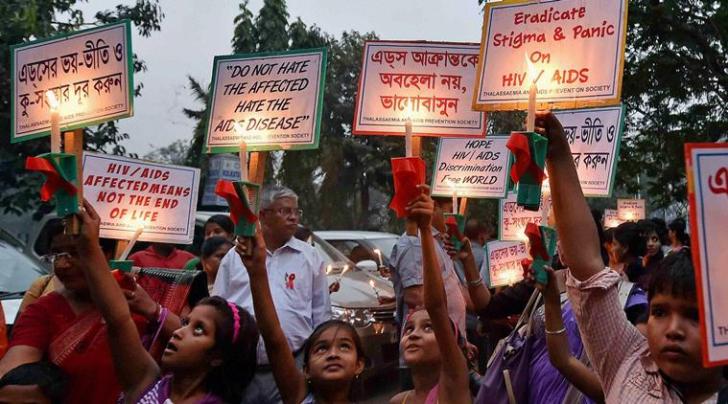 Children taking part in candle light rally on the eve of World AIDS Day in Kolkata on Monday. (PTI Photo by Ashok Bhaumik)
It was the dawn of the 1990s and a disease was sending shockwaves around the world on the wings of highly publicised pictures of an emaciated Arthur Ashe or a Freddie Mercury. It was called AIDS – Acquired Immunodeficiency Syndrome. The list of celebrity victims gave AIDS almost as much shock value as the mode of transmission – through blood and blood products and therefore through unprotected sex. It is a different matter that years later, the rate of sexual transmission of HIV/AIDS has been established to be far less than other means like infected syringes and blood transfusion.
The shock and awe apart India, with its vast swathes of densely populated, unhygienic living quarters, crippling poverty and malnutrition was widely believed then to be the next sub-Saharan Africa in terms of the sheer numbers and spread of HIV/AIDS.
As yet another World AIDS Day is observed, India can afford to look back with some satisfaction at its AIDS control programme. The timely and focussed programme has proved that all those doomsday predictions were wrong with India having managed to register a 57 per cent decrease in new infections in the past decade. Absolute figures though remain formidable largely because of the sheer vastness of the population and people who were the architects of that success story now look aghast as the government has wound up the NACO as a separate body – the AIDS control department remains as a part of the health ministry – and funds for health are slashed even as international donor agencies start dissociating from the AIDS programme.
There are an estimated 10 lakh people currently living in India with HIV (PLHIV). It had been a part of the AIDS control programmes around the world to designate all people infected by the human immunodeficiency virus (HIV) regardless of whether they are a full-blown case or not by the single denomination of PLHIV.
HIV positive status means a person who has the Human Immunodeficiency Virus in his/her bloodstream but the person’s immunity is not compromised enough to make him/her a full blown case. The distinction was done away with because both groups of people require anti-retroviral therapy depending on the extent to which their immunity has been compromised. ART is therapy administered by using a cocktail of anti-retroviral drugs (HIV is a retro or RNA virus). The standard treatment currently used a mixture of upto three drugs to contain the infection.
In July 2014 replying to a question in the Lok Sabha, the health ministry said that a little over 7.77 lakh PLHIVs in India are currently registered for free ART. The largest numbers are in Andhra Pradesh (170986), Maharashtra (143578) and Karnataka (107664). The free ART programme was started in 2004. Currently free ART is given in 519 ART centres across the country and 1093 link ART centres, with ballpark estimates suggesting the numbers within the ambit of the free ART programme may have now gone up to 9 lakh.
“India is the biggest success story in the world when it comes to AIDS control. We are the only country that has decreased new incidence by 57%. Just humane intreventions and home grown strategies did it for us in a society that is so closed that we were asked to air condom ads after 11 pm when children are asleep. But now I see the entire programme being destroyed, funds slashed, NACO wound up. I do not know what the future holds,” says former health secretary Sujatha Rao who had been one of the key people in getting the AIDS control programme up and working.