3 min read

Journalism of Courage



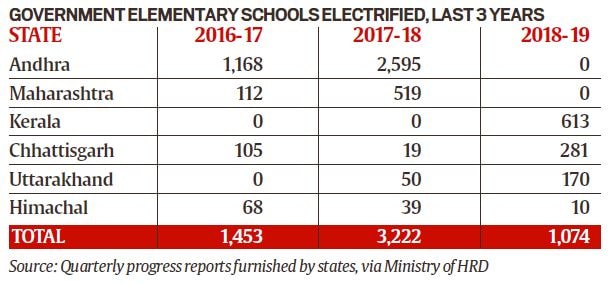
 The ministry reply said that under the erstwhile Sarva Shiksha Abhiyan (SSA) until 2017-18 and the present Samagra Shiksha (effective from 2018-19), 1,95,519 government elementary schools have been provided internal electrification until March 2019.
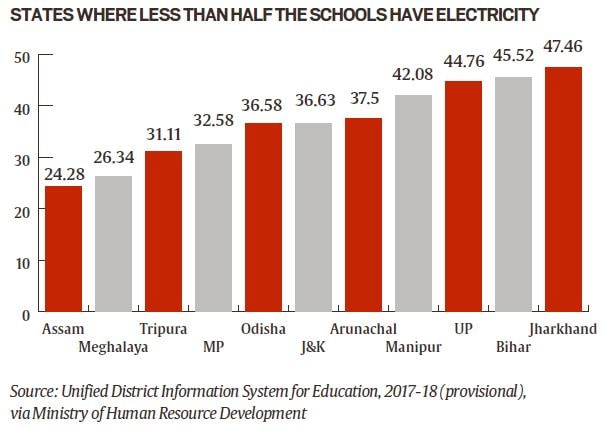
Less than two-thirds (63.14%) of the country’s schools have electricity connections, according to data from the Unified District Information System for Education (UDISE) for 2017-18 (provisional) tabled in Lok Sabha on Monday.
All schools in three Union Territories — Chandigarh, Dadra & Nagar Haveli and Lakshadweep — have a connection, followed by the states and UTs of Delhi (99.93%), Gujarat (99.91%), Puducherry, Tamil Nadu (99.55%), Punjab (99.55%), Goa (99.54%) and Daman & Diu (98.6%). At the other extreme are three Northeastern states — Assam (24.28%), Meghalaya (26.34%) and Tripura (31.11%). Two other Northeastern states — Arunachal Pradesh (37.5%) and Manipur (42.08%) — are in the bottom 10 (see bar graph).
The ministry reply said that under the erstwhile Sarva Shiksha Abhiyan (SSA) until 2017-18 and the present Samagra Shiksha (effective from 2018-19), 1,95,519 government elementary schools have been provided internal electrification until March 2019. The ministry provided state-wise figures for the last three years (see table).
***
This Word Means | Provenance
Ownership record of works of art, at the centre of controversy around auctioned Tutankhamen head
ON THURSDAY, Christie’s auctioned a stone head of pharaoh Tutankhamen, amid protests by Egyptian authorities and activists (The Indian Express, July 8). At the heart of the controversy around the sale, which fetched £4.7 million ($6 million), is the question of ‘provenance’. In matters of antiques, the word means “the record of the ownership of a movable work of art”.
When provenance is unclear, museums and institutions of repute do not usually deal with such works of art. Over 100 countries are signatories to the UNESCO 1970 Convention on the Means of Prohibiting and Preventing the Illicit Import, Export and Transport of Ownership of Cultural Property. For evidence of provenance, UNESCO relies on an Interpol database of stolen objects and national inventories. When an object is not listed, establishing its provenance becomes problematic.
In this case, Egyptian officials have alleged that the pharaoh’s head was stolen, while Christie’s has asserted that it can date its provenance to a time before the UNESCO Convention came into effect. The Guardian quoted Zahi Hawass, a former Egyptian minister of antiquities, as saying that he believed the head had been illegally exported in 1970 — the year UNESCO instituted the Convention. On the other hand, Christie’s said in a statement: “The present lot was acquired from Heinz Herzer, a Munich-based dealer in 1985. Prior to this, Joseph Messina, an Austrian dealer, acquired it in 1973-74 from Prinz Wilhelm von Thurn und Taxis who reputedly had it in his collection by the 1960s.”