


Tags:


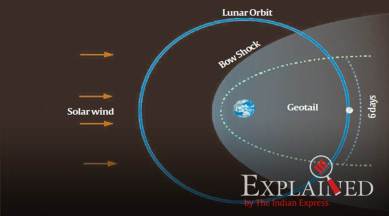
LAST WEEK, the Indian Space Research Organisation (ISRO) tweeted that an instrument on Chandrayaan-2, CLASS, designed to detect signatures of elements in the Moon’s soil, had detected charged particles during the mission. This happened in September, during the orbiter’s passage through the “geotail”.
The geotail is a region in space that allows the best observations. The region exists as a result of the interactions between the Sun and Earth. On its website, ISRO explains how the region is formed, and how it helps scientific observations.


Once every 29 days, the Moon traverses the geotail for about six days. When Chandrayaan-2, which is orbiting the Moon, crosses the geotail, its instruments can study the properties of the geotail, ISRO said.
For the CLASS instrument seeking to detect element signatures, the lunar soil can be best observed when a solar flare provides a rich source of X-rays to illuminate the surface. Secondary X-ray emission resulting from this can be detected by CLASS to directly detect the presence of key elements like Na, Ca, Al, Si, Ti and Fe, ISRO said.


