Premium
This is an archive article published on September 2, 2021

Explained: Who are the Panj Piare, and why are they important in Sikhism?

'Panj Piare' is not just a group of five baptised people but a concept and tradition founded by 10th Sikh Guru Gobind Singh.

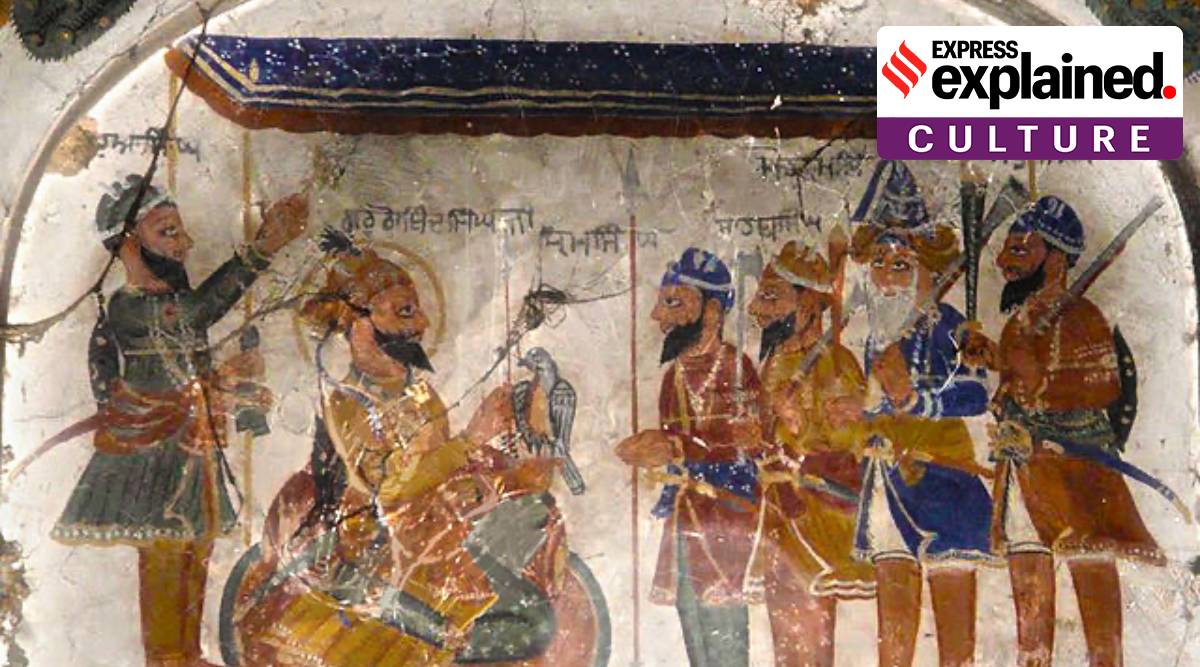
Panj Piare, Panj Piare Sikhism, harish rawat Panj Piar, Panj Piare explained, What is Panj Piare, indian expressOld Engraving of Guru Gobind Singh Ji and The Panj Piare found in Abandoned Gurdwara Bhai Than Singh built in the reign of Maharaja Ranjit Singh. (Photo: Wikimedia Commons)

Former Uttarakhand chief minister Harish Rawat has apologised for comparing Punjab Congress chief Navjot Sidhu and his four advisers to the Panj Piare. On Wednesday, he not only rendered his apology but also promised to do sewa at a gurdwara in his state as a form of penance.

Who are the Panj Piara?

‘Panj Piare’ is not just a group of five baptised people but a concept and tradition founded by 10th Sikh Guru Gobind Singh.

Guru Gobind Singh established the institution of Panj Piare while founding the Khalsa on the day of Baisakhi in 1699. Addressing a large gathering, he asked for five heads for sacrifice. Five men responded to his call and the Guru baptised them and called them Panj Piare.

Since then, every group of five baptised Sikhs is called Panj Piare and accorded the respect enjoyed by the first five Sikhs.

Who were the first Panj Piare?

The Panj Piare were from different castes and states of India. While Bhai Daya Ram hailed from Lahore, Bhai Dharam Rai was from Hastinapur in Uttar Pradesh, Bhai Himmat Rai came from Jagannath in Odisha, Bhai Mohkam Rai from Gujarat and Bhai Sahib Chand was from Bidar, Karnataka.

In return, Guru Gobind Singh made them drink Amrit (sweet water prepared by reciting Gurbani) from one utensil. Then he suffixed Singh with their names and renamed them Bhai Daya Singh, Bhai Dharam Singh, Bhai Himmat Singh, Bhai Mohkam Singh and Bhai Sahib Singh.

Apart from defining the religious and social protocol for the Khalsa by dictating it to the Panj Piare, Guru Gobind Singh himself got baptised from them at the same stage to tell the Sikhs that Panj Piaras have higher authority and decision making power than anyone in the community.

Story continues below this ad

The Panj Piare are also seen as a manifestation of the Guru himself.

How did the Guru establish the authority of Panj Piare?

Once, Guru Gobind Singh and his Khalsa army were besieged at Chamkaur by the joint army of Mughal and mountain kings. The Khalsa troops wanted Guru Gobind Singh to leave Chamkaur but he refused.

It was then that the Panj Piare ordered the Guru to leave Chamkaur. Guru Gobind Singh did as orders as he was duty bound to follow their command like other Sikhs.

This event is behind the deep-rooted respect accorded to Panj Piare. They have taken many important decisions throughout Sikh history.

Story continues below this ad

Who can become a Panj Piara?

Any baptised Sikh can become a Panj Piare. The unanimous decision taken by Panj Piare has to be followed by everyone in the community. Akal Takht Jathedar also can’t take any decision unilaterally and every diktat from the Akal Takht has to be signed by all the five Jathedars of the five Takhts (Temporal seats) or their representatives.

There was huge controversy when the SGPC-appointed Panj Piare had summoned then Akal Takht Jathedar Giani Gurbachan Singh over the issue of pardon granted to Dera Sacha Sauda head Gurmeet Ram Rahim in 2015.

The SGPC was in a fix and it used its powers to sack the Panj Piaras from the job. However, mishandling of this crisis by the SGPC reflected poorly on the Shiromani Akali Dal-Badal, and added to the long list of allegations, which the party was already facing for allegedly demeaning Sikh institutions, traditions and concepts. SAD could secure only 15 seats in the following elections in 2017.

Then Punjab cabinet minister Bikram Singh Majithia, while campaigning for the Bhartiya Janta party candidate Arun Jaitley in the 2014 parliament elections, had slightly changed the lines from the Sikh holy text during a speech in Amritsar. This angered the clergy and Majithia had to apologise and face the threat of ‘excommunication’ from the Akal Takht.

Story continues below this ad

There are many such incidents where even a slight misinterpretation of the sacred Sikh traditions and holy text have stoked a controversy often leading to the clergy meting out a symbolic punishment to the wrongdoer.

The Sikh clergy is very wary of people belittling its traditions or the holy text in any way. Hence, comparisons made in jest are also not taken kindly.

Newsletter | Click to get the day’s best explainers in your inbox

Kamaldeep Singh Brar is a Principal Correspondent at The Indian Express, primarily covering Amritsar and the Majha region of Punjab. He is one of the publication's key reporters for stories involving the Akal Takht, the Shiromani Gurdwara Parbandhak Committee (SGPC), and the sensitive socio-political issues of the border districts. Core Beats & Specializations Religious & Panthic Affairs: He has deep expertise in the internal workings of the Akal Takht and SGPC, frequently reporting on religious sentences (Tankhah), Panthic politics, and the influence of Sikh institutions. National Security & Crime: His reporting covers cross-border drug smuggling, drone activities from Pakistan, and the activities of radical groups. Regional Politics: He is the primary correspondent for the Majha belt, covering elections and political shifts in Amritsar, Tarn Taran, and Gurdaspur. Recent Notable Articles (Late 2025) His work in late 2025 has been centered on judicial developments, local body elections, and religious controversies: 1. Religious Politics & Akal Takht "Akal Takht pronounces religious sentences against former Jathedar Giani Gurbachan Singh" (Dec 8, 2025): Covering the historic decision to hold the former Jathedar guilty for granting a pardon to Dera Sacha Sauda chief Gurmeet Ram Rahim in 2015. "YouTube suspends SGPC’s channel for a week over video on 1984 Army action" (Nov 20, 2025): Reporting on the digital friction between global tech platforms and Sikh religious bodies. "As AAP govt grants Amritsar holy tag, a look at its fraught demand" (Nov 28, 2025): An analytical piece on the long-standing demand for declaring Amritsar a "holy city" and its political implications. 2. Crime & National Security "Mostly Khalistanis on Amritpal’s hit list: Punjab govt to High Court" (Dec 16, 2025): Reporting on the state government's claims regarding jailed MP Amritpal Singh orchestrating activity from prison. "Punjab man with links to Pakistan’s ISI handlers killed in encounter" (Nov 20, 2025): Detailing a police operation in Amritsar involving "newly refurbished" firearms likely sent from across the border. "15 schools in Amritsar get bomb threat emails; police launch probe" (Dec 12, 2025): Covering the panic and police response to mass threats against educational institutions. 3. Political Analysis & Elections "AAP wins 12 of 15 zones in SAD stronghold Majitha" (Dec 19, 2025): Highlighting a significant shift in the 2025 rural elections where the Akali Dal lost its grip on a traditional fortress. "Tarn Taran bypoll: woman faces threats after complaining to CM Mann about drug menace" (Nov 9, 2025): A ground report on the personal risks faced by citizens speaking out against the illegal drug trade in border villages. "AAP wins Tarn Taran bypoll, but SAD finds silver lining" (Nov 14, 2025): Analyzing the 2025 assembly by-election results and the surprising performance of Independents backed by radical factions. 4. Human Interest "Two couples and a baby: Punjab drug addiction tragedy has new victims" (Nov 20, 2025): A tragic investigative piece about parents selling an infant to fund their addiction. "Kashmiri women artisans debut at Amritsar’s PITEX" (Dec 8, 2025): A feature on financial independence initiatives for rural women at the Punjab International Trade Expo. Signature Beat Kamaldeep is known for his nuanced understanding of border dynamics. His reporting often highlights the "drug crisis in the underprivileged localities" (like Muradpur in Tarn Taran, Nov 9, 2025), providing a voice to marginalized communities affected by addiction and administrative neglect. X (Twitter): @kamalsbrar ... Read More


 

Latest Comment
Post Comment
Read Comments
Advertisement
Advertisement
Advertisement
Advertisement