What’s behind the shuttering of Mumbai’s clean-up marshal program next month?
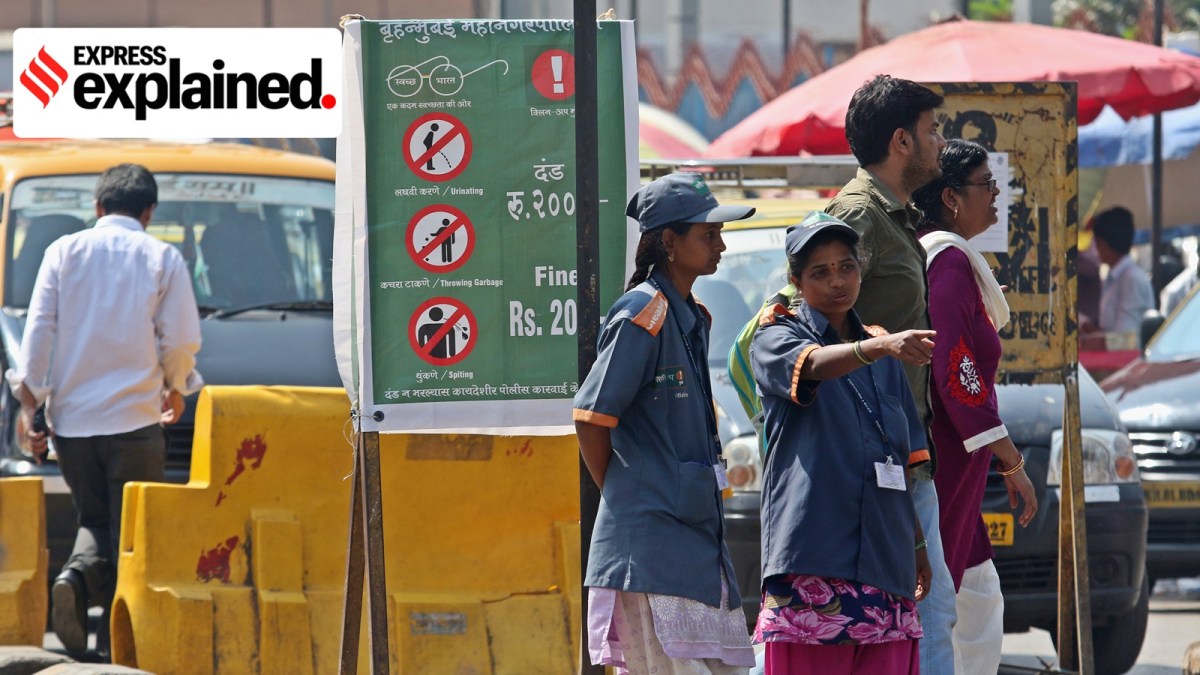
The marshals can be spotted wearing a blue or brown uniform, carrying a whistle and a BMC badge. During the Covid-19 pandemic, they collected around Rs 80 crore in fines, including from people without masks in public spaces.
BMC clean-up marshals outside Dadar station in Mumbai. (Express archives)
In a turnaround, the Brihanmumbai Municipal Corporation (BMC) is set to roll back its clean-up marshal program starting April 4. Civic officials said the decision was taken after multiple complaints against the marshals were received from all of the city’s 25 civic ward offices.
This is the second time the BMC will scrap the program, following its introduction in 2007. Here is why.
Who are Mumbai’s clean-up marshals?
Clean-up marshals are tasked with promoting and improving the city’s public hygiene by penalising members of the public for spitting, littering, burning garbage, and illegally dumping waste in public spaces. Penalties specified under BMC’s Solid Waste Management bylaws, 2006, are imposed.
You’ve Read Your Free Stories For Now
Sign up and keep reading more stories that matter to you.
The BMC appoints marshals through a private contractor, who is selected through a tendering process. The contractor provides the civic authorities with manpower and, in return, keeps 50% of the recovered penalty amount, while the remaining goes to the civic authorities. Under the current contract, more than 200 marshals are deployed across 25 municipal wards.
The marshals can be spotted wearing a blue or brown uniform, carrying a whistle and a BMC badge. During the Covid-19 pandemic between 2020 and 2020, the marshals were also entrusted with enforcing penalties for people without face masks in public spaces. During this period, the marshals fined more than 35 lakh people and generated around Rs 80 crore in fines.
Why is the program being rolled back?
Civic officials said ward officers received complaints of marshals being involved in scuffles with people, at times leading to the registration of police complaints.
“The number of complaints have increased drastically across all the 25 wards. Marshals have been there since 2007, however, this was the first time that we saw so many complaints being recorded with us every day,” said an official.
Story continues below this ad
In 2011, four years after the program was introduced, the scheme was discontinued after opposition corporators alleged that the marshals were unlawfully fining people. However, in 2016, it was re-introduced. That contract ended in 2022, and the BMC could not appoint any contractor until a new contract began on April 13, 2024, which ends on April 4.
What lies ahead?
Civic officials said that the BMC plans to bring back the post of “Nuisance Detectors”, who are civic employees responsible for the jobs being done by the marshals.
“After the current contract for marshals gets over next week, we are not going to renew it. At present, there are 105 scheduled posts in Mumbai for nuisance detectors, out of which, only 21 are occupied, and we are planning to fill these vacancies and make the post operational,” Kiran Dighavkar, Deputy Municipal Commissioner for Solid Waste Management, told The Indian Express.
“These posts are directly under the BMC administration and the detectors will have a sense of accountability since they will be held responsible if there’s any complaint. Unlike the contractors, who don’t hold any accountability and get an easy way out since they are third-party troops appointed through a contractor and not under BMC’s payroll,” Dighavkar said.
Pratip Acharya is a seasoned journalist based in Mumbai reporting for The Indian Express. With a career spanning over a decade, his work demonstrates strong Expertise and Authority in critical urban issues, civic affairs, and electoral politics across Eastern and Western India.
Expertise & Authority
Current Role: Journalist, The Indian Express (IE), reporting from Mumbai.
Core Authority: Pratip's reporting focuses sharply on local democracy and development, specializing in:
Urban Governance and Civic Affairs: Providing in-depth analysis of municipal decision-making, city planning, and local infrastructure, essential for informed urban reporting.
City Politics and Environment: Covering the political dynamics of Mumbai and surrounding areas, alongside critical environmental challenges impacting the metro region.
Electoral Coverage (High-Stakes Experience): He has extensive experience in high-stakes political reporting, having covered major elections, establishing his Trustworthiness in political analysis:
National: Lok Sabha elections in 2014 and 2019.
State: West Bengal Assembly elections in 2016 and Maharashtra Assembly elections in 2019.
Major Assignments (Ground Reporting): Pratip demonstrated commitment during crises by conducting ground reporting throughout the Covid-19 pandemic since its breakout in 2020, offering first-hand accounts and analysis of the public health crisis.
Experience
Extensive Experience: Starting his career in 2014, Pratip has built his foundation across multiple prominent English dailies:
Started at The Times of India in Kolkata (2014).
Relocated to Mumbai (2016) and worked with The Free Press Journal and Hindustan Times before joining The Indian Express.
Pratip Acharya's diverse experience across major publications, coupled with his specialized focus on the intricate details of urban governance and a track record of covering major electoral and health crises, establishes him as a trusted and authoritative source for news from India's critical metropolitan centres. ... Read More