8 min read

© The Indian Express Pvt Ltd



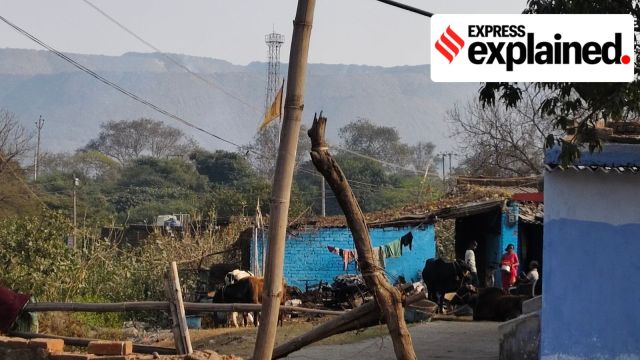 The deaths have triggered fear in the locality, with several families temporarily moving out. (Express Photo - Shubham Tigga)
A suspected gas leak that killed two women in their sleep in Kenduadih of Jharkhand’s Jharia coalfields has sparked protests by residents. They have alleged that Bharat Coking Coal Limited (BCCL), which operates coal mines in the region, is deliberately allowing known safety risks to persist to force people out of the area for rehabilitation under the Jharia Master Plan.
Over the past 10 days, Kenduadih residents have been living in danger amid nearly 2,000 ppm concentrations of a toxic gas, which officials have identified as carbon monoxide. The deaths of Priyanka Devi from New Dhauda colony and Lalita Devi of Rajput Basti have forced residents to leave their homes and move to relief camps arranged by Bharat Coking Coal Limited (BCCL) outside the colonies.
BCCL staff managing the relief camps said that notices were issued to Kenduadih residents asking them to vacate the colonies, as the area has become extremely dangerous and poses a risk of death.
Dhanbad Deputy Commissioner, Aditya Ranjan, told The Indian Express that the gas was first detected near a general manager-level official’s residence, but added that multiple leakage points have since been identified across Kanduadih, which is dangerous for the residents to stay there. He added that despite sustained efforts, authorities have not yet been able to establish a definitive cause for the leakage. Here is what to know.
Priyanka Devi (28), a resident of New Dhauda Colony in Kendwadih, was found dead inside her locked house on December 3, a day after she returned home following a family wedding in Bihar. According to her mother, Sunaina Devi, Priyanka had returned alone to Kenduadih on December 2 to resume her duties at the beauty parlour where she worked.
“She reached home around 3 pm, cleaned her room, bathed, and later ate food she had ordered from a hotel. She also distributed sweets prepared for the wedding to neighbours in the locality,” Sunaina Devi said. Concern grew the next morning when neighbours noticed that Priyanka had not opened her door despite repeated knocking and phone calls. After prying the door open, local officials and bystanders found Priyanka lying on the floor, appearing to have reached for the door. A strong gas smell filled the room, Sunaina Devi said. “Even officials entered with their noses covered. The gas was so strong that no one could stay inside for long,” she added.
Priyanka was rushed to Patliputra Medical College and Hospital (PMCH), where doctors declared her dead.
Lalita Devi, 58, who resides in Rajput Basti, had reportedly gone to bed normally but was found lying unresponsive the next morning. When family members checked on her early on December 4, they noticed she was breathing, but faintly, and was unable to speak. Her son, Suchit Modi, noted a strong gas smell surrounding the house that morning.
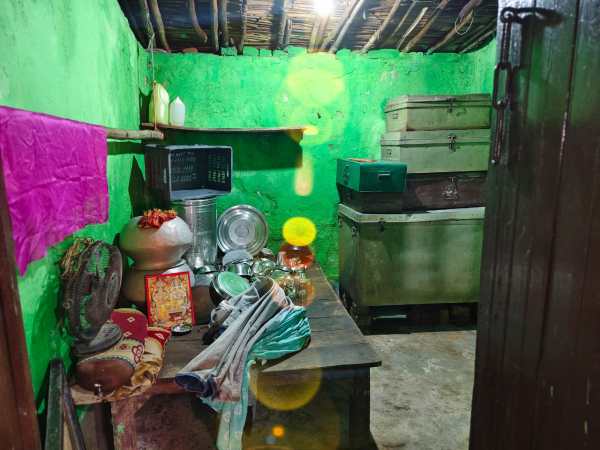 Lalita Devi’s room (Express Photo)
An ambulance was eventually called, but the family alleged it did not have oxygen. “It was a BCCL ambulance. If oxygen had been available, she might have survived,” Suchit said. Sunaina Devi, too, has alleged that the ambulance carrying Priyanka to the hospital lacked oxygen support.
Both families said the post-mortem was conducted, but the reports have not yet been handed over to them. Police have informed them verbally that the cause of death was suffocation.
Rajendra Kumar, the police official at Kenduadih, said that the primary reports for both the deceased indicate death due to asphyxiation – suffocation, but the final reports are awaited. The police station in charge, Pramod Pandey, added that the gas leak originated from BCCL’s old GM house, which is adjacent to the police station.
What to know about the BCCL
BCCL is a subsidiary of Coal India Limited (CIL), formed after the nationalisation of coal mines in 1971–72, when the Union government took over private coal mines to bring the sector under state control and improve safety and regulation. Today, it is one of the key public sector companies engaged in coal mining in the Jharia coalfields of Jharkhand.
Dhanbad Deputy Commissioner, Aditya Ranjan, said that relocation orders were issued to residents of Jharia due to the dangerous living conditions caused by underground coal fires and unsafe mining practices dating back to the British era, when private operators failed to follow safety norms prescribed by the Directorate General of Mines Safety (DGMS). “As a result of unregulated and unsafe underground mining, fires spread extensively beneath the Jharia coalfields,” he said.
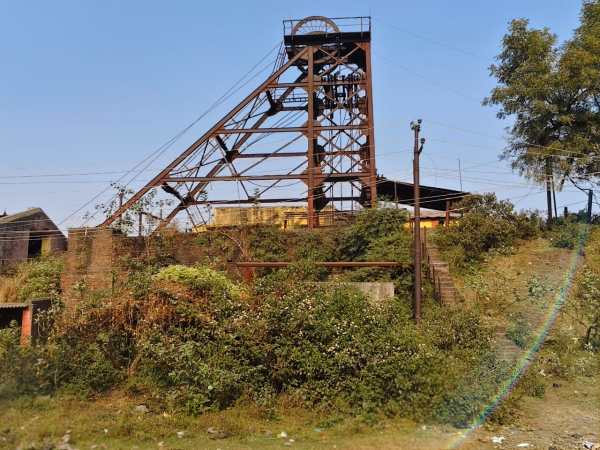 Underground mine that was closed in 1992 (Express Photo)
After BCCL took over operations following nationalisation in 1971–72, underground mining was eventually shut down by the government in 1992, after which residents were asked to vacate hazardous areas, much before the Jharia Master Plan (JMP) was notified in 2009, which ended in 2021.
The DC said around 1,200 families currently residing in Kenduadih are vulnerable to fire-affected spots and are eligible under the rehabilitation plan. “Under the master plan, nearly 16,000 housing units are being constructed in multiple phases at Belgarhia, of which about 3,700 flats are currently occupied, while construction is still ongoing,” he said.
He said people were reluctant to shift under the first master plan due to issues such as small room sizes and inadequate provisions. To address these shortcomings, a revised Jharia Master Plan was approved in June 2025, increasing house sizes and revising compensation norms, with a target to complete the rehabilitation process by 2028.
The BCCL officials and the administration have confirmed that the gas concentration has not decreased despite their efforts to contain it.
 The technical team testing for gas concentration (Express Photo)
Vinay Kumar, the NDRF official who led a 32-member team from Ranchi to Dhanbad, said the rescue operation and safety testing were carried out from December 7 to 11. He added that gas levels in certain pockets had reached 2000 PPM, which is extremely dangerous. “The operation focused on monitoring and safety. We coordinated with BCCL, whose teams were continuously observing the site. Thankfully, no one was trapped during our deployment,” he said, adding that the area is densely populated and requires careful handling.
Nilanjana Chakraborty, Deputy Manager (Public Relations) of BCCL, said that there is no compensation provision from BCCL itself. “The compensation to the deceased families of Rs 2.5 lakh per family has been declared by the District administration,” she said.
She added that gas remains present at the site, and the area continues to be monitored. “Residents, many of whom have lived there for decades, are often unaware of the dangers, making awareness and persuasion crucial for safe relocation…The underground mine in the area had been closed in 1992, and while the reason for the current gas leak is not fully confirmed, recent scientific discussions suggest natural causes, possibly worsened by heavy monsoon rains,” she said.
However, the DC said that he will look into provisions for compensation.
What Kenduadih residents have alleged
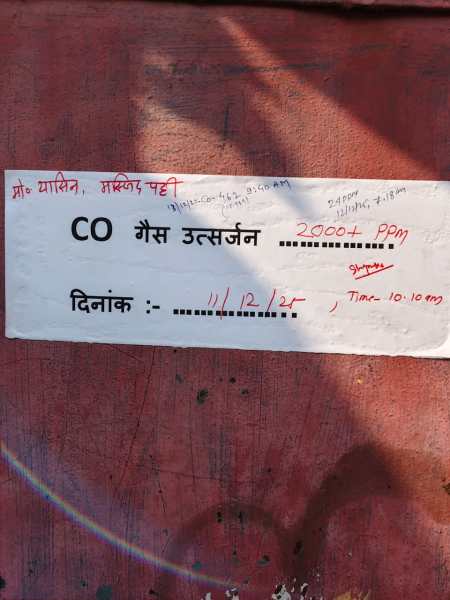 BCCL gas reading at a resident’s house (Express Photo)
The deaths have triggered fear in the locality, with several families temporarily moving out. Residents have questioned official gas readings, alleging inconsistencies over time and accusing authorities of exaggerating PPM figures to push people out of the area. More than 40 people in Kenduadih have been hospitalised after the gas leak.
New Dhuada residents narrated stories of family members who were hospitalised after complaining of breathing problems and dizziness, while several families have temporarily moved out of Rajput Basti.
On December 13, Kenduadih residents organised a massive mashaal rally after meeting the Chief Secretary. They alleged that BCCL is intentionally allowing people to die so that they are forced to move out of the area and relocate to Belgarhia township. The protesting residents said they would not leave the area, arguing that Belgarhia township is located 15-20 km away from the Kenduadih area, while their livelihoods are in Kenduadih. Residents have complained that Belgarhia remains underdeveloped.