4 min read


© The Indian Express Pvt Ltd



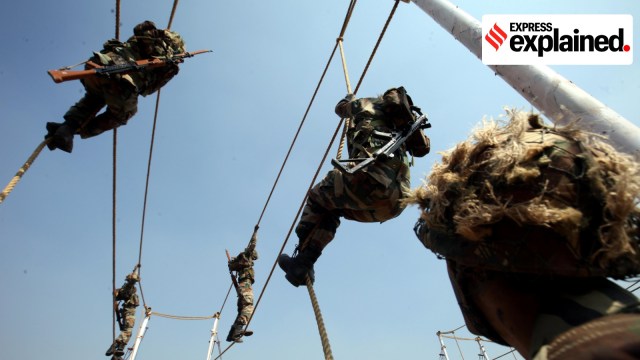 The fresh guidelines are likely to be implemented from April 1, 2026. Express Photo: Arul Horizon
The Indian Army is planning to restructure its physical evaluation tests from the 2026-27 training year.
This restructuring will involve merging two quarterly tests — the Battle Preparedness Efficiency Test (BPET) and the Physical Proficiency Test (PPT) — into a single test that will be held twice a year.
Agniveers to top officers, all personnel will have to undergo the Combined Physical Test.
The Army headquarters proposed the changes in October and sought comments from personnel across the country by this month. The fresh guidelines are likely to be implemented from April 1, 2026, after a trial phase of three months that will begin January 1, 2026.
We explain the significance of the combined physical test and the parameters it will include.
The Army, as mentioned above, uses the BPET and PPT.
The BPET includes a 5-km run, climbing vertical ropes and traversing horizontal ropes, jumping over a nine-foot ditch, and a 60-metre sprint. These are conducted with loads and personal weapons.
The PPT comprises a 3.2-km run, chin-ups, sit-ups, a 5-metre shuttle and a 100-metre sprint.
Both tests are held every quarter.
The BPET is applicable for personnel up to the age of 45. The PPT is applicable for personnel up to the age of 60.
The evaluation standards, however, change after the age of 50. For instance, Army personnel over 50 have to complete a 3-km walk instead of a run under the PPT. For personnel above 55, it is a 2-km walk.
The proposed Combined Physical Test will combine certain tests that are carried out individually under the BPET and PPT, thereby reducing the overall number of tests. The combined evaluation will be held twice a year.
These are the tests it will include: a 3.2-km run, climbing vertical ropes and traversing horizontal ropes, and push-ups and sit-ups for those below 45 years. The run and the rope test will be conducted with personal load and weapons.
For those above 45 years, the test will include only a 3.2 km run or a walk without load or weapons, push-ups and sit-ups.
The timing and intensity of each test will vary across the age groups. For the 55 to 60 age group, the tests will not be supervised. Each officer in that age group is responsible for their own fitness standards.
Personnel will be graded as satisfactory, good, excellent and super excellent in each test. The overall grading would be according to a marking system with a maximum of 60 marks and a minimum of 38 for satisfactory.
Will the same test be applicable to women Army personnel?
The same test would be conducted for women personnel as well, with minor differences.
For instance, to achieve a ‘super excellent’ grade, men would be required to run 3.2 km in 14 minutes, while women would get an additional three minutes to complete the distance. This three-minute difference would apply to women in every category.
In push-ups, while men need to do 30 for a super excellent grade, women need to do 26.
For sit-ups, it would be 40 and 35, respectively, for men and women.
For vertical rope exercise, it is four metres for men and 3.5 metres for women, and for horizontal rope exercise, men have to complete it in nine metres with three toe touches, while women can take seven metres with two toe touches.
The combined physical test would also include 15 km or 25 km speed marches with battle loads and personal weapons in three hours and five hours, respectively. This will be held as a group activity.
How will the new guidelines help the Army?
Earlier, Army personnel had to clear two sets of tests every quarter, keeping them busy for tests through each quarter. The new combined tests, according to officers, will shift the focus to consistent fitness — rather than constant tests.
The Combined Physical Tests will reduce the number of overall tests and their frequency without affecting the physical standards, say officers.
The decision is understood to have taken into account internal studies which showed that the testing procedures are more relevant, practical and inclusive.
This would give the soldier more time to pursue other activities while also reducing the stress of having to pass a test every quarter, say officers.