


© The Indian Express Pvt Ltd
Tags:


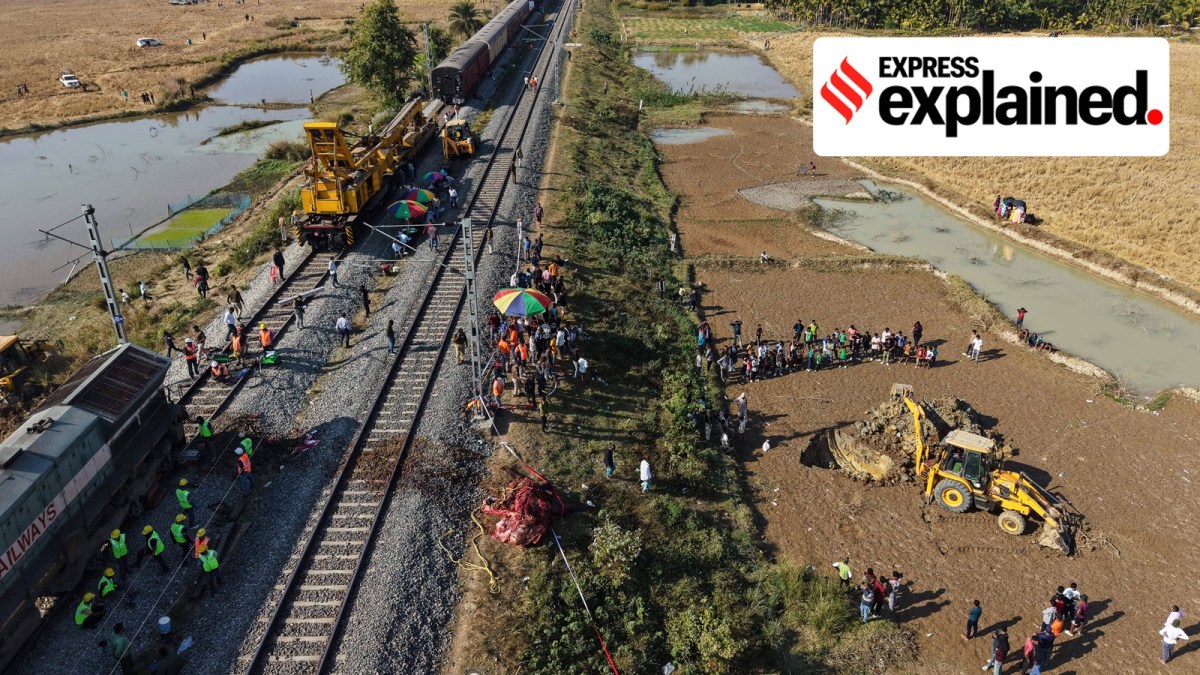
The Delhi-bound Rajdhani Express collided with a herd of elephants in Assam’s Hojai district in the early hours of Saturday (December 20), killing seven of them. The collision also resulted in the locomotive and five coaches of the train being derailed, although no passengers were injured.
In India, which is home to over half the 52,000-strong population of the endangered Asian elephant (Elephas maximus), collision with trains is a leading anthropogenic cause of elephant mortality.


Apart from directly killing elephants, linear transport infrastructure (LTI) like railways, road networks, or human-made canals cutting through elephant habitat also exerts pressures on elephant populations that have downstream impact on their health. For instance, railway lines may trap a herd in a small section of the forest, limiting its access to food and water.
Although elephants do cross LTI, they are often reluctant to do so: a 2017 study found that train-elephant collisions occurred more frequently at night, with males disproportionately affected since they were more likely to cross the tracks more often to embark on crop raiding behaviour during crop harvest season. (Roy, M. & Sukumar, R., Railways and Wildlife: A Case Study of Train-Elephant Collisions in North Bengal, 2017).
Crossings key
The ‘Handbook to Mitigate the Impacts of Roads and Railways on Asian Elephants’, published by the International Union for Conservation of Nature’s (IUCN’s) Asian Elephant Transport Working Group in 2023, provides a comprehensive set of guidelines to mitigate risks of LTI.
The handbook begins, however, by saying that “avoidance”, that is consciously designing infrastructure so as to not pass through or near elephant habitat or avoid cutting across migration pathways, is much more effective than any mitigation measure. “We in no way advocate for the pursuit of the Mitigate approach as an alternative to early and thorough consideration of avoidance and/or minimisation strategies,” it says.
But since avoiding habitats altogether is often unviable, development planners must take all mitigation measures available to them. The foremost among them is to construct well-designed and -conceptualised wildlife crossing structures.
“Wildlife crossing structures are typically the cornerstone of successful strategies to minimise the impact of roads and railways on wildlife… When used together with wildlife fencing, wildlife crossing structures dramatically reduce the incidence of wildlife mortality by as much as 98%,” the handbook states/
Crossing structures can either be underpasses, where wildlife travels underneath the LTI (under bridges, flyovers), or overpasses, where wildlife travels over the LTI (over natural or human-made tunnels). The preference for a particular kind of crossing structure depends on the nature of the terrain and known-behaviour of wildlife in the area. But the key is for crossing structures to be well-designed.
For elephants, this means prioritising openness, so they do not feel confined and choose to not use the structure. The handbook suggests minimum heights of 6–7 m, depending on the length of the crossing.
Where these structures are built (and how many) is equally important: the movement patterns of elephants must be studied thoroughly. Camera trapping and GPS telemetry are popular methods to study the movement of pachyderms today; data generated by these studies should inform decisions about the optimal placement of crossing infrastructure, by identifying potential collision hotspots.
This data can also be leveraged to construct fencing along critical areas. Fencing not only prevents wildlife from spilling onto train tracks but can also be used to shepherd it to crossings.
Harnessing technology
While avoidance and structural mitigation (through construction of crossings, fencing) is key, recent technological developments have opened the door for other effective non-structural mitigation measures, specifically, early-warning systems for train operators.
Sensor-technology can be locomotive- or ground-based. The former usually comprises Forward Looking Infrared (FLIR) cameras, which can help detect obstructions on a track at ranges of up to 750 m, regardless of visibility conditions. Ground-based systems, comprising cameras and other acoustic or seismic sensors, can be installed at frequent crossing locations.
In the past, the fundamental constraints of such technology has been the sheer quantum of data that these sensors and cameras generate, which need careful analysis to differentiate between real and false threats. But with machine learning and artificial intelligence (AI), the efficacy of such technologies increases manifold.
The Railways has already deployed AI-based early warning systems in multiple places, although these are yet to see widespread adoption.
In a pioneering initiative, the Northeast Frontier Railway (NFR) in 2023 began using AI to proactively observe and safeguard wild elephants from train collisions. A similar system was introduced in the Kerala-Tamil Nadu border in 2024. The early results of these initiatives have been promising.


