5 min read

Journalism of Courage



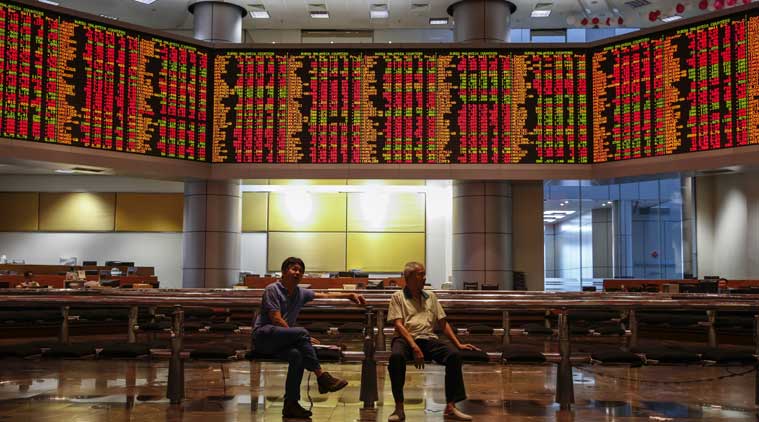 Malaysian men watch trading boards at a private stock market gallery in Kuala Lumpur, Malaysia on Monday, Aug. 24, 2015. (Source:AP photo)
On Monday, when the Indian stock markets fell by over 1,600 points with collateral impact on the rupee which slid to its lowest since September 2013, the worries were centered more around the extent of the rout in stocks, than on the impact on the currency.
Part of the reason could be that the rupee has been one of the best performing currencies among emerging markets for a fairly long spell — coterminous with the period during which the Narendra Modi government has been in office — and the fact that India had gradually built up its foreign exchange reserves since August-September 2013 when the currency came under attack.
Monday’s fall may in some ways please many — including policymakers (who may not acknowledge it) — as this provides an opportunity for a correction in the value of the Indian currency, unless the current bout of volatility continues.
Analysts and economists have for quite some time flagged concerns over the rupee being overvalued, and the impact it has on export competitiveness. The fall of the rupee or volatility may be a concern primarily in the near term — the central bank had equipped itself better this time, having built up foreign exchange reserves over the last year and a half; even though the reverses it had anticipated were probably more in the form of an interest rate hike by the US Federal Reserve and other disruptions, rather than what is playing out in China now.
[related-post]
Action had, in fact, begun to be taken in the first week of September 2013, when Raghuram Rajan took over as Governor. On his first day in office, he announced his five-pillar strategy — rather like Japanese Prime Minister Shinzo Abe’s three-arrow plan to boost growth.
The central bank managed to add $ 34 billion through inflows from foreign currency deposits and a concessional swap facility for banks.
What helped stabilise the Indian currency — which had fallen to 68.80 the same year (2013) — was also a confident central bank taking up “open mouth operations”, as a former RBI Governor put it.
It is that build-up of the forex pile ($ 355 billion at last count) and low twin deficits — current account and relatively low fiscal deficit — low inflation and plunging oil prices, which perhaps gives Rajan the confidence to say that the central bank would not hesitate to use its foreign exchange reserves to reduce currency volatility.
It also does help when emerging market peers — many of whom are commodity exporters — are in trouble, and India’s relatively low external indebtedness offers comfort.
The timing of the devaluation of the Chinese yuan, and the 9 per cent plunge in Chinese stocks on Monday may have come as a big surprise to many — but unless it is a longer term depreciation, or a process of ensuring a more competitive exchange rate, India has a good opportunity now to use this window to get some of its policies right, including on rationalising subsidies.
The other positive is the receding prospect of an increase in interest rates by the US Federal Reserve now given these developments. Global fund managers may be bullish on the Indian currency in the medium term considering the growth prospects.
What will, however, be a worry is the foreign debt exposure of some of India’s bigger corporates, especially those in the infrastructure sector who have borrowed in foreign currency but have rupee revenues. And many of them — as the central bank has often warned — have not hedged their exposure, adding to the worries of lenders.
That apart, hopefully, this time will be different from 2013, when the Indian rupee was targeted by speculators in what is known as the Non Deliverable Forward or NDF market overseas — which forced RBI to squeeze liquidity and tighten short-term rates.
On Monday, the rupee weakened along with almost all global currencies, which gives rise to hopes that another round of exceptional policy measures may not be needed this time.
More importantly, if India’s policymakers and the political establishment get a move on swiftly and show greater resolve and credibility — similar in some ways to what the government did in 2008 after the global financial crisis — they may be soon looking at a stronger rupee. That is, if they want to repair the roof well before it leaks.
shaji.vikraman@expressindia.com