© IE Online Media Services Pvt Ltd
 8 min read


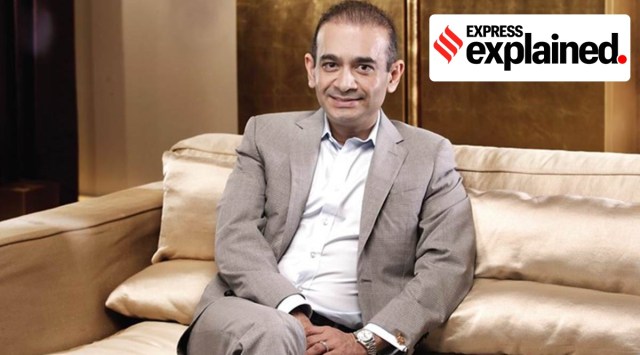 Since Nirav Modi was in prison, and his lawyers argued that his mental condition had deteriorated, especially in Covid-19 prison restrictions.
Nirav Modi, the diamond merchant wanted for money laundering and fraud in India, appealed to fight his extradition from Europe to India on the grounds of mental health and human rights. On August 9, the London High Court granted him permission to fight his case on those grounds.
The UK courts are bound to consider whether a verdict, which leads to the extradition of an individual to a foreign country, is aligned with the European convention of human rights.
Nirav Modi’s legal team, while presenting the case, stated his “severe depression” and “high risk of suicide” during the hearing.
Since Modi was in prison, and his lawyers argued that his mental condition had deteriorated, they submitted that the courts take this into consideration before arriving at their judgment, especially in Covid-19 prison restrictions.
The judge granted Modi permission to fight on grounds 3 and 4 relating to Article 3 of the European Convention of Human Rights (ECHR), which related to the right to life, liberty and security; and Section 91 of the UK’s 2003 Criminal Justice Act relating to fitness to plead.
Section 91 states that the court has to consider the physical and mental condition of an individual and if it would be unjust to extradite him/her.
It also states that if an individual has physical or mental conditions which make it unjust to extradite him, the courts have to take this into consideration and either 1) order their discharge or 2) wait and adjourn the hearing until they no longer satisfy those physical/mental conditions.
According to the law, Article 3 is for “Prohibition of Torture”. The provision states, “No one shall be subjected to torture or to inhuman or degrading treatment or punishment.” Torture, in this case, can be an infliction of serious mental or physical pain or intentional infliction of the pain.
Article 3 can be used in extradition, when — according to Human Rights Handbook by the Council of Europe — “deportation would expose the deportee to inhuman treatment in the recipient, third state”. The law protects one from extradition to a country if the court believes that an individual would face torture; degrading or inhuman treatment in the said country.
Article 3 has to take into consideration the vulnerability and inability of mentally ill individuals to complain about how a particular punishment affects them.
 How are Nirav Modi’s lawyers using Article 3 of ECHR?
Nirav Modi’s lawyers claimed that his extradition was contrary to Article 6 (right to a fair trial, in India) and Article 3 (torture and inhuman treatment, in India) as the publicity awarded to his trial would make it hard for him to achieve fair trial in India “amidst press and social media commentaries” and lead to poor treatment in an Indian prison.
How did extradition become a part of Article 3?
In the 1989 Soering vs United Kingdom case, ECHR has established that the extradition of a German man to the United States would be a violation of Article 3 under ECHR, which guaranteed protection from inhuman treatment and torture.
In 1985, Jens Soering had allegedly fled to Europe after killing a couple in the US. In 1986, the United States requested his extradition. In 1988, Soering appealed under Article 3 of ECHR that he would face degrading and inhuman treatment if he were to be extradited since he would face the death penalty which, according to him, would engage the right to life.
Soering also appealed that the “death row phenomenon”, which is the stress prisoners on death row go through, was violating Article 3 of ECHR.
He was only extradited to the US after the UK sought confirmation that the former wouldn’t grant Soering the death penalty in the murder case.
In this case, ECHR ruled that the “death row phenomenon” breached Article 3.
In 1996, Karamjit Singh Chahal had fought against extradition using Article 3 of ECHR stating the possibility of torture and inhuman treatment in India on being extradited.
According to ECHR, Chahal had illegally entered the UK in 1971 in search of employment. Chahal visited India in 1984 amidst Sikh organisations demanding a separate homeland. Chahal had also visited Sant Jarnail Singh Bhindranwale, who was advocating violence according to the Indian government, at the Golden Temple.
Chahal alleged that he was arrested by Punjab police, detained for 21 days, electrocuted, beaten and kept in unsanitary conditions.
For political reasons, the United Kingdom had decided to extradite Chahal, which is when he filed his argument that his deportation would violate Article 3 of ECHR.
The court concluded, “It is well-established in the case-law of the Court that expulsion by a Contracting State may give rise to an issue under Article 3, and hence engage the responsibility of that State under the Convention, where substantial grounds have been shown for believing that the person in question, if expelled, would face a real risk of being subjected to treatment contrary to Article 3 in the receiving country. In these circumstances, Article 3 implies the obligation not to expel the person in question to that country.”
Newsletter | Click to get the day’s best explainers in your inbox
Nirav Modi’s lawyers are fighting on the grounds of him not being “fit to plead”. They submitted psychiatric evidence about his mental state since he was detained in prison. They had submitted that Modi developed a “recurrent depressive disorder” which classifies as a Level 2 disorder — meaning that if his mental health deteriorates more, he would, by law, have to be sent to a hospital and could not be seen as fit to plead in court for criminal liability.
Hence, the Indian government had to submit evidence that Arthur Road Jail in Mumbai — where he is being transferred — has adequate facilities.
Indian government has guaranteed assurances in Nirav Modi’s extradition. The assurances provided in court were on the basis of overall conditions; the amount of individual space per inmate; material conditions (sleeping arrangements, number of people per area, sanitation arrangements, drinking water, food and exercise facilities); security; violence; and medical facilities.
The government mentioned in detail that Modi would have adequate facilities that matched European standards for space, hygiene, food, water and medical support — including mental health treatment.
After Justice Martin Chamberlain approved Nirav Modi’s appeal to fight against his extradition on grounds of mental health and human rights, the judge noted that it was important to understand the adequacy of Arthur Road Jail in Mumbai — where he is being transferred — in preventing suicide attempts.
After the judgment, UK’s Crown Prosecution Service (CPS), which represents the Indian authorities in the court, said it was reviewing the judgment for the next legal step.
PTI reported, “If Modi wins that appeal hearing in the High Court, he cannot be extradited unless the Indian government is successful in getting permission to appeal at the Supreme Court on a point of law of public importance”.
Nirav Modi is accused of routing transactions of about Rs 13,600 crore through fraudulent Letters of Undertaking (LoUs) of Punjab National Bank (PNB). He left India in 2018 before the scam went public. He has been lodged in Wandsworth Prison.