Journalism of Courage
 5 min read


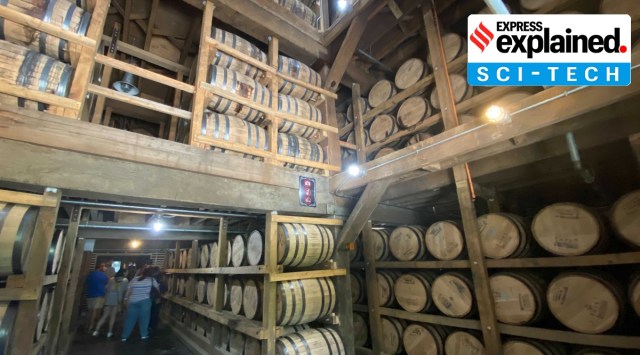 According to New York Times, Jack Daniel's currently has six barrelhouses in the Tennessee region and was building a seventh on a property that has space to house one more, before the court ruling arrived. (Photo: Wikimedia Commons)
 A local court in Lincoln county, Tennessee, recently stopped the construction of a new barrel warehouse (also called a barrelhouse) for Jack Daniel’s, the world’s biggest-selling brand of American whiskey.
The order came after a resident named Christi Long, who lives close to the company’s barrelhouses, filed a suit against the county claiming that a black, sooty fungus — known as whiskey fungus, which is commonly found near bakeries and distilleries around the world — has spread uncontrollably and covered cars, homes and trees.
Alleging that the county officials didn’t properly approve permits for the warehouses, Long and other residents of the area are demanding that Jack Daniel’s implement an air-filtration system to tackle the problem. Currently, the company has six barrelhouses in the region and was building a seventh on a property that has space to house one more, before the court ruling arrived, according to the New York Times.
Over the years, several lawsuits have been filed against alcohol makers by residents in different countries who claim that the whiskey fungus not only covers houses, trees and outdoor furniture with the black crust but also harms property value and adversely affects their lives.
To understand what whiskey fungus is, we first need to know about something called “angel’s share”. When whiskey or any other spirit is kept inside a cask for maturing, a small amount of it evaporates into the atmosphere through the wood. Up to two per cent of the alcohol leaves the cask this way every year.
According to Oak & Eden, a famous whiskey maker, “This whiskey that evaporates into the air and perfumes the storehouse was dubbed the angel’s share in mediaeval Ireland and Scotland. They believed the whiskey that disappeared into the air was meant as an offering for the angels.”
Whiskey fungus, or Baudoinia compniacensis, feeds on these alcoholic vapours and is velvety or crust-like — it can reach one or two centimetres in thickness. The fungus tends to spread to nearby surfaces, blanketing almost everything that comes in its way.
According to the Indiana State Department of Health, it is found across North America, Europe and Asia and thrives where fermentation occurs, like in bakeries and distilleries.
“Baudoinia compniacensis uses the ethanolic vapour to initiate germination and to express proteins in the fungus that allow the fungus to tolerate high temperatures,” the department said.
It was first discovered in the 1870s, when Antonin Baudoin, the director of the French Distillers’ Association, saw a “plague of soot” around the distilleries in the Cognac region of France, the NYT reported.
Researchers haven’t found any instances of health risks from short or long-term exposure to the whiskey fungus yet, the Indiana State Department of Heath mentioned in its 2019 report. However, it can destroy trees and damage properties.
Speaking to Insider, James Scott, the mycologist who first classified whiskey fungus, said, “I’d say it’s more than a nuisance”. He added, “It is really destructive.”
Moreover, removing the fungus from the affected surfaces might prove to be a daunting task. In her lawsuit, Christie Long has claimed that she and her husband have to spend $10,000 annually to power-wash their house, covered with Baudoinia compniacensis, four times a year with bleach.
The health department recommended homeowners use N95 masks, goggles and gloves while removing the whiskey fungus. It also mentioned that if the fungus is found in a private water well, the well must be disinfected.
Before Christie Long’s case, a couple based in Scotland’s Falkirk sued whiskey giant Diageo for £40,000 in 2019, saying the whiskey fungus caused due to the company’s barrelhouse in the nearby area had damaged their house and furniture.
According to the BBC, the complainants claimed that “the value of their house has been reduced by between five and 10 per cent because of the effects of the fungus on properties.”
In 2012, residents of Kentucky, the US, filed class-action lawsuits against several Louisville distilleries regarding the same issue but they were all eventually dismissed.