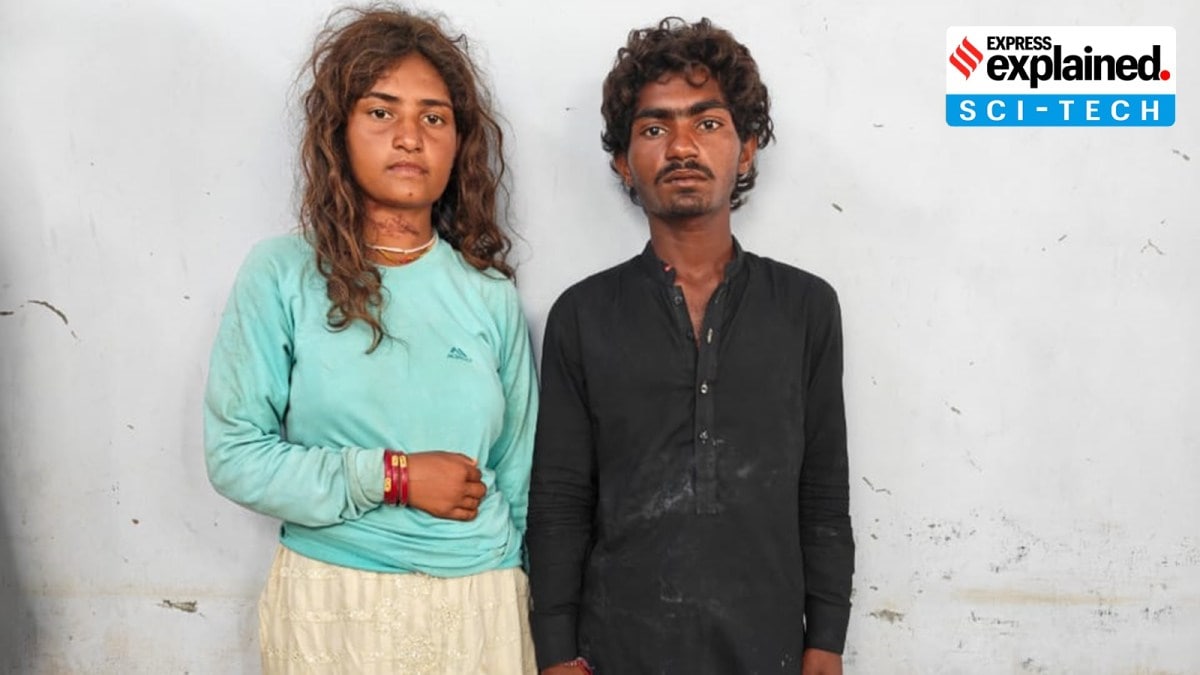
Tara Ranmal Chudi, or Toto, and Puja Karsan Chudi, or Meena, who claim to hail from Lasri village in the Tharparkar district of Pakistan, were not carrying any documents when they entered the village of Ratanpar in India. While Toto said he was around 16 years old, Meena said she was around 15.
However, their medical examination has revealed that Toto is over 20, and Meena is between 18 and 20 years of age.
Here’s how the ages of Toto and Meena were determined.
Bones and teeth hold the key
The procedure for Medical Age Estimation is established in law, under which a person’s bones and teeth are examined to determine age. Specifically, experts measure the level of ossification of bones and mineralisation of teeth to figure out the age of a person.
Ossification is the process of bone formation, where cartilage and other tissues harden into bones. Mineralisation is the natural enamel repair process of teeth.
Since bones and teeth follow set biological processes for development, and are relatively unaffected by environmental changes unlike other parts of the body, they are the preferred choice for age estimation procedures.
Story continues below this ad
These tests are most commonly used in medico-legal cases, to find out if a victim or perpetrator is a minor, and to identify victims of fires, natural disasters, and other accidents or crimes if they can’t otherwise be identified.
Upon request from investigative agencies or courts, a Medical Age Estimation Board is set up, usually in a tertiary level healthcare institution where specialities like forensic medicine, radiology, and forensic odontology are available. The Board is headed by the Civil Surgeon or Chief District Medical Officer (CDMO), who then signs the final report.
In the case of the Pakistani couple, the GK General Hospital in Bhuj conducted the examination, said officials at Khadir police station in Kutch (East). Since, the hospital authorities declined to comment on these investigations, the Indian Express spoke to two senior independent experts on the matter.
Bones that determine adulthood
According to Professor (Dr) G Rajesh Babu, dean, School of Medico-Legal Studies at the National Forensic Sciences University (NFSU), Gandhinagar, first, an upper body X-ray is done to assess the skeletal age of a person. The carpal bones in the wrist, the wrist joint, elbow joint and shoulder joint are enough to establish the age of the person. If required, the same procedure is done for the lower limbs too.
Story continues below this ad
On why bone ossification is used as an age marker, Dr Rajesh Babu said, “Bones develop as early as 8 weeks after egg fertilisation and begin from the clavicle (shoulder bone). There are 800 primary ossification centres, and ultimately, a person develops 206 bones. Skeletal age is measured as newborn, infant, pre-adolescent (9-12 years), adolescent (13-17 years), pre-adult (17-18 years), adult (18 years and above), and older adults.”
According to Dr Babu, the wrist has eight carpal bones that are ossified at the rate of “one bone each from the first year of birth to the eighth year”. One of these bones — the pisiform — ossifies between 8 and 12 years. “So, if all the bones are ossified in the wrist, we can confirm that the person is more than 12 years old at least,” he said.
Distinguishing minors from adults are two bones — radius and ulna — that form the forearm. “These two bones and the humerus (upper arm) are fused to the elbow joint at 16-17 years. Then, we will check the lower end of the radius and ulna, at the wrist. This is crucial as ossification of these bones at the wrist will confirm if the person is younger or older than 18 years old, the difference between minority and legal adulthood in India,” said Dr Babu.
“In most bones, ossification is complete by the age of 18 years. But the sacrum, which is the triangular bone located on the back wall of the pelvic cavity and connects to the two hip bones and is located above the tailbone, is completely ossified at the age of 25 years,” said the dean.
Story continues below this ad
He added that there are differences between men and women. “Bone fusion in females takes place a year or two earlier than males. The margin of error is 1 to 2 years,” he said.
Role of the third molar
Forensic Odontologist Dr Jayasankar Pillai, faculty at the Government Dental College in Ahmedabad and one of the team leaders identifying the bodies of the June Air India crash victims, said the third molar is a good marker. “The calcification or mineralisation of this tooth starts at 8 years. It gets over by 21 years of age. The level of mineralisation determines the approximate age of the person,” said Dr Pillai.
He explained that an Orthopantomogram (OPG) x-ray of the entire jaw is taken and then one segment is examined. “From the tooth development process, you can give the age of the person with a standard error of 1.6 years,” he said.
On the verification of whether a person is a minor or an adult, Dr Pillai said, “The third molar may not always erupt but can stay inside, which is called an impacted third molar. Thus, we don’t rely on its articulation in the mouth but on the development of its root as seen in the x-ray. If the root formation is complete, it is an indication that the person is 21 years old. The level of root formation is checked by root closure. If it is even a little wide, that means it is not complete.”
Story continues below this ad
In cases where the question is not just of confirming majority but estimating actual age, experts use a more lengthy process, as was done in the Disaster Victim Identification (DVI) procedure in some cases of the AI 171 plane crash in Ahmedabad.