


© The Indian Express Pvt Ltd
Tags:


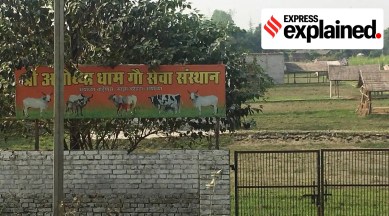
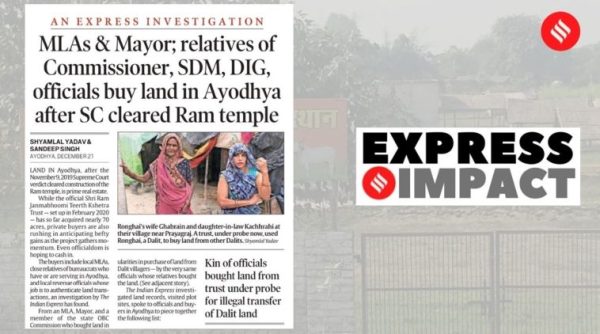
The government of Uttar Pradesh has ordered an inquiry after an investigation by The Indian Express revealed purchases of land in Ayodhya by politicians and relatives of state officials that raise serious questions of propriety and conflict of interest. Some of the buyers are related to officials who are investigating the seller — Maharishi Ramayan Vidyapeeth Trust — for alleged irregularities in the transfer of the land from the original owners, who are Dalit.
The inquiry, which was ordered by Chief Minister Yogi Adityanath on December 22 after the publication of The Indian Express investigation, was supposed to be completed in a week.
Land transfer curbs
Under Section 98(1) of the Uttar Pradesh Revenue Code, 2006 — which was implemented with the publication of the Uttar Pradesh Revenue Code Rules, 2016 — “no bhumidhar (land owner) belonging to a Scheduled Caste shall have the right to transfer, by way of sale, gift, mortgage or lease any land to a person not belonging to a Scheduled Caste, except with the previous permission of the Collector in writing”.
The district collector can grant such permission under five specific conditions: if the SC bhumidhar has no surviving heir; if the person has settled or is ordinarily resident in a different district or state; if the person or a member of his family is suffering from a fatal disease; if the person is seeking permission to transfer in order to purchase any other land; and if the land held by the applicant on the date of application does not, after such transfer, reduce to less than 1.26 hectares.
Curbs prior to 2016
Prior to 2016, the UP Zamindari Abolition Act, 1950 was applicable. This was the law in 1992, when the Maharishi Ramayan Vidyapeeth Trust (MRVT) bought land in Ayodhya, including some land from Dalit owners.
Under Section 157-A of the Zamindari Abolition Act, a person of Scheduled Caste had no right to transfer his land by sale, gift, mortgage or lease to a person of non-Scheduled Caste except with prior approval of the Collector. Collectors were barred from giving approval in case the landholding was smaller than 1.26 hectares.
Dodging provisions

Then, after about four years, the land was taken by MRVT as “donation” from Ronghai, using an unregistered donation deed. Documents show that permission was not taken from the Collector before these 21 bighas were transferred from Ronghai to MRVT.
MRVT was registered in December 1991. Twenty-nine years later, its “Objects and Purposes” such as establishing “schools, colleges, vidyapeeth, vaidic schools and other institutions”, and institutions “for the elevation of Ramayan”, remain largely unfulfilled.
MRVT trustee Salikram Mishra told The Indian Express: “We are going to establish a university in this area very soon. The process is ongoing.” Asked if the land of the trust could be sold, he said, “We sold only some small parts of the land after taking due permission from our headquarters in Delhi/Noida.”
What happens now
As per provisions of the UP Land Revenue Code Rules, 2016, the 21 bighas in question in Barhata Manjha village of Ayodhya which was bought from over a dozen Dalits in the name of then MRVT employee Ronghai and subsequently “donated” to the trust, will go to the state government. In case there are complaints from any of the original Dalit owners, action under the SC/ST Act could follow.
The relatives of UP government officials who figured in The Indian Express report last week did not buy land out of these 21 bighas. Officials who have worked in vigilance and the CVC, however, said action could be initiated against the buyers if a conflict of interest is established.
The report of Radhe Shyam Mishra, special secretary in the UP revenue department, is likely to be based on a preliminary inquiry into violations of revenue rules. As per CVC guidelines, he cannot inquire into the roles of officers and others (such as mayor, MLA, OBC commission members, information commissioner, divisional commissioner) who are higher than him in protocol.
[Update: Ronghai, who is 60 plus now, called The Indian Express on January 7 on phone and said, “I still work with them (MRVT) and get Rs 5000 per month salary from Delhi (the MRVT headquarters).” He said he is working in a family in his village which is associated with MRVT and gets salary from MRVT. When asked, he said he is not aware of the cancellation of the donation deed about transferring 21 bigha Ayodhya land to MRVT. When asked about a possible legal battle, he said, “Mere paas paisa nahin hai ladne ke liye, main kaise karunga (I don’t have the money for legal battle, how will I do this?).”]


