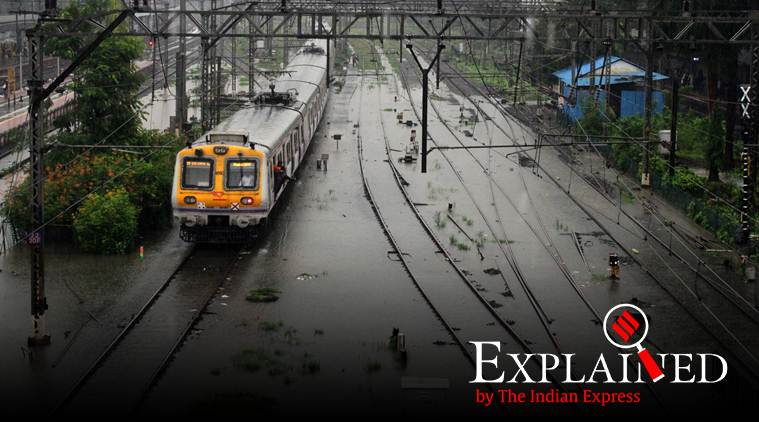
The CR, which is an important component of the Suburban Railways system, the lifeline of the city, came to a grinding halt even as its counterpart, the Western Railways, managed to operate its services. (Express photo: Deepak Joshi)
Mumbai recorded a decadal high rainfall of 375.22-mm rainfall in the suburbs which caused widespread flooding, loss of lives and a 16-hour shutdown of Central Railways. The CR, which is an important component of the Suburban Railways system, the lifeline of the city, came to a grinding halt even as its counterpart, the Western Railways, managed to operate its services. During the 2005 Mumbai deluge, CR had bore the brunt of the massive rains which had hit the city registering greater losses and disruptions compared to WR. The Indian Express finds out why CR services are more prone to be affected by monsoon and the steps it is taking to address the problem.
Do topographic conditions play a role?
Officials say topographic conditions play a decisive role in making CR more susceptible to flooding than WR. The mean sea level of WR stations are a little higher. In contrast, the CR suburban rail line passes through low lying areas. The low lying flood-prone areas in Western line are Bandra, Santa Cruz, Matunga, Elphinstone and Nallasopara. On the Central line they include stations like Sion, Kurla, Vikhroli, Ghatkopar and on the Harbour line, the low lying areas are Sewri, Wadala and Chunabhatti.
However, on the Western line, the low lying areas are closer to the coast. The proximity of WR to the sea means that water accumulated in these stations gets discharged far more quickly through the BMC drains, which run from east to west, into the sea. On the other hand, the relative remoteness of Central line stations from the coast means the water takes time to drain out. The long distance that this water must travel from the Central line to the sea also makes it susceptible to obstruction and hindrances.
Is there a difference in drainage infrastructure of Western and Central railways?
The existing drainage system on railway lines constitutes of longitudinal drains constructed by the Railways, which are laid between tracks. These drains discharge water into the latitudinal drains of the BMC which cross the tracks and join the larger drains that discharge the water into the sea. The WR traditionally has had a better drainage system compared to CR. Over the last few years, the WR has further augmented these drains and also constructed additional cross-drains under the tracks in vulnerable areas to ensure faster discharge of water into BMC drains. The layout of BMC drains is such that their incline gets steeper as they get closer to the sea which allows faster dispersal of water. In case of CR, the incline of the BMC drains is relatively flat and the water does not gush out with a greater force. The CR has, however, been working on augmenting its drains as well. The WR also benefited from the massive cleanup drives and widening that the BMC undertook on Bandra’s Chamdawadi nullah and Dharavi’s Mukhyadhyapak nullah which led to easier dispersal of water.
What other infrastructure work has been carried out to stop flooding?
In order to prevent flooding the Railways has been working on lifting the height of tracks. Chronic flooding at Nallasopara had last year caused all suburban services between Bhayander and Virar to be suspended for over 24 hours. Since that fiasco, WR lifted the tracks by around 300 mm which meant that there was not much accumulation of water on the tracks this year and services were not disrupted. Officials say CR had also done a similar exercise to lift tracks in the flood-prone Sion Kurla stretch before the monsoon but it did not have the desired effect in stopping flooding due to the massive downpour. The CR also faces problems in raising the height of tracks compared to the WR as the height of certain existing Foot Over Bridges do not give it the required space clearance.
Why did CR come to a grinding halt on Monday and much of Tuesday?
CR officials say that services were stopped largely due to flooding in low lying areas in the Sion-Kurla and Chunabhatti-Tilak Nagar stretch. Officials say that the entire area is prone to waterlogging and water was pouring into the station from the surrounding low lying localities. Officials said that even pumping out water was not a solution as the water being pumped out was gushing back again. The BMC and Railways had to subsequently deploy two 50 HP pumps at Sion station which pumped the water up and discharged it on the Sion flyover.
Is CR prepared if a similar downpour hits the city in the coming days?
The CR has undertaken a drive to identify trouble-spots, officials say. Teams had been sent to survey the drains and find spots where waterlogging was severe. The CR has said that such bottlenecks will be cleaned up. Officials, however, say that the constant flooding is part of a larger urban planning problem. Officials claim that the problems may continue till there is no improved urban planning coordination between the various agencies that govern Mumbai.


 5 min read


 The CR, which is an important component of the Suburban Railways system, the lifeline of the city, came to a grinding halt even as its counterpart, the Western Railways, managed to operate its services. (Express photo: Deepak Joshi)