


Tags:



If India goes ahead with a proposed legislation allowing 26 weeks of paid maternity leave, it will join a league of 16 nations, from among the 186 member-states of the International Labour Organisation (ILO), that offer the highest duration of paid maternity leave. On Monday, Women and Child Development Minister Maneka Gandhi said the Ministry of Labour had agreed to increase maternity leave to six-and-a-half months.
Under the Maternity Benefit Act, 1961, a women employee who has worked in the same place for at least 160 days in the 12 months preceding her delivery is eligible for maternity benefit. According to this Act, women employees can go on leave for 12 weeks — six weeks each before and after delivery — during which they are paid 100 per cent of their salary. The Centre’s proposed amendment will now increase the paid maternity leave to 26 weeks.

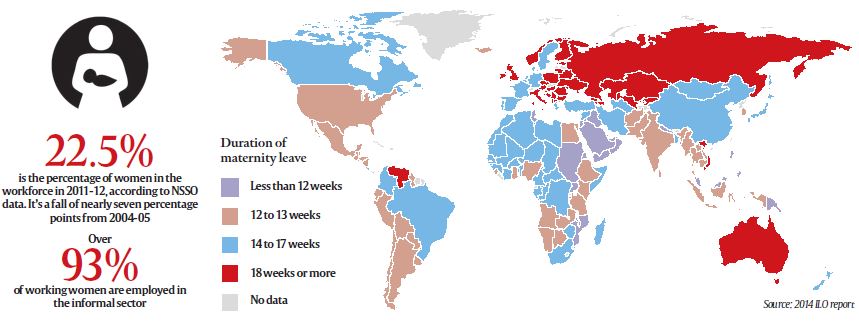
However, the amendment to the Act doesn’t cover a vast majority of the women work force employed in the informal sector in India. According to former Planning Commission secretary Naresh Chandra Saxena, over 93 per cent of the women workforce in India are those employed in the informal sector.
[related-post]
The proposed amendment to the law is the result of various studies that showed that the post-natal leave must be increased owing to factors such as increasing number of late marriages, increase in Cesarean births, urbanisation and transition towards the nuclear family structure. Various international studies have established a direct link between greater maternity leave duration and lower infant mortality rates.
While 16 other ILO member-countries mandate a maternity leave of 26 weeks or more, very few provide for women to be paid 100 per cent of their average daily wages. Norway, Croatia, Montenegro and Macedonia top the list when it comes to providing the maximum period of leave at 100 per cent pay while countries such as Venezuela, Poland and Vietnam offer 26 weeks of fully paid leave, as is proposed in the case of India. Certain countries, in fact, provide extended maternity leave according to the family size. For instance, in Croatia, women can avail maternity leave for up to 3 years for the third or subsequent child. The United States and Papua New Guinea are the only two countries that have no provision for any kind of paid maternity leave.
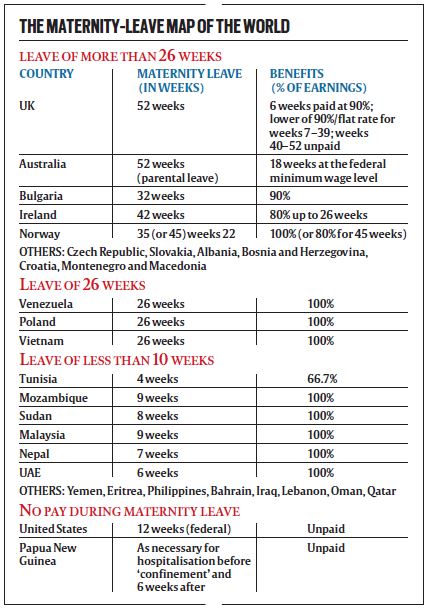
A 2012 Ministry of Labour review of attitudes towards the Maternity Benefit Act in four sectors, namely IT, ITES, health and education, shows that employers perceive the direct wages that they have to pay during the maternity leave period as a burden. They also complain about the “indirect cost of human capital depreciation”, essentially that they will have to invest as much in training the new mother as in training any new recruit. This discriminatory attitude was also evident in a recent study that the Centre for Social Sciences did for the National Commission of Women which showed that 11 per cent of the women surveyed had to face dismissal at work due to pregnancy.
This kind of a setback to a woman’s career owing to pregnancy is not unique to India. The recent Human Development Report states that career breaks due to maternity leave “may reduce women’s earning power and pension benefits as they miss chances to gain experience and win promotion. Moving into senior management becomes particularly hard”. It records how in Germany, each year of maternity leave reduces a woman’s earnings upon resuming work by 6 to 20 per cent, in France by 7 per cent.
Making a case for increasing the fiscal space for maternity benefits in the unorganised sector, Saxena said, “Why should the state alone shoulder the burden? The law should be amended so that the private sector provides paid maternity leave for the informal labour hired by them,” said Saxena.


