


© The Indian Express Pvt Ltd
Tags:


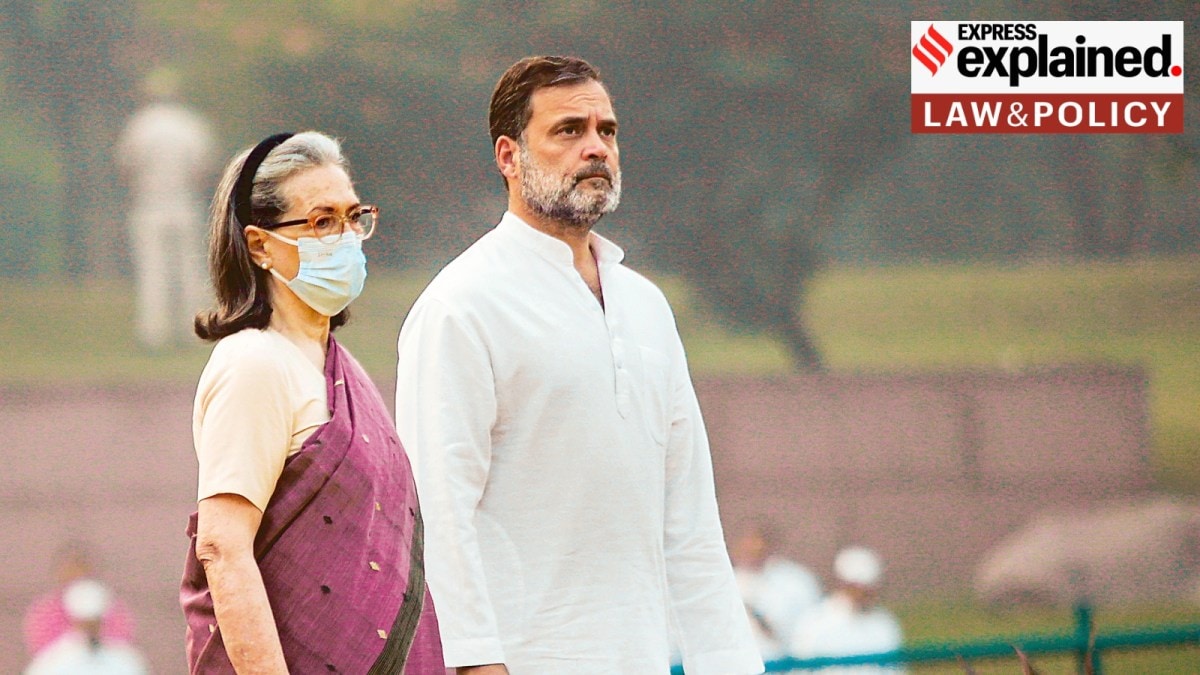
A special court in Delhi on Tuesday declined to take cognizance of the Enforcement Directorate’s (ED’s) prosecution complaint filed in the alleged Rs 2,000-crore National Herald money laundering case against senior Congress leaders Sonia and Rahul Gandhi, and five others. Special Judge Vishal Gogne of Rouse Avenue Court essentially declined to start judicial proceedings based on the ED’s complaint.
The ED’s primary allegation is that the Gandhis, along with a few other office-bearers of the Congress, entered into a criminal conspiracy to usurp Rs 2,000-crore-worth assets of Associated Journals Limited (AJL), a public unlisted company and the publisher of the National Herald newspaper. The All India Congress Committee (AICC) had loaned Rs 90.21 crores to AJL. Subsequently, Young Indian, a private not-for-profit company in which Sonia and Rahul Gandhi together held 76% of shares, purchased from AICC the right to recover the loan for Rs 50 lakhs.


In a 117-page order, the court declined to take cognizance of the money laundering offence primarily on two grounds.
Private complaint: The ED’s case was built on the basis of a 2014 order by a magistrate that summoned the accused to appear before the court based on a complaint by Swamy. On Tuesday, the court held that the Prevention of Money Laundering Act (PMLA) only contemplates complaints by an investigating officer from a law enforcement agency, and not by public persons.
Lack of a predicate offence: The PMLA states that “Whosoever… assists… is a party or is actually involved in… activity connected with the proceeds of crime including its concealment, possession, acquisition or use… shall be guilty of an offence of money laundering.”
Here, “proceeds of crime” is “ any property derived or obtained, directly or indirectly, by any person as a result of criminal activity relating to a scheduled offence”. These “scheduled offences” are listed in two schedules attached to the PMLA, and also called predicate offences. The court on Tuesday declined to take cognizance of ED’s complaint as there is no FIR against the Gandhis for a predicate offence.
In July 2014, the ED had dispatched a letter to the CBI for appropriate action based on Swamy’s complaining; this was reiterated by the ED Director in a letter to the CBI Director in 2015. But the CBI did not file an FIR. The court, in its order, revisited annual reports of the ED and Financial Action Task Force (FATF) and landmark Supreme Court rulings to reiterate that “the registration of a FIR qua the scheduled offence was a sine qua non for prosecution under the PMLA.”
Although the ED has, in recent years, argued that money laundering is a stand-alone offence and can be investigated independently, this ruling reaffirms that a money laundering probe cannot be launched without a scheduled offence.
Apart from the ED case, the Income Tax Department has been investigating a case of alleged tax fraud by Young Indian since 2017. However, IT cases are not categorised as scheduled offences under the PMLA.
The stringent PMLA has onerous bail conditions and reverses the burden of proof, and gives the agency a long rope to attach properties. Therefore, in November, the Delhi Police Economic Offences Wing (EOW) also filed an FIR in the same case, to perhaps create another window for a money laundering probe. However, the complainant in that case is Shiv Kumar Gupta, Assistant Director of the ED, and the complaint is based on the aforementioned 2014 summoning order.


