


© The Indian Express Pvt Ltd
Tags:


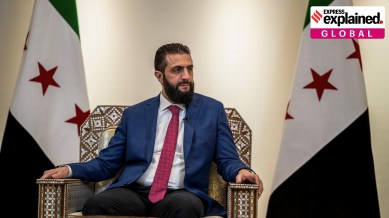
A year after the fall of Bashar al-Assad, Syria faces multiple challenges as its terrorist-turned-statesman president picks up the pieces of 14-year-long civil war.
Assad fled to Russia last December after a lightning rebel offensive, led by Hay’et Tahrir al-Sham (HTS), overwhelmed his forces. HTS leader Ahmed al-Sharaa, formerly a sanctioned al-Qaeda terrorist with a $10 million bounty on his head, took over as Syria President.


Al-Sharaa has the unenviable task of leading a country that is fractured on ethnic lines and left economically impoverished by the lengthy civil war. While the establishment of the national commissions for Transitional Justice (NCTJ) and for Missing Persons earlier this year has been hailed as a welcome step, much more still needs to be done.
Since the fall of the Assad regime, there has been widespread ethnic violence, with Sunni groups aligned to the new regime targeting minority communities, notably, Shia Alawites (Assad’s community), the Druze, and Kurds. Al-Sharaa has been criticised for not doing enough to control this violence. Certain actions have been viewed as explicitly fanning tensions: The failure of Syria’s interim constitution to guarantee Kurdish rights is being seen as a betrayal by the Kurds, who too fought Assad.
Human Rights Watch has criticised the NCTJ for focussing on the Assad regime, and overlooking war crimes committed by others, including al-Sharaa’s HTS.
Meanwhile, millions remain in need of continued humanitarian assistance. Many live in refugee camps or damaged homes, and face stark food insecurity; in November the International Rescue Committee reported that “more than half of the water supply networks and four out of five electricity grids are either destroyed or non-functional”. The cost of reconstruction could be high as $345 billion.
India enjoyed robust ties with the Assad regime for over five decades. Even during the peak of the civil war, it maintained its embassy in Damascus. After the collapse, New Delhi called for a “peaceful and inclusive Syrian-led political process”. The first official outreach to the new regime came in July.
On Monday, an Indian delegation met Syria Foreign Minister Asaad Al-Shaibani in Damascus. It also met Syria Health Minister Musab Al-Ali; sources said the talks focussed on collaboration in “pharmaceutical manufacturing and medical training”. Both sides also spoke on a “scholarship program for Syrian students” and a “specialised engineering cooperation initiative tailored for Syrian government employees”.


