6 min read


© The Indian Express Pvt Ltd



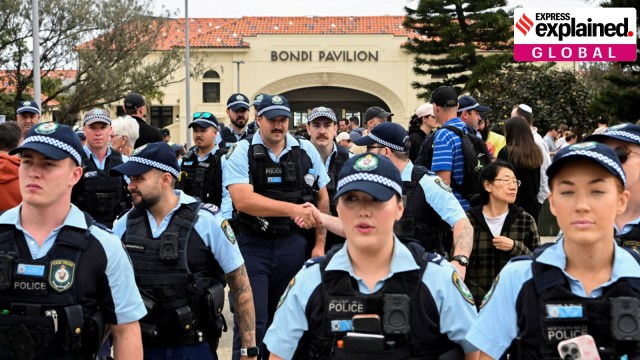 Police officers at the Bondi beach pavilion in Sydney. Reuters
The Bondi beach shooting, in which 15 Jewish people were killed, is hardly Australia’s first brush with Islamic State terrorism, reviving an old challenge for the country in dealing with the terror group.
What Australia has faced is not just a threat of terror attacks by the Islamic State but also its potential to attract Australian citizens to its cause.
Australia’s security agency had, as recently as September 2024, put the terrorism threat level at “probable” — that is, there was a greater than 50 per cent chance of an onshore attack over the next 12 months. But it had also felt that support for the Islamic State declined within the country after its collapse.
Sunday’s shooting by a father-son duo — who were allegedly inspired by Islamic State ideology — shows that the challenge from this terror group is far from over.
Both had recently travelled to a part of the Philippines that has long been a hotbed of extremism.
Naveed Akram, 24, and his father, Sajid Akram, 50, carried out the shooting during a Hanukkah event at Sydney’s Bondi beach.
Both were shot by police. Sajid Akram died at the scene of the attack. His son, who has woken up from a coma in a Sydney hospital, was charged on Wednesday with 59 offences, including 15 charges of murder.
Australian Prime Minister Anthony Albanese said the attackers were motivated by “Islamic State ideology”. “Radical perversion of Islam is absolutely a problem,” Albanese said.
Between 2012 and 2019, more than 200 Australian individuals — men, women and children — travelled to Syria and Iraq to join Islamic State, according to Australia’s national security agency.
Dozens more assisted the Islamic State by supporting those overseas or by planning or carrying out terrorist attacks in Australia.
“Australians fighting with Islamic State have been involved in acts of violence including suicide bombings and holding the decapitated head of a Syrian soldier following Islamic State beheadings. These incidents have subsequently been used in Islamic State’s propaganda campaign,” the agency notes on its website.
In September 2014, the Islamic State released a directive to supporters around the world, sanctioning unilateral terrorist attacks against Australia and other western nations “wherever, whenever and however” they could, without instruction or permission from its leadership.
Just three months later, Australian citizen Man Haron Monis held ten civilians hostage inside a Sydney cafe. Monis, a Shia Muslim, had previously converted to Sunni Islam and sworn allegiance to the Islamic State. Two civilians and Monis died in the incident.
The Australian National Security agency acknowledges on its website that the “Islamic State retains an enduring presence” within certain extremist fora.
“Islamic State’s coordinated and effective propaganda campaign exposed susceptible Australians to an extremist ideology and influenced some toward radicalization and violence,” it says.
The Australian government first listed the Islamic State as a terrorist organisation under its former Arabic name, Tanzim Qa’idat al-Jihad fi Bilad al-Rafidayn, in 2005. Over the years, it has kept relisting the group under its different names.
In 2015, during the heyday of the Islamic state, the then Australian Attorney General George Brandis met top officials in India including National Security Advisor Ajit Doval.
The key worry for Brandis was the rise of the Islamic State and how Australians were being recruited into the terrorist group. As senior Cabinet Minister, Senator Brandis was the leader of the Australian government in the Senate and was responsible for national security and law enforcement.
A senior Indian official, who attended those meetings in 2015, told The Indian Express: “Brandis was keen to know how India, despite having a large Muslim population, did not have so many youth joining the ISIS — either by travelling to Syria or Iraq or were causing attacks at home in Australia.”
The official Indian response, at the time, was that the Indian Muslims do not identify themselves with those in West Asia. Indians accounted for about 100 ISIS fighters, as compared to 200 Australians who joined ISIS.
During the October 2015 visit, Brandis also met then Union home minister Rajnath Singh in New Delhi to discuss shared counter-terrorism challenges. During these meetings, Australia requested information sharing and offered assistance in investigations related to Indian-origin IS suspects.
Australian authorities also agreed to cooperate with India’s National Investigation Agency (NIA) in the case of Areeb Majeed, a suspected IS recruiter who had returned to India.
In May 2016, Brandis announced that Neil Prakash, an Australian of Indian-origin and the “highest value target” from an Australian counter-terrorism perspective, had been killed in a US military airstrike in Iraq. Brandis cited Prakash’s significant and influential role as a senior IS recruiter and attack facilitator who was actively inspiring domestic terrorism attacks in Australia.
The terror group, through its media arms, has often issued threats against different communities. On June 21, 2021, its al-Furqan Media Foundation released an audiotape that encouraged Islamic State fighters around the world to intensify their attacks against their enemies, particularly against “Crusaders”. On February 2, 2023, came a direct threat against Jewish people. The Islamic State’s weekly Al-Naba published an article explicitly titled “Kill the Jews”, which called on Muslims around the world to carry out terrorist attacks against members of the Jewish community.
Back in April 2015, then Australian Foreign minister Julie Bishop had said, “We are witnessing a more complex, more global, more dangerous form of terrorism than ever before. It is exemplified by IS in the Middle East. We are affected, in fact very few countries are immune from this… That is why Australia has joined the coalition led by the US and Iraqi government to try and stop this terrorist organisation…”