4 min read

© The Indian Express Pvt Ltd



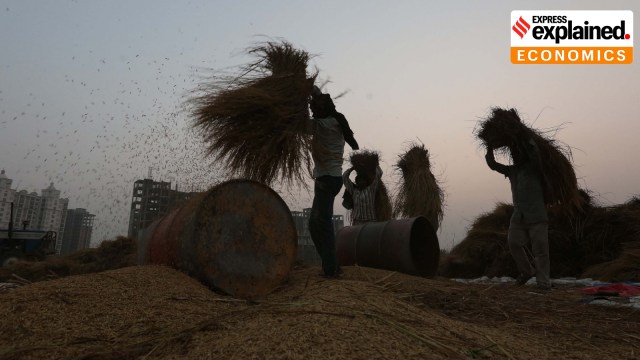 Workers thresh basmati paddy in Punjab’s SAS
Nagar district.
(Jasbir Malhi/file)
Workers thresh basmati paddy in Punjab’s SAS
Nagar district.
(Jasbir Malhi/file)Trump claims India dumping rice in the US: US President Donald Trump has claimed India can’t be allowed to “dump” rice in the US and undercut domestic producers, and that he would take care of the problem using tariffs.
“We’ll take care of it… Tariffs, again, solves the problem in two minutes,” he said at a White House roundtable event with US farmers, also attended by the Agriculture Secretary Brooke Rollins and Treasury Secretary Scott Bessent.
The truth is that the US isn’t a very large rice producer and exports more than what it imports. In 2024-25, the US was ranked 13th with an estimated output of 7.05 million tonnes (mt), which was way below the 150 mt of India, the world’s number one producer. Even with its relatively low production, the US exported 3 mt and imported 1.6 mt of rice.
In value terms, US exports of rice stood at $2,456 million in 2024 and $1,303.8 million in January-August 2025. Imports were valued at $1,497.8 million in 2024 and $1,078.9 million in January-August 2025. The imports were mostly from Thailand ($802.5 million in 2024 and $626.8 million in January-August 2025) and India ($391.2 million in 2024 and $263.9 million in January-August 2025).
Neither Thailand nor India export low-value rice to the US. The bulk of what the latter imports from these two comprises aromatic varieties, fetching high prices. Fragrant Thai Hom Mali and Jasmine rice are now quoting at around $1,125 and $690-700 per tonne respectively, while the price is $880-900 for Indian basmati with 2% broken grains content.
These are higher than the export prices of $560-570 per tonne for 4% brokens white rice and $670-675 for 4% brokens parboiled rice from the US.
A country that exports more than imports cannot really complain of “dumping”. The argument holds even more so when the imports are mainly of premium aromatic rice varieties.
Probably not much.
India is the world’s largest producer as well as exporter of rice. According to the US Department of Agriculture, India’s total rice exports in 2024-25 were at 22.5 mt. For the 2025-26 marketing year (October-September), the agency has projected its exports at 25 mt.
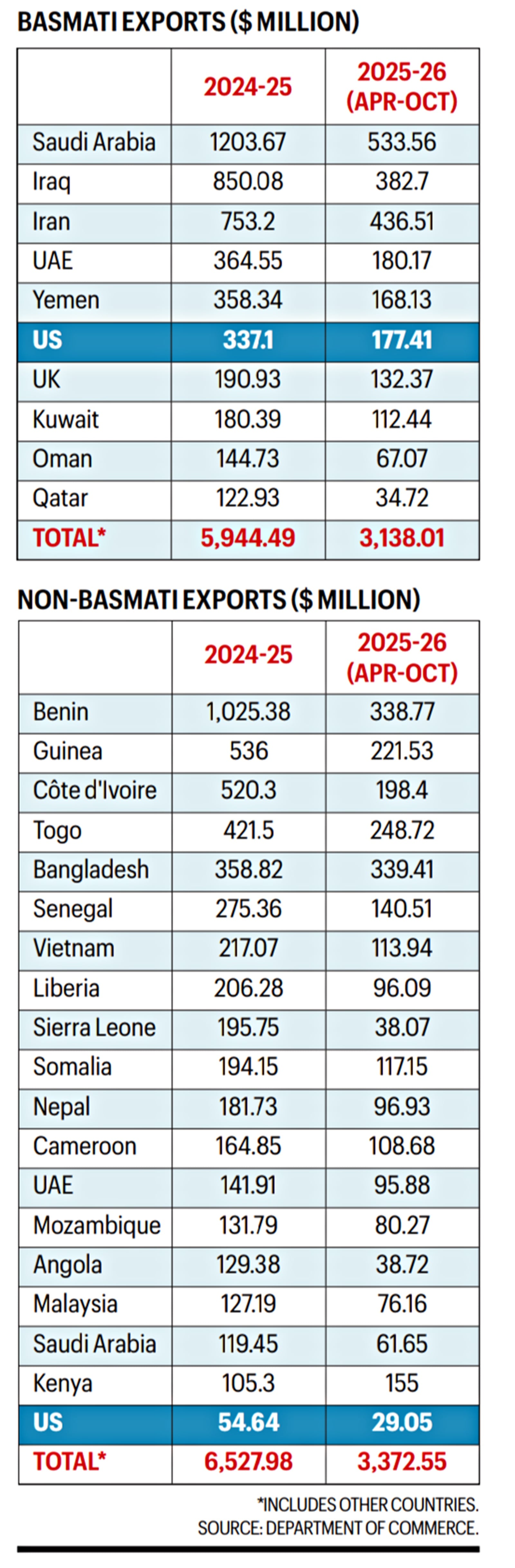
The share of the US in India’s rice exports is, however, quite small. During 2024-26 (April-March), India exported 60.65 lakh tonnes (lt) of basmati rice valued at $5,944.49 million. The US accounted for only 2.74 lt ($337.10 million) out of that, as per data from India’s department of commerce.
The share of the US was even less in non-basmati rice — a mere 0.61 lt ($54.64 million) out of the total exports of 141.30 lt ($6,527.98 million).
 Basmati exports
During the current fiscal (April-October), too, India has shipped out 35.90 lt of basmati and 82.77 lt of non-basmati rice valued at $3,138.01 million and $3,372.55 million respectively.
The US share in these was just 1.75 lt ($177.41 million) for basmati and 0.36 lt ($29.05 million) for non-basmati rice.
A country-wise break-up of India’s rice exports (see tables) reveals a clear trend.
A major chunk of basmati exports go to West Asia, with the likes of Saudi Arabia, Iraq, Iran and the United Arab Emirates being bigger markets than the US. The US basmati rice market is dominated by a few big Indian players such as LT Foods. The New Delhi-based company claims its ‘Royal’ brand holds a 55% market share in North America.
In the case of non-basmati rice, the biggest market for Indian grain is Africa — especially countries in the western part of the continent, like Benin, Togo, Côte d’Ivoire, Liberia, Sierra Leone, Guinea and Senegal. The US is practically non-existent as a market for non-basmati.
On the whole, an additional Trump tariff on Indian rice isn’t going to hurt the way it has in shrimps, gems and jewellery and readymade garments.