Fast-melting Arctic ice is turning the ocean acidic, threatening life
The ocean's chemistry growing more acidic creates life-threatening problems for the diverse population of sea creatures, plants and other living things that depend on a healthy ocean.
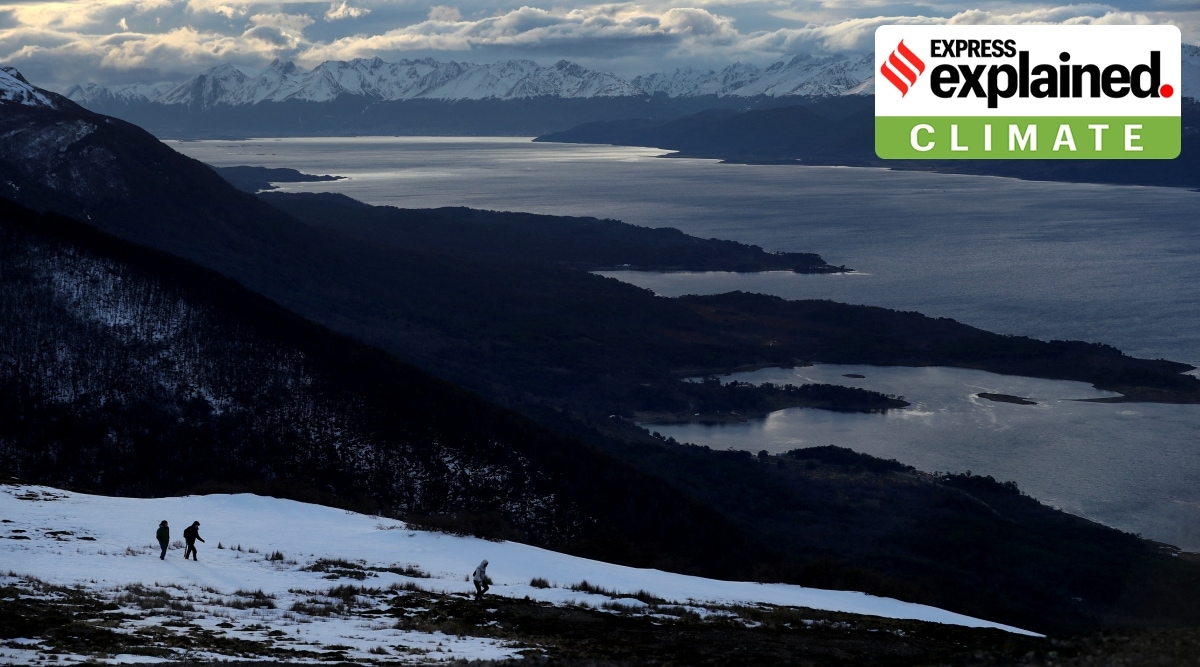
Scientists walk on Bandera hill in front of Beagle channel, Cabo de Hornos area, at Navarino island, Magallanes and Chilean Antarctic Region, close to Puerto Williams town, Chile, September 24, 2022. (REUTERS)
A team of researchers has flagged the changing chemistry of the western region of the Arctic Ocean after discovering acidity levels increasing three to four times faster than ocean waters elsewhere.
The team also identified a strong correlation between the accelerated rate of melting ice and the rate of ocean acidification. The study, published on Thursday in ‘Science’, the journal of the American Association for the Advancement of Science, is the first analysis of Arctic acidification that includes data from 1994 to 2020.
Scientists have predicted that by 2050, Arctic sea ice in this region will no longer survive the increasingly warm summers. As a result, the ocean’s chemistry will grow more acidic, creating life-threatening problems for the diverse population of sea creatures, plants and other living things that depend on a healthy ocean. Crabs, for example, live in a crusty shell built from the calcium carbonate prevalent in ocean water. Polar bears rely on healthy fish populations for food, fish and sea birds rely on plankton and plants, and seafood is a key element of many humans’ diets.
You’ve Read Your Free Stories For Now
Sign up and keep reading more stories that matter to you.
Seawater is normally alkaline, with a pH value of around 8.1.
The first author on the publication was Di Qi, who works with Chinese research institutes in Xiamen and Qingdao. Also collaborating were scientists from Seattle, Sweden, Russia and six other Chinese research sites.
They point to sea-ice melt as the key mechanism to explain this rapid pH decrease, because it changes surface water in three primary ways.
First, the water under the sea ice, which had a deficit of carbon dioxide, now is exposed to the atmospheric carbon dioxide and can take it up freely.
The seawater mixed with meltwater is light and can’t mix easily into deeper waters, which means the carbon dioxide is concentrated at the surface.
Story continues below this ad
The meltwater dilutes the carbonate ion concentration in the seawater, weakening its ability to neutralise the carbon dioxide into bicarbonate and rapidly decreasing ocean pH.