Explained: BJP’s defeat in Jharkhand shows limits of the Modi-centric campaign in state elections
The BJP, according to sources in the party, was aware of the anger against the Chief Minister — but it had hoped to overcome it riding on a non-tribal consolidation and a palpable sentiment in favour of a stable government.
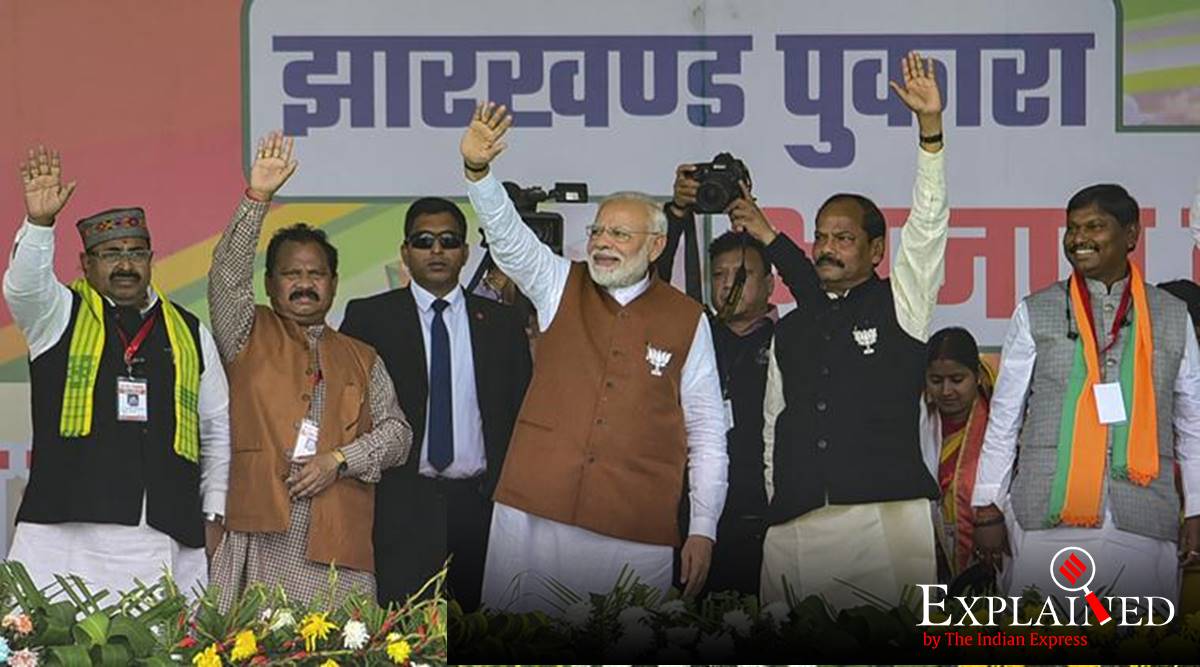
The BJP ran a national campaign referring to the Ram temple, Article 370, and even the new citizenship law, just like it had done in Maharashtra and Haryana. (Photo: PTI)
After its below-par performance in Maharashtra and Haryana, the BJP is heading towards defeat in Jharkhand. At 3.15 pm, the JMM-Congress-RJD alliance was leading in 44 seats in the 81-member House, well past the majority mark.
The BJP was leading in 26 seats, behind the JMM’s 27. Chief Minister Raghubar Das was trailing BJP rebel Saryu Roy by nearly 6,000 votes at the Jamshedpur East seat.
You’ve Read Your Free Stories For Now
Sign up and keep reading more stories that matter to you.
The verdict sends out the signal, again, that the image of Prime Minister Narendra Modi, despite his enduring personal popularity, has limitations as a mascot when it comes to state elections.
The BJP ran a national campaign referring to the Ram temple, Article 370, and even the new citizenship law, just like it had done in Maharashtra and Haryana.
In contrast, the Congress and JMM focused on local issues and the palpable disenchantment — maybe even anger — with the state government headed by Chief Minister Das and, in some places, the local MLA.
The BJP, according to sources in the party, was aware of the anger against the Chief Minister — but it had hoped to overcome it riding on a non-tribal consolidation and a palpable sentiment in favour of a stable government.
The state, which has seen a large number of lynchings, was heavily polarised, but the BJP perhaps overestimated its electoral potential.
Travelling across Jharkhand, one could find that the people were satisfied with the performance of the Narendra Modi government and were still rooting for him. But there was a clear change of mood when it came to the state government.
There was anger against Das over the way he handled the agitations by para teachers and anganwadi workers, and unhappiness over the “lack” of new recruitments by the Jharkhand Public Service Commission (JPSC) and Jharkhand Staff Selection Commission (JSSC).
The BJP’s decision to go alone and not give in to the AJSU’s demand for 18 seats perhaps resulted in a division of its votes. Adding to the split of votes was the fact that Babulal Marandi’s JVM(P) contested in all 81 seats.
Story continues below this ad
In Haryana and now in Jharkhand, the perception is that the Chief Minister has dragged the party down.
The verdict has a clear message for the Congress as well.
Although the party may be gloating, the fact is that the BJP for all of Monday morning and much of the afternoon was the single largest party — until it felt behind the JMM. The BJP’s showing — like in Haryana and Maharasthra — demonstrates that saffron is still the dominant political player.
A tactical alliance with the JMM and the RJD may have helped the Congress upstage the BJP. But the fact remains that the party, on its own, is still not seen as an alternative to the BJP.
While a clamour has already begun in the Congress for bringing back Rahul Gandhi as party chief, the Congress’s performance in Haryana and now in Jharkhand can be largely attributed to the state leaderships and their campaigns focusing on local issues.
While the party had a relatively strong leadership in Haryana, in Jharkhand it chose to piggyback on the JMM and send a message that the Opposition can provide a credible alternative.
Manoj C G currently serves as the Chief of National Political Bureau at The Indian Express. A veteran journalist with a career spanning nearly two decades, he plays a pivotal role in shaping the publication's coverage of India's political landscape.
Experience & Career: Manoj has built a robust career in political journalism, marked by a transition from wire service reporting to in-depth newspaper analysis.
The Indian Express (2008 – Present): He joined the organization in 2008 and has risen to lead the National Political Bureau, overseeing key political coverage.
Press Trust of India (PTI): Prior to his tenure at The Indian Express, Manoj worked with India’s premier news agency, PTI, honing his skills in breaking news and accurate reporting.
Expertise & Focus Areas: As a seasoned political observer, Manoj focuses on the nuances of governance and party dynamics.
National Politics: extensive reporting on the central government, parliamentary affairs, and national elections.
Political Strategy: Deep analysis of party structures, coalition politics, and the shifting ideologies within the Indian political spectrum.
Bureau Leadership: directing a team of reporters to cover the most critical developments in the nation's capital.
Authoritativeness & Trust: Manoj’s authoritativeness is grounded in his nearly 20 years of field experience and his leadership role at a legacy newspaper. His long-standing association with The Indian Express underscores a reputation for consistency, editorial integrity, and rigorous reporting standards required of a Bureau Chief.
Find all stories by Manoj C G here. ... Read More