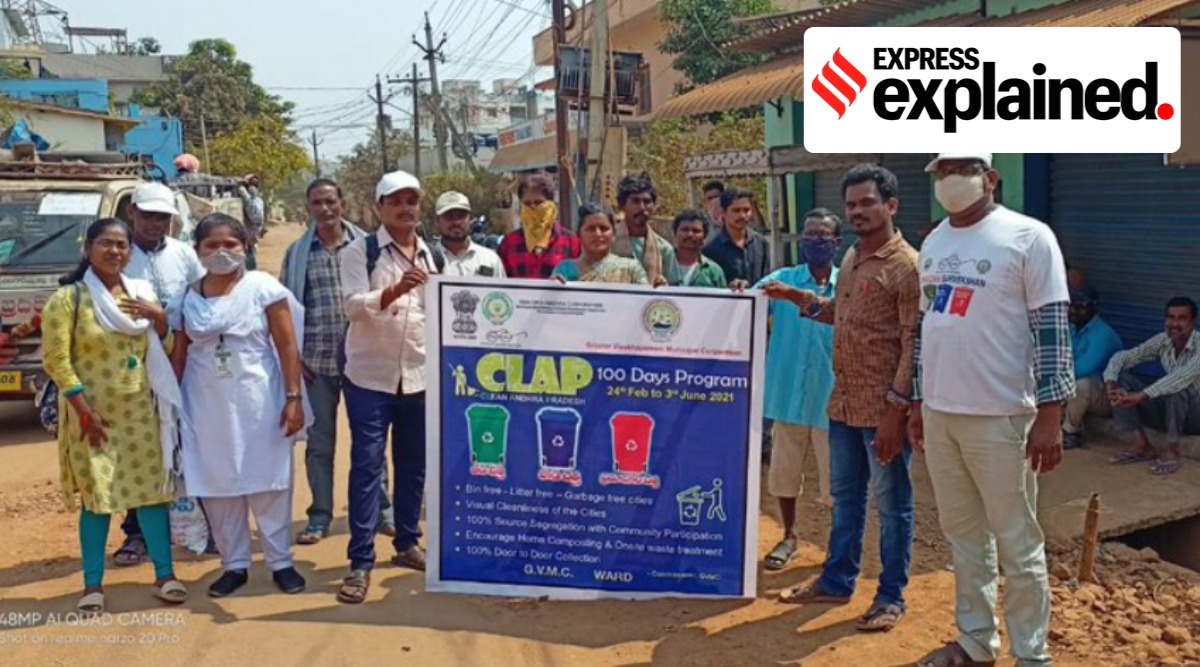
Explained: What is Andhra Pradesh’s CLAP campaign to clean up villages?
The Clean Andhra Pradesh programme started last November to clean up rural areas, improve sanitation conditions and waste management with public participation. Who is involved in the sanitation drive? What is the progress so far?
CLAP is a campaign to clean up rural areas in Andhra Pradesh.
The Andhra Pradesh government had on October 2 started the Clean Andhra Pradesh (CLAP)-Jagananna Swachha Sankalpam programme to clean up rural areas, improve sanitation conditions and waste management with public participation. Rural households are told not to dispose of garbage on the streets and instead hand it over to the garbage collector.
Chief Minister Y S Jagan Mohan Reddy had flagged off 4,097 garbage collecting vehicles to kick off the campaign. By the end of November, garbage collection directly from rural households was at 22 per cent but by the end of January, it had reached 61.50 per cent. Several Gram Panchayat officials have already started sharing photos of garbage-free village roads and streets. Panchayat Raj Minister Peddireddy Ramachandra Reddy said that by October this year, they will achieve all the targets under CLAP which includes 100 per cent rural household garbage collection.
You’ve Read Your Free Stories For Now
Sign up and keep reading more stories that matter to you.
Apart from door-to-door collection of garbage, the campaign aims for segregation of liquid and solid waste, onsite waste treatment, and encouraging home composting. Another major initiative is to make the rural areas free of open defecation. In fact, over 13,000 sarpanches have been “strictly instructed” to lead the Open Defecation Free (ODF) campaign from the front and ensure that their villages are ODF and achieve ODF Plus status by the end of 2022.
An ODF plus village is defined as “a village which sustains its ODF status, ensures solid and liquid waste management and is visually clean. By the end of this year, the Andhra government wants the state to become litter-free and garbage-free. A more complex project involves treatment of sewage water at 582 locations across the state using soil bio-technology treatment, wetland treatment, and waste stabilisation ponds.
Who all are involved in the sanitation drive? What is the progress so far?
Ahead of the launch of CLAP, more than 13,000 sarpanches and 1,200 district and mandal officials participated in an online training programme on the sanitation drive conducted by UNICEF WASH (Water, Sanitation and Hygiene). The government has deployed gram panchayat workers and officials, health workers, members of the village and ward secretariats set up by the government, and members of Zilla and Mandal Parishad Territorial Constituencies.
Story continues below this ad
The door-to-door collection drive has crossed 60 per cent and will cover all households by October this year but officials say it is difficult to maintain total cleanliness as many people continue to litter and throw garbage irresponsibly. The objectives of waste segregation and sewage water treatment are also being met slowly, Panchayat Raj Minister Peddireddy Ramachandra Reddy said.
Sreenivas Janyala is a Deputy Associate Editor at The Indian Express, where he serves as one of the most authoritative voices on the socio-political and economic landscape of Telangana and Andhra Pradesh. With a career spanning over two decades in mainstream journalism, he provides deep-dive analysis and frontline reporting on the intricate dynamics of South Indian governance.
Expertise and Experience
Regional Specialization: Based in Hyderabad, Sreenivas has spent more than 20 years documenting the evolution of the Telugu-speaking states. His reporting was foundational during the historic Telangana statehood movement and continues to track the post-bifurcation development of both Telangana and Andhra Pradesh.
Key Coverage Beats: His extensive portfolio covers a vast spectrum of critical issues:
High-Stakes Politics: Comprehensive tracking of regional powerhouses (BRS, TDP, YSRCP, and Congress), electoral shifts, and the political careers of figures like K. Chandrashekar Rao, Chandrababu Naidu, and Jagan Mohan Reddy.
Internal Security & Conflict: Authoritative reporting on Left-Wing Extremism (LWE), the decline of the Maoist movement in former hotbeds, and intelligence-led investigations into regional security modules.
Governance & Infrastructure: Detailed analysis of massive irrigation projects (like Kaleshwaram and Polavaram), capital city developments (Amaravati), and the implementation of state welfare schemes.
Crisis & Health Reporting: Led the publication's ground-level coverage of the Covid-19 pandemic in South India and major industrial incidents, such as the Vizag gas leak.
Analytical Depth: Beyond daily news, Sreenivas is known for his "Explained" pieces that demystify complex regional disputes, such as river water sharing and judicial allocations between the sister states. ... Read More