Investors in front of screen outside the Bombay Stock Exchange which displays Brexit shocker in Mumbai on Friday. Sensex dropped by more than 1000 points following the Brexit. (PTI Photo)
Brexit, it is. Beyond today, India, however, would do better to look within. India’s problems are more domestic — stuck projects, a choked credit system, banks laden with bad debt, corporates with bloated debt, poor capacity utilisation across sectors, etc. There is little to look forward on growth from the rest of the world, except of course, by way of stable crude oil prices at around $50 a barrel. Lower oil and commodity prices help, by keeping subsidies low for the government, and input costs for India Inc under control — both important during times of low economic activity.
An optimistic world expected Britain to Remain, but the ‘united we fall’ sentiment prevailed and Britons decided to separate themselves from the European Union. In India, 25 years of liberalisation has meant we are now closely connected with the rest of the world. So, any disruption affects us. But the situation, today, is different because the world economy is still in doldrums and global trade is insipid. So, Brexit doesn’t do any damage to us. Its impact will show as just a temporary blip.
[related-post]
Watch Video: What’s making news
The initial reaction in stock and currency markets is more because the whole world had not quite not priced in Brexit. The rupee depreciated against the dollar more because of the relative higher stability of the dollar and yen today compared with the euro and the pound.
Logically, the rupee appreciated against the pound and euro. The stock market too — after the initial 1,000-point plus plunge of Sensex — recovered over 40 per cent to end with a loss of about 600 points. With $364 billion in forex reserves, the RBI’s reassurance on maintaining orderliness had kept the markets stable.
As far as bilateral trade is concerned, it will be business as usual. Trade has remained stable over the years and India has a trade advantage with Britain with exports of $8.83 billion and imports of $5.19 billion. In other words, export exposure is negligible at 3.3 per cent of total exports.
With the European Union though, trade has been declining over the last couple of years. It is also expected Britain will have more flexibility negotiating an Indo-UK trade deal with Brexit.
However, Britain has to first sort its own trade deals with the EU over the next two years and with other trading partners. This, in turn, will affect Indian businesses with operations in Britain. There are over 750 Indian
companies employing over a lakh people in the UK and they would look at recalibrating their European strategies.


 3 min read


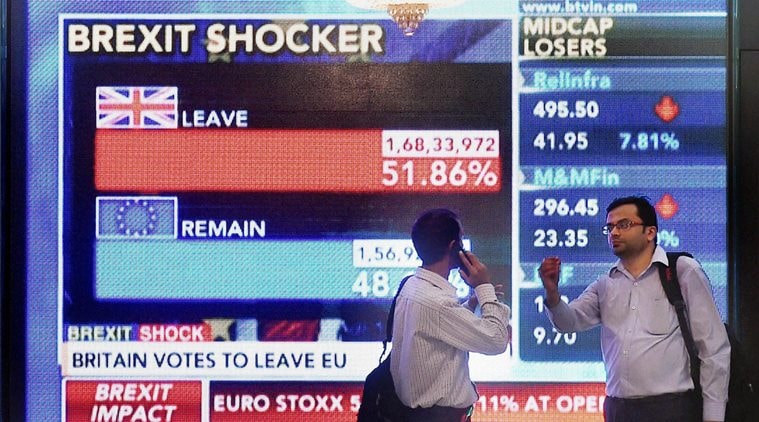 Investors in front of screen outside the Bombay Stock Exchange which displays Brexit shocker in Mumbai on Friday. Sensex dropped by more than 1000 points following the Brexit. (PTI Photo)