


© The Indian Express Pvt Ltd
Tags:


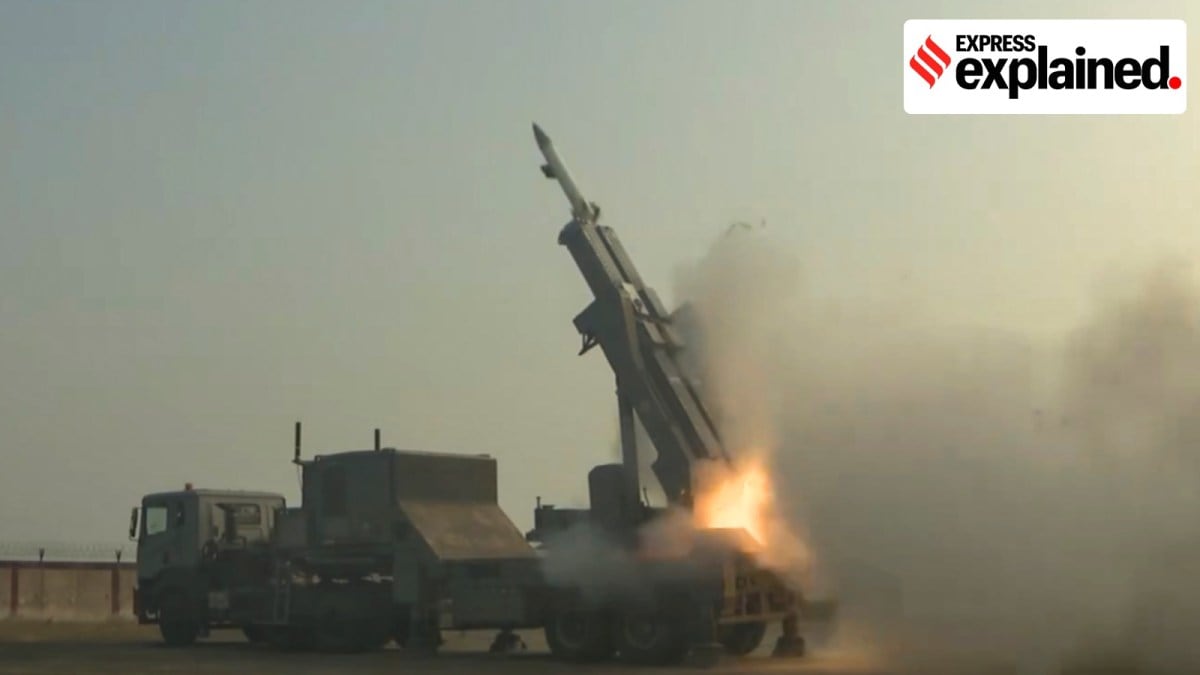
Defence Research and Development Organisation (DRDO) has successfully completed the user evaluation trials (UET) of Akash-New Generation, also called Akash-NG, missile system, paving the way for its induction into the Indian Air Force (IAF).
Here is a look at the features of Akash-NG and its developmental journey.
The development of the Akash missile system
The development of the Akash, a short to medium range surface-to-air missile, was started by DRDO in the late 1980s as part of the Integrated Guided Missile Development Programme led by Dr APJ Abdul Kalam. Following the developmental trials in the 1990s and early 2000s, extensive user trials were conducted by the IAF and the Indian Army.

Named after the Sanskrit word for sky, Akash symbolises the deterrence in the air. It is primarily designed to provide air defence cover to the vulnerable areas and critical installations. The Akash weapon system can simultaneously engage multiple targets in group mode or in autonomous mode. It features built-in electronic counter-counter measures (ECCM), which means it has onboard mechanisms that can counter electronic systems that deceive detection systems.
Akash was inducted into the IAF in 2014, and into the Indian Army the next year. Both the IAF and the Army currently operate multiple squadrons and groups of missiles, respectively. The DRDO has said the Akash missile has 96% indigenous components.
In December 2020, the Cabinet approved the Akash missile for exports after many friendly foreign countries showed interest in it during various international exhibitions. The export version of Akash will be different from those in service with the Indian Armed Forces.
The initial version of the Akash has an operational range of 27 to 30 kilometres and a flight altitude of around 18 kilometres. The Akash-NG system has been developed with better deployability compared to other similar systems with a canisterised launcher and a much smaller ground system footprint. The beginning of the development of Akash-NG coincides with the time when the earlier version was being inducted in the IAF and the Indian Army in the mid-2010s.
Akash-NG is primarily designed for the IAF with an aim of intercepting high manoeuvring aerial threats that have low radar cross section (RCS), which is the electromagnetic signature of an airborne object. Besides improved effectiveness against low electromagnetic signature threats, the NG version features a range of up to 70 kilometres, a sleeker and lighter profile, and a much smaller ground system footprint. Akash-NG contains an indigenously developed radio frequency seeker, launcher, multi-function radar, and command, control and communication system.
Being canisterised, the Akash-NG missiles are stored and operated from specially designed sealed containers. The controlled internal environment of the canister not only simplifies transportation and storage but also significantly enhances the missile’s shelf life and operational readiness.
The DRDO has also developed another version of Akash, Akash Prime, which has the same range as that of the earlier version but has a crucial new addition of an indigenous active Radio Frequency (RF) seeker for improved accuracy to hit the aerial targets.
The user evaluation trials & their significance
The maiden test of the Akash-NG missile was conducted on January 25, 2021, from the Integrated Test Range off the coast of Odisha. On January 12, 2024, a successful flight test was conducted against a high-speed unmanned aerial target at very low altitude, paving the way for its user trials.
User evaluation trials of the Akash-NG missile on Tuesday (December 23) successfully met provisional staff qualitative requirements (PSQR). During the trials, the missiles successfully intercepted aerial targets at different ranges and altitudes, including the near-boundary-low-altitude and long-range, high altitude scenarios. Akash-NG, equipped with an indigenous RF seeker and propelled by a solid rocket motor, successfully neutralised different types of aerial threats
All the systems and subsystems, including the multi-function radar (MFR), command and control unit, missile launch vehicle (MLV), etc., have been designed by various laboratories of DRDO with the help of Indian industries. The trials were witnessed by senior scientists of DRDO and user representatives from the IAF.
The development cycle of systems from DRDO broadly consists of three phases: developmental trials, user-assisted trials in various conditions, and user evaluation trials (UETs). The successful UET clears the way for the induction of the system, and an acceptance of necessity (AoN) is issued by the user, which, in Akash-NG’s case, is the IAF.


