


Click here to follow Screen Digital on YouTube and stay updated with the latest from the world of cinema.
© IE Online Media Services Pvt Ltd
Tags:


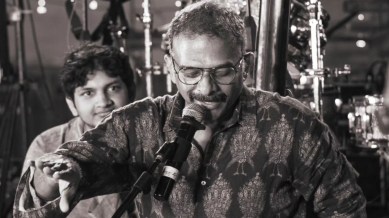

The Madras Music Academy conferring its prestigious title “Sangita Kalanidhi” for 2024 has polarised both the senior artistes and the audiences like never before. The Academy, considered to be the aspirational Sanctum Sanctorum of every practicing Carnatic musician, not just in Tamil Nadu where it’s practiced the most, but also elsewhere in India and even abroad, has come in for unprecedented attack from both the musicians and the audiences. The reason is simple: Krishna, a black sheep, has tarnished the ‘community’ that sustains Carnatic music, its traditional practitioners, and the entire ecosystem, and by honouring him, he is being rewarded for dishonoring the Carnatic community.
A few of the star musicians and discourse-orators (part of the unique Carnatic compact of music and religious bhakti; they don’t sing, but give religious discourses) have already withdrawn from the coveted annual festival of the Academy while a former Sangita Kalanidhi awardee, Chitraveena Ravikiran has decided to return his title in protest. Although the Carnatic music ecosystem is extremely small – probably the smallest for any genre of music in the world – on social media, its polarised factions are fighting a pitched battle. There’s a lot of invectives, language in bad taste, hatred, and even rancour that are not consistent with any sophisticated art form.


Their most common accusation is that the Academy bigwigs have fallen for Krishna’s “anti-Brahmin” (Krishna himself is a Brahmin) ideology for political reasons. Although many haven’t noticed, coincidentally, the highest title of the Academy for a dancer for 2024 went to a Kerala-based dancer considered to be close to the CPM.
Although ideologically and politically Krishna has been a bundle of contradictions with an acquired penchant for polemic, he is one of the finest Carnatic musicians. Highly skilled and systematically trained by the doyens of Carnatic music including Semmangudi Srinivasa Iyer, his artistic insights and abilities are nothing short of remarkable. And he has a huge pan-Indian following too. He’s as much at ease in a makeshift stage in a Kerala temple as he’s in a Dolby Atmos theatre in New York and he has been a mentor to a large number of the current crop of A-list musicians who swear by the musical prowess, generosity and camaraderie of their “Krishna Anna”.
Although a lot of his polemical rhetoric is largely political posturing that leads to nowhere, it’s hard to accuse him of insincerity in his purpose and deeds. The nature of the Carnatic ecosystem is such that it’s hard to be both an insider iconoclast and a performer. You can criticise Thyagaraja, but you can’t practice Carnatic music without singing him; you can criticise faith-based religiosity, but the music you sing is replete with it. This inherent contradiction makes Carnatic enthusiasts uneasy, but in the urban talk shops and left conclaves, it wins him tremendous popularity.
Krishna wants Carnatic music to be inclusive (and not Brahminical as many critics would accuse it to be), more easily accessible, and unbundled from religiosity and right-wing politics. These are certainly fair and honourable objectives, but probably the moral superiority he assumes puts off a lot of people. Many top-ranking Carnatic musicians now espouse more contemporary and cosmopolitan values and are even daring in their innovation but with less noise and posturing. They may not be as popular as Krishna in the socio-political circles.
The present controversy exposes the gnawing or rather abhorrent conservatism of the Carnatic music enthusiasts rather than the musicians themselves. In fact, they seem to be leading the polarisation drive. Recently when a superstar musician decided to foray into more universal forms of music after being steadfastly Carnatic for decades, there was an equally visceral pushback.
Krishna’s award is therefore a shock treatment. A strong message from the pulpit itself–that art and conservatism contradict each other, that blind faith-based conservatism limits the pursuit of excellence. Whether his pursuit of democratising Carnatic music and liberating it from its habitual conservatism has been successful or not, Krishna has certainly won a personal battle. Will it have a wider impact and spread beyond his personality cult? Hard to tell because artistic excellence, that too in a complex musical form, rests on too many human and systemic endeavours.


Click here to follow Screen Digital on YouTube and stay updated with the latest from the world of cinema.


