

 16 min read
Click here to follow Screen Digital on YouTube and stay updated with the latest from the world of cinema.
Premium
This is an archive article published on June 6, 2014
“Arthouse Cinema is Dead” – Hansal Mehta
Film-makers Mahesh Bhatt and Hansal Mehta, co-conspirators behind Citylights, unravel the creative mysteries and connect the dots of their chequered cinematic journeys. Screen brings you the storytellers’ version of how they lost and found their mojo



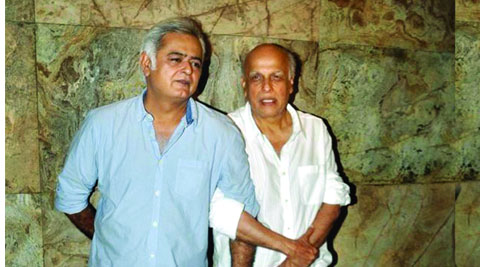 Hansal Mehta and Mahesh Bhatt
It’s interesting that both of you have starddled both mainstream and disruptive cinema with various turning points; how would you describe that journey?
Mahesh Bhatt: My life is nothing but turning points. In fact, I began my career when I was in my twenties, with what is called subversive cinema. My first film Manzilein Aur Bhi Hain spoke about an amoral relationship of two convicts and a prostitute on the run. It was banned by the Censor Board as the film undermined the institution of marriage. After that, I made three films for the mainstream. My personal life was traumatised by my extra-marital affair and the subsequent mental collapse of Parveen Babi that became the life-blood of Arth. So in my thirties, after my disastrous 10 years, when I was written off, my obituary was penned and people dismissed me as a hopeful who was nipped in the bud. I rewrote my narrative with Arth and the climb began.
I was reinventing myself in every decade. I was a film-maker who was comfortable making products according to market specifications. But, there were also some films that were burning in my heart to find expression. The nineties saw more successful days when I made Aashiqui, Sadak, Dil Hai Ki Manta Nahin, Hum Hain Raahi Pyaar Ke—I had almost four or five golden jubilees over time, but my desire to make movies withered…and then it became my wasteland. I was like a leaf blown in the wind until I resolved to give up film-making as a director. I said, “Now let me make my last defining film.” By then the politics of the country had changed. I had seen the carnage and the demolition of the Babri Masjid and my identity, my mixed heritage, Hindu father and Muslim mother, my illegitimacy—these were all things waiting to be expressed. And my identity which is the narrative of India, (is still playing out) found expression in ’98 when I made Zakhm. With this film, I found I could once again stir people emotionally. Although the film won a National Award, it did not run at the box-office. Ajay (Devgn) received an award. I was 50 then when I hung my gloves. I realised that India had changed, there was a new liberal India.
I made a conscious, clear and unapologetic departure, and I said I am going to make films without stars and those that cater to the senses, gratification of the body. With Murder, Jism and all those kind of films that became successful, we established our brand name. At the peak of success, with all those films, we made Aashiqui 2 which was to test the ground again; whether the emotional quotient is still alive in the brain dead young, and I found that it was very much alive. It was the biggest hit of our career—its return on equity was most stunning. And then came Hansal’s Citylights which was a turn back to the shore I swam away from in 1998. So this is a defining film of my journey. It came ironically, in the 30th year of Saaransh (May 23), so in a way, I am passing on the torch. It is that kind of cinema which is left-of-centre, the alternate voice not conforming to the assembly-line. CityLights has made me so proud, and once again I find myself completely alone in my own establishment. I find that it’s only me who roots for this kind of a film. Luckily, since I have been successful so, I have the elbow room where monies are given to me to make this kind of film. I find that we are the only ones working on this kind of cinema, that is not sourced from the debris of Cannes, Berlin and multiple film festivals, but something that has grown from down up. Citylights is a watershed in my cinematic journey and I am very happy and proud of fathering it. I have this gut feeling that it will work in a very elementary way, and will resonate years after the way Saaransh did. I keep reiterating that there are two kinds of cinema—one that is to astound us and the other to jolt and comfort us. Citylights jolts the comfortable and Mr X comforts the jolted, and that’s been my journey too.
Hansal Mehta: I started with what was called off-beat at that time and surprisingly, it was inspired by Saaransh. I had seen Saaransh as a kid and the film had left an impact on me. I used to cry frequently at home so my parents took me to watch this film. They said, ‘it’s going to be a depressing film, but now you cry at the theater instead of crying at home’! (Laughs) I still remember scenes from the film, especially the one wherein news of the son’s death reaches the elderly couple— that visual has never left me. Even now, I get up in the morning to check if my son is at home. I started with a film called Jayate, but it never found a theatrical release. It was about a lawyer in his 50s who led a meaningless life. He had never seen the inside of a court. He earned money only to buy Old Monk and Will’s Navy Cut. He didn’t have a family, so he found meaning to his life through somebody else’s child. And then I made Dil Pe Mat Le Yaar which tried to be mainstream, but was middle-of the road movie. It did not work, and I started feeling dejected with the kind of films I was making.
After that, I made another small budget, stylish thriller called Chal which was similar to what Vishesh Films is doing now. The film worked with a section of the industry and I started getting a lot of work. I made a sex comedy. I don’t know what people saw in me, but they approached me for sex comedies. I made a lot of indifferent films and that journey was a downward spiral. At one point, my senses had numbed my brain. I did not have any guilt or any feelings. I just kept making those films, but luckily none of those films worked. The wake up call came when I made Woodstock Villa, that launched Sikandar. It was the last film I made before Shahid. After the film got over, Anupam Kher came out and he did a thumbs-up to me and said, “This is a blockbuster.” It was a moment of reckoning—I didn’t know who was lying to whom. It was time to introspect, so I just left the city. I thought the best thing to do at a time like this was to quit. I knew that it was also the end of the road for me. So, it was from the end of the road that I started rediscovering life. I went to a village called Mallavali (near Lonavala) famous for artist Raja Ravi Varma’s printing press, and I stayed there for nearly three years. I was working there, doing small things like teaching at local schools, growing vegetables in the garden— basically, I had nothing to do with films. And I thought this kind of life was good. Until the story of the slain human activist lawyer Shahid Azmi stared at me from the papers and that sort of revived my conscience as a film-maker. I went back to what Bhatt sa’ab calls the left-of-centre leanings.
In the present scenario, is the art of cinema adequately supported by its commerce?
MB: The law of the mass media is that it has to appeal to maximum number of people; that is the prerequisite, the paradigm we operate in. The state government funded parallel cinema movement was still-born because its source of revenue was not the box-office, but the taxpayer’s money and irrespective of its performance such films were funded. That cinema did not have its feet on the ground, because it was not rooted in reality. It was just a club of 50 people who raved about it. Even Doordarshan refused to air those films because the consumers put off the TV when such films were shown.
The movement of middle-of-the-road cinema was within the parameters of the mainstream where the industry, distributors and financiers started investing in that kind of cinema. That’s when the change began. In the fifties, there was a stream represented by greats like Bimal Roy, Guru Dutt which had a left-of-centre kind of sensibility. It died out over time, but there is no denying that people like Basu Chatterjee, even Hrishida, contributed to it. Films like Arth and a Saaransh created a space for movies like these. But getting money for such films was always difficult. For instance, my brother, (Mukesh Bhatt) is completely opposed to such films. He doesn’t have a stomach for this kind of cinema at all, unless he sees something lucrative in it. It is difficult to make these kind of films because to protect your vision from the collective conformist mindset around you can be very frustrating. The so-called English speaking corporate honchos whom you thought would be an enlightened lot, are speaking the same language that the conformists in our business spoke earlier.
In such a time, a film like Shahid, and the initiative by Hansal to make it, deserves salutation. I get up and offer a salaam. But we must also applaud Fox Studios for giving us this space. There is no denying that the CEO of Star Fox Studio, Vijay Singh, responded to my angst without pre-conditions. Fortunately unlike the UPA, we had made an Aashiqui 2 recently and therefore got a lease of life.
In ’98, I had made Zakhm when the NDA was in power in Delhi and Shiv Sena over here, and I managed to pass their gates. And that is what subversion is, so if cinema doesn’t subvert revolt, dare to walk away from the tried and tested, then it has got no vitality. It lacks the spark which I thought Hansal showed in Shahid.
He may not be a part of Vishesh Films, but he is an extension of that left-of-centre ideology. It’s so ironic that none of my own immediate ones were shaped by me or have this kind of bone in them. There is a great line by Neruda— ‘To be is to inherit’. Karl Marx was an individual who inherited the traits of Jesus Christ of sharing of the bread. What I did in Saaransh or Arth was not something that made me unique in my thought or structure. But it was like a kind of ‘cinema of rage’ that my predecessors had touched upon. So I would say that this is very sentimental. Citylights has been funded by a corporate house; the producers are Vishesh Films which has a glorious record of unapologetic mainline cinema that caters to the senses. In that mix you have a Hansal Mehta who caters to the independent minded. Even with me around, it can get a little cold out there, so retaining the purity of his vision at every stage has been one hell of a battle.
Has the mindset within the film industry been adequately subverted?
HM: If you want your voice to be heard and there is a crowd of conformists, you have to subvert by talking their language and doing their thing. I have found a way of doing it. So you will deliver a film that on paper, looks like it conforms. The system does not really change even though we believe that it does. But at every stage some subversive mind comes in —Bhattji made Saraansh for Rajshri Productions which had a history of making traditional family cinema.
Story continues below this ad
MB: Only an independent mind can produce independent cinema. Saaransh was the most pathbreaking film because the patriarch of the Rajshri family was a key trustee of the Aurobindo Ashram which perpetuated the Hindu belief in reincarnation and Saaransh assaulted the whole idea of reincarnation. Now, to be able to go into their citadel, use their money and make a film that is completely different was an achievement. Similarly, for Hansal to be able to make Citylights, with Vishesh Films is a major thing.
As film-makers is the choice of not working with stars an effort to subvert and convert?
HM: I have never worked with stars, no star ever wanted to work with me. I worked with Mithun Chakraborthy—he is the biggest star I have worked with.
MB: An independent mind says, “I will get up and walk on my own feet. I don’t need crutches.” One of the manifestations of that mind is that his cinema will not have the cinematic trappings that a normal film-maker would like. What good is the art of saying things with a person who has nothing to say?
Story continues below this ad
HM: I work with actors who are ready to surrender completely to my vision. Stars would have been miscast in Citylights.
Also, you have to create your own guerrilla team. Working with an independent mind within a conformist industry, what do I tell the producer? My belief is that budgets fail, films don’t. Nobody can assure you of maximum profits. But if I make a film in a budget that minimises risks, it works well. The cost of Citylights is just a few crores and with Vishesh there is the safety net of satellite and music, so it’s also important to know the market and then subvert ideas.
To what degree has our changing worldview impacted Indian cinema?
MB: I think it is a global space that all of us are living in. That’s something that happened thanks to the digital age and today you can wake up to read New York Times while living in Mumbai. There is no denying that a new worldview has shaped this consumer of ours. Yet there is an Indianness which is essential for our films to work here. What worked for Aashiqui2 was not so much ‘A Star is Born’, but the Indianness of the character of that girl—the fact that she remains a wife— though they are not married, and her refusal to leave her self-destructive lover. Cinema cannot merely cater to a multiplex audience and forget the underprivileged co-traveller. In this quest for perpetual pleasure, our cinema will be one that has no depth. It’s contradictory because escapist fare does work but to remain rooted in the world you live and dream in, that’s what cinema is really about. Cinema is a by-product of a free mind. If you are watched like a hawk, your country will have all the razzle-dazzle, but won’t have the irreverence that shakes the establishment.
The material that Citylights offers is pliant enough for a full-blown thriller too, but you didn’t go down that path…
Story continues below this ad
MB: We are all pleasure seekers. I have no delusions that the quest for pleasure is never going to come to an end. But within the parameters, sometimes someone slips in his unique world and that’s what Hansal has done.
HM: In Citylights, it was the emotional journey which was central within the same. When Bhatt sa’ab saw the first cut, he said, “I want to see the wife and the child again. You really long for them.” The thriller element shows the darker side of the city. But, delving on that meant two films.
Cinematic evolution suggests that mainstream and arthouse films have both considerably influenced the ‘other’. Would you agree?
HM: I feel arthouse cinema of the ’80s is dead. All of us want our films to be consumed somewhere. For me, arthouse cinema is something we borrowed from the west . I believe everything what we are making is art house. Murder is arthouse too. Everybody wants their films to be consumed now. For instance, The Lunchbox is an independent minded film that has taken the Hrishikesh Mukherjee paradigm, packaged it in today’s language. And it has grossed Rs.100 crore!
Story continues below this ad
MB: Murder is part of the subversion from the very same mind that created Saaransh.
But surely good arthouse films in the past worked too—Ardh Satya to name one such example..
HM: Ardh Satya worked, but there were 20 Ardh Satyas after that. It became formulaic.
Is irreverence essential for creativity?
MB: Irreverence is creativity and vice-versa. Life doesn’t support homogeneity. No two snowflakes are the same. No two twins are the same. There is nothing called duplication. There is no common mould from which life creates. Never was there a person like you, never will there be another like you, but this mould called culture, creates assembly-line. You want a Gandhi, you want a Sartre, but creativity is to break away from them. So creativity has to reject, to dethrone.
If I had not set fire to myself and penned my own obituary in 1998, it wouldn’t have given people around, the space or force to look for a new kind of rhythm.
priyanka.sinha@expressindia.com
Advertisement


More Entertainment




Advertisement
PHOTOS

PHOTOS





Top Stories









Must Read







Advertisement
- 01
- 02
- 03
- 04
- 05
Advertisement
