

 6 min read
Click here to follow Screen Digital on YouTube and stay updated with the latest from the world of cinema.
Premium
This is an archive article published on February 10, 2017
When I joined films, it was the worst time to be a heroine, says Tisca Chopra
Actor-producer Tisca Chopra’s long dance with failure, sexism and success in Bollywood takes a fresh turn — with an award for her short film, Chutney.



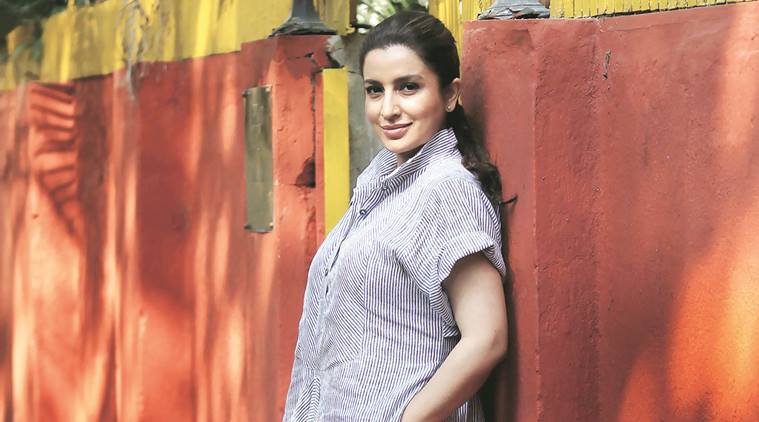 Actor Tisca Chopra
When Tisca Chopra arrives at Prithvi Theatre, Juhu, for our interview, she is a far cry from the plain wife from Ghaziabad she plays in Chutney, her award-winning short film. Shot in Delhi, Chutney is a glimpse into the life of a housewife whose husband’s roving eye (Adil Hussain) has settled on a nubile woman (Rasika Duggal). She invites the younger rival home for pakodas and cola, and spins a macabre tale that unnerves Duggal’s character. Chopra, 43, is at the prime of her life and career, and she has only just begun. Excerpts from a conversation:
Your short film, Chutney, won the Filmfare award recently. How did the film come about?
The story came to me right here at Prithvi Cafe about 16 years ago, when I was a rookie actor. We used to be allowed to perform at the Platform, and not inside the main auditorium. It was initially a monologue and the protagonist was 60 years old, although I was 21 at the time. Our film is based on a short story by Bhisham Sahni, but we’ve darkened it and condensed it. I wrote Chutney with director Jyoti Kapur Das in my living room. One day, Imtiaz Ali, who is a dear friend, told me to make a short film and I said, ‘Okay, I’m going to do this’. My husband, Sanjay, encouraged me to produce the film. The kind of roles one wants to do aren’t being written; the stories one wants to tell are few and far between; and the ones that come to me, I do them. Maybe I’m late, but I didn’t have the courage to write and produce before.
More from the world of Entertainment:
You underwent a slight but very effective transformation for this role. The teeth, the sallow skin — how did you decide on the look?
We live in a society where everybody is trying to ‘pop.’ Everybody is adding different embellishments to their bodies, so that they are less ordinary. I wondered, ‘What if somebody is truly ordinary?’ Not just in the way they look, with bad teeth, but also in their diction, below-average education, their professional capacity — and yet have an extraordinary tale. I don’t believe a cheating husband diminishes a woman’s worth, but in the world she lives in, it does. She’s childless, so that source of power is also gone. She’s accepted her low self-worth, and that makes her a very dangerous person.
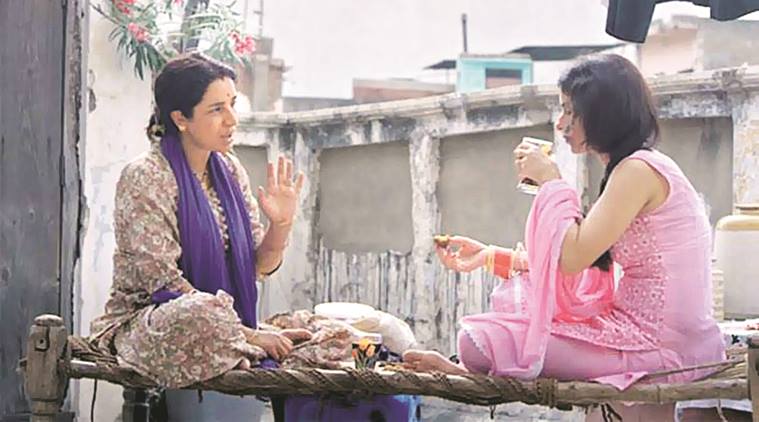 Talking about her character Tisca Chopra says, “I wondered, ‘What if somebody is truly ordinary?’ Not just in the way they look, with bad teeth, but also in their diction, below-average education, their professional capacity — and yet have an extraordinary tale.”
When you made your debut with Platform (1993), you were a rank outsider. What made you join Bollywood?
I was 14 when I first mentioned that I wanted to be actor and my father said, ‘Why do you want to do something so silly?’ I thought you could do so much with acting. I was in the final year of my English Literature degree at Hindu College, Delhi University, when I came to Mumbai. I liked the city and the sense of freedom — here, I wasn’t a principal’s daughter anymore. It was the worst time to be a heroine in Hindi films. I walked into a cliche. I auditioned and bagged the role. During the narration, it was all about the hero jumping, the hero’s dialogues. When I asked about my dialogues, they said, ‘Madam, you have four songs.’ I think I also got to shout ‘Raju, Raju’ at some point. I signed a spate of films but they were all disasters. I had a complete rethink after that — I had succeeded and failed and I thought I’d made a mistake.
What happened next?
Story continues below this ad
I started doing theatre with Satyadev Dubey at Prithvi and I had to start from scratch. I had fallen in love with the craft of acting by then. I did some plays that were well received, a little television, and it opened the door to Taare Zameen Par (2007). I actually didn’t go for the audition because I thought it was better to say that you were offered an Aamir Khan film but you didn’t do it — in case I didn’t get the role. But they called again and I went. I worked very hard at the audition.
Last year, in a storytelling session that went viral, you recounted your brush with the casting couch. This is also an integral part of your 2014 book, Acting Smart. What compelled you to write the book?
One of my friends, who is an aspiring actor, was asked to pay Rs 1 lakh to be cast in a film that I was supposedly doing — except that I wasn’t. Then I started talking to people and found out that a lot of bad information was out there. Another friend was taken location hunting by the director who wanted the script to ‘penetrate her skin’. Acting Smart is a handbook to help one navigate through the industry. I’ve spoken to filmmakers such as Imtiaz Ali and Raju Hirani, Boman Irani and other actors, as well as designers such as Manish Malhotra and Wendell Rodricks.
What would you say has been the toughest aspect of working in an industry that is so inherently sexist and even misogynistic?
Story continues below this ad
I’d like to be very candid now. There’s jack all one can really do about it, so I don’t even think about it. If you find what you really like to do, it has its own energy and will find its way to you.
What are you working on now?
I’ve finished shooting for Bornila Chatterjee’s The Hungry with Naseeruddin Shah and Neeraj Kabi. It’s a cinematic adaptation of William Shakespeare’s Titus Andronicus and is the toughest shoot I have ever done.
Advertisement


More Entertainment




Advertisement
PHOTOS

PHOTOS





Top Stories








Must Read







Advertisement
- 01
- 02
- 03
- 04
- 05
Advertisement
