4 min read


Click here to follow Screen Digital on YouTube and stay updated with the latest from the world of cinema.
© IE Online Media Services Pvt Ltd



 As Bobby Deol's Soldier turn 25, we draw parallels between this film and Shah Rukh Khan's Jawan.
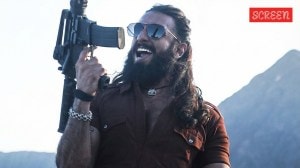
 I was looking for a subtle way to say this, but since the recent action thrillers in the Hindi cinema have been anything but subtle, I will put it plainly: Jawan gave me a headache. Too harsh? Hear me out. Jawan paraded a familiar narrative: a villain named Kalee (Vijay Sethupathi), a global arms dealer, a son (Azad, played by Shah Rukh Khan) seeking retribution for his supposedly deceased father (Vikram Rathore, also portrayed by SRK), unjustly branded a traitor to the nation. Meanwhile, the son’s grieving mother (Deepika Padukone) faces society’s harsh judgment. This film was a concoction of patriotism and on-the-nose messaging, essentially wrapping an outdated ’90s storyline in the sheen of modernity —high-tech slow-motion shots, sleek cinematography, and sophisticated graphics — served up for the 2023 audience.
Don’t believe me? I recently got a chance to watch Bobby Deol’s Soldier, the 1998 action thriller, that reminded me a lot of Shah Rukh Khan’s Jawan. Celebrating its 25th anniversary this week, Soldier features Bobby Deol as Vicky, the son of a deceased Army officer, embarking on a vendetta to avenge his father, falsely accused of treachery. His ostracised mother seeks solace in a temple, shunned by society. The film’s antagonists are responsible for slandering Vicky’s father, in the same way that Kalee besmirched Azad’s father, Vikram Rathore, in Jawan.
To be fair, the parallels between Jawan and Soldier aren’t that absolute. In Soldier, female characters served as mere footnotes, offering romantic interludes amidst the intense and frantic plot. Preity Zinta’s character, Vicky’s love interest, gained prominence primarily through the romantic song sequences and was used as a mere conjunction in Vicky’s story. In contrast, Jawan is obviously a superior film. The dialogues are nuanced, the filmmaking is sleek, the acting is subtle, it addresses many current societal problems and it places its women at the forefront. Even Deepika Padukone’s extended cameo in Jawan boasted a more substantial character arc than Preity in Soldier.
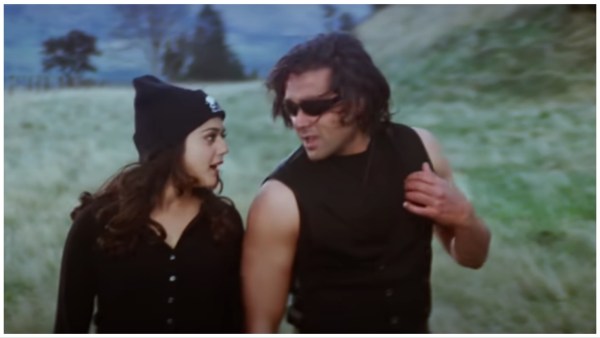 Preity Zinta and Bobby Deol in a still from Soldier.
Soldier’s archaic dialogue induces unintended laughter rather than tension. Lines were not spoken but proclaimed, leaving no room for subtlety or imagination. Dialogues like, “Main contract sirf khoon karne ka leta hoon … mohabbat ke khel khelne ka nahi (I only take contract to kill people, not to play the game of love),” “Joh desh ke liye jaan dete hai woh shaheed kehlate hai … joh desh ke liye jaan lete hai woh kaatil nahi … soldier kehlate hai (Those who lay their lives for a nation are called martyr, those who take life for a nation are called soldier),” made you chuckle in relatively serious scenes.
Even with this clunky treatment of the story, Soldier could be remade in 2023. Which begs the question: Is Hindi cinema truly progressing or inadvertently circling back to familiar tropes? If Tara Singh can go back to Pakistan in Gadar 2 and trash their army single-handedly to rescue his son — mirroring his heroic feats from the original 2001 film Gadar: Ek Prem Katha for his wife Sakena — and mint crores in 2023, why can’t Bobby return as Soldier? If refurbishing age-old tales continues to guarantee box office numbers then Soldier 2.0 might not be a bad idea.
It is bad news for the audience though. Amidst the cacophony of average action films, box office numbers set benchmarks for filmmakers. In the post-pandemic era, with OTT platforms as viable options, filmmakers might lean toward formulaic films for guaranteed ticket sales. Though drawing inspiration from the past can at times generate nuanced films and shows like Qala, Guns and Gulaabs, Monica O My Darling and Jubilee, it shouldn’t be done in a boring and a repetitive way.
Click here to follow Screen Digital on YouTube and stay updated with the latest from the world of cinema.