2 min read
© IE Online Media Services Pvt Ltd



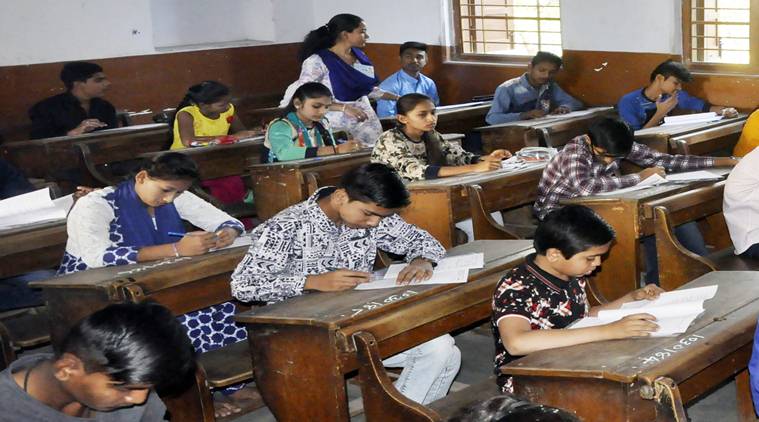 UGC recommends changes in question paper setting, evaluation and assessment. (Representational Image)
Calling the standard academic system ‘flawed’, a report by committee set-up by the Univerity Grants Commission (UGC) has made suggestions to change the way Indian higher education institutes (HEIs) assess students. Among major recommendations were setting up of a question bank, changing the academic system and a national bank for question paper setting.
The committee headed by the vice-chancellor, Bharati Vidyapeeth, Pune MM Salunkhe recommended using different models to assess students at various levels of education. Implying, separate assessment model for undergraduate, graduate and PhD courses as “no size fits all”. Some of the assessment models suggested by the committee were
Not only evaluation but the committee also suggested changes in the way HEIs set question papers. It said, guidelines are necessary for proper question paper setting as well as learning outcome-based education. Questions papers, it said, should be made from a set of question bank that carries all type of questions — difficult, easy etc. The ratio of how many questions should be from which level of difficulty should be pre-decided.
While the paper should be objective-type, it also suggested to audit question papers on a regular interval. Setting up a board which can conduct exams on-demand where students from any age, minimum eligibility, et al.
The committee has called the Indian assessment system ‘flawed’ stating that the “exams are (reduced to a) moment of anxiety”. It has recommended ‘Interpretive Structural model (ISM)’ for assessment. This mode, claims the report, identifies 93 elements.
The committee suggested holding two-level of exams — internal and external. The internal exams should be conducted in a stress-free manner. Additionally, ability test for on-spot assessment was also recommended.
The committee has also suggested many changes in the academic system as well including familiarise students with multiple languages including another Indian language such as Telugu, Tamil, Oriya, Bengali or even foreign languages such as Russian, French etc.
It also suggested introducing subjects with 50 per cent weightage and elective subjects. Provision of lateral entry to allow movement from one level of education to another for better-qualified students.