8 min read


© IE Online Media Services Pvt Ltd



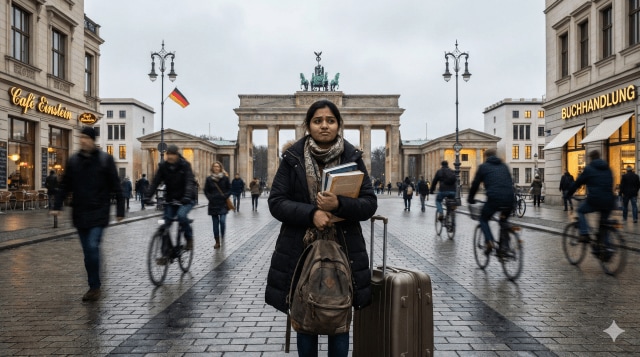 Those who do not learn the language often find it difficult to integrate socially and emotionally, once they are in the country (Representative image/AI Generated)
Government data and multiple surveys highlight that Germany has rapidly emerged as a major destination for Indian students and professionals, especially as traditional countries like the US, UK, Australia, and Canada tighten immigration norms. According to DAAD (a German academic exchange programme), the number of Indian students in Germany has doubled from 28,905 in 2020 to 59,419 at present.
Study abroad consultant companies also shared that they have seen a spike in interest from aspirants. ApplyBoard’s internal survey echoes the trend — 75 per cent of students surveyed expressed interest in Germany, and 77 per cent of counsellors said it remains one of the most affordable major study-abroad options.
Experts say the enthusiasm is driven by Germany’s reputation for quality education, tuition-free or low-cost public universities, and strong post-study opportunities. A recent DAAD survey highlights how nearly two-thirds of international students want to remain and work in the country after graduation. Germany also boasts one of the highest long-term retention rates globally, with 45 per cent of foreign students still living there a decade after they first enrolled, according to a study by the Organisation for Economic Co-operation and Development (OECD).
However, the question remains: Are students arriving with a full understanding of the country’s challenges? Consultants report rising interest, but those living in Germany describe a tougher reality — one shaped by language barriers, scarce accommodation, and slow bureaucracy.
Germany is currently facing a shortage of over 2 lakh jobs, with particularly high demand in six sectors, according to Deutschland.de, a portal operated on behalf of the Federal Foreign Office. These include engineering, IT, especially roles in cybersecurity, software development, data analytics, and network administration. In the healthcare sector, there are 35,000 open nursing positions, driven by Germany’s ageing population.
Read | 97% of Indian students want education leading directly to jobs: Study
As per study abroad consultant companies, the country also offers strong job opportunities, with nearly a million vacancies across sectors due to its ageing population. “Average annual salaries for skilled professionals stand around Rs 50 to 52 lakh, depending on qualifications and experience,” said Mahapavit Singh Anand, founder of GostudyFree.
Yet, students say landing part-time jobs, internships or full-time roles is far from guaranteed. “It’s not easy to find a job or internship. Be prepared to apply to 500 companies and get only a handful of calls,” said Prajwal Bekal, 25, who is studying at the Cham campus of the Deggendorf Institute. He said the system of applying is slower than in India, and one has to be patient to receive a call.
Another student living in Munich claims the most openings are in healthcare rather than STEM fields that most Indians aim for. As a result, students often fail to secure full-time jobs even after extended job-seeking visas, leading some to return home in debt. “Part-time jobs — which students rely on for living expenses — are also scarce due to competition from other international students and asylum seekers. Financial pressures and difficult courses force many to drop out or return to India,” he said, adding that a few of his friends were given false hope by education consultants about the job situation, and many are now struggling to survive.
Also read | NEET UG 2026: Can Germany attract more Indian medical aspirants? Know more about visa policy, courses
David Kipp, an associate at Stiftung Wissenschaft und Politik (SWP), the German Institute for International and Security Affairs, in his research paper on the migration policy, cautioned against the misuse of the country’s immigration policies. He pointed out that some private universities and recruitment agencies exploit loopholes. They sell seats to Indian students for high fees, offering programmes of questionable quality that often go unrecognised by German authorities, leaving graduates with poor employment prospects. If unchecked, such practices could undermine the credibility of the entire migration corridor, he noted — similar to what occurred in Canada.
Housing remains one of the biggest pain points. Berlin, Munich, Hamburg and Stuttgart are extremely competitive, with high rents and limited supply. Paras Verma, 27, currently working as a Production Manager in Hamburg, said finding accommodation was “extremely difficult” and the biggest contributor to living expenses.
“Finding housing was extremely difficult, especially in major student cities like Berlin, and even Hamburg is the same, if not worse. It was a significant source of stress. Rent is high, and the demand far outweighs the supply. While food and public transport costs are manageable compared to other major European cities, rent makes up the largest portion of the living expenses, making the overall cost of living quite high despite the lack of tuition fees,” he said.
This crunch is not limited to big cities. In smaller towns like Cham in Bavaria, students face limited transport connectivity and fewer housing options. “Housing is very difficult in interior Germany,” said Bekal. “Transport is not great, and you will have to cook your own meals. Be prepared to manage independently.”
Rising housing costs are part of a broader national trend, as noted in a London School of Economics (LSE) blog. The rent in Germany has jumped nearly 70 per cent and property prices have doubled in just 15 years.
Kipp’s research paper also factored in this issue. “The growing number of Indian students is having a direct impact on the German labour market, as many have part-time jobs in the gig economy and logistics. Many Indian students have to generate an income while studying – mainly through temporary jobs in services such as food delivery – in order to pay off the debts they incurred when migrating to Germany. At the same time, they face high rents and precarious living conditions and have to do everything in their power to protect their residence status.”
ApplyBoard advises students to secure admission early, start the housing search months before arrival, consider areas outside city centres and keep documents ready for fast application turnarounds.
While many private institutions teach in English, daily life in Germany is strongly tied to German. From renting a house to opening a bank account, visiting a doctor or applying for jobs, knowing German significantly improves outcomes. Flavia San Filippo, Director (Germany), ApplyBoard, said: “The language barrier is often cited as a significant concern, but it is important to clarify that students studying at private institutions in Germany do not need to speak German to complete their programmes. However, learning the basics of the language is essential not just for academic integration, but more importantly for navigating everyday life, finding part-time work, and fully integrating into German society.”
Verma agreed that German proficiency often becomes a deciding factor even for English-language roles. “Bureaucracy adds to the challenge — visa extensions, job-seeker visas and communication with the Ausländerbehörde (immigration officer) are known to be slow, paper-heavy and unpredictable. Everything here needs an appointment, and nothing is online,” he said.
Bekal added that local residents, especially living in the small towns of Germany, will be ignorant if you talk to them in English outright. “Even if it is broken German, they appreciate it and try to answer your questions,” he said.
Also read | After sharp slump in 2023-24, IIT placements improve, still below 2021-22 mark
Verma advised students to reach at least B2 level of proficiency in German before arriving in the country. “It opens up doors academically, professionally and socially,” he said.
Those who do not learn the language often find it difficult to integrate socially and emotionally. Even students who appreciate Germany’s stability admit to feeling a lack of deeper connection or belonging due to linguistic and cultural barriers.
San Filippo opines that success depends on the field of study, preparation, and most importantly, willingness to learn the language and understand the system. “The challenge often lies not in the availability of jobs, but in students’ preparedness. Those who invest time in learning German, understanding the formal German hiring process, and actively networking tend to have much better outcomes. We encourage students to start their job search early, leverage university career services, and engage with the iStart programme or similar initiatives that have shown remarkable success in transitioning international students into employment,” she said.