






 NEP 2020 3rd Anniversary: India celebrates third anniversary of the National Education Policy (NEP), 2020.
(Graphic by Angshuman Maity)
NEP 2020 3rd Anniversary: India celebrates third anniversary of the National Education Policy (NEP), 2020.
(Graphic by Angshuman Maity)NEP 2020 Third Anniversary Updates: On the occasion of the third anniversary of the National Education Policy 2020, Prime Minister Narendra Modi today inaugurated ‘Shiksha Mahakumbh’.
The first National Education Policy came into effect in 1968, the second came in 1986 which was revised in 1992. The earlier NEPs came into force during Congress’ rule, this was the first NEP under BJP’s rule.

NEP 2020 introduces many changes multiple entry and exit options for students, Academic Bank of Credit (ABC), a new pedagogical and curricular restructuring of 5+3+3+4, covering ages 3 to 18 years (3 to 8 as foundational stage, 8 to 11 as preparatory stage, 11 to 14 as middle stage and 14 to 18 as secondary stage) among others.
As per NEP 2020, students should be taught in their mother tongue or regional language until Class 5. The government is also encouraging students to take courses in their regional language. The policy proposes that all universities and colleges must aim to become multidisciplinary by 2040, phasing out all institutions offering single streams.
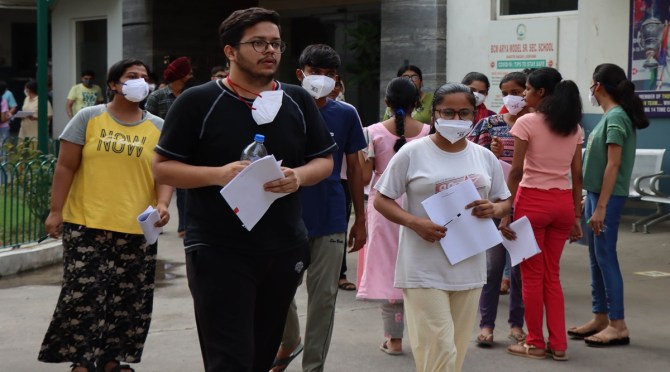 Many educational bodies have implemented the NEP 2020. Express Photo by Gurmeet Singh

With an aim of institutional restructuring and consolidation to make sure quality education is delivered to all, the institute has established multi-disciplinary academic centres and schools such as:
– Centre for Disaster Management and Research
– Centre for Intelligent Cyber Physical Systems
– Centre for Indian Knowledge Systems
– Centre for Sustainable Polymers
– Centre for Drone Technology
– Centre for Sustainable Water Research
– Mehta Family School of Data Science and Artificial Intelligence
– School of Energy Science and Engineering
– School of Agro and Rural Technology
– School of Health Science & Technology
– School of Business
Additionally, a few more programmes were included, such as:
– MTech programme in Biomedical Science and Engineering with Specialization in Medical Devices and Diagnostics
– BTech in Energy Engineering from July 2022 Session
– BTech in Data Science and AI
– MA in Liberal Arts
– Dual Degree [MTech + PhD] Programme in the Department of Computer Science and Engineering for non-CSE background students
– Dual Degree [MS (Engineering) + PhD] Programme in the Department of Electronics and Electrical Engineering
– Inter-Disciplinary MTech Programme in Data Science
– Inter-Disciplinary MS (Research) Programme in E-Mobility
"Glad to see our #AmritPeedhi acting as torchbearers of this pro-planet movement," Pradhan said.
Union Minister of Information & Broadcasting and Youth Affairs and Sports praises NEP 2020 for "connecting sports and physical activities to education that will make our youth fit and energetic and help in their overall development".
"The world is looking at India as a nursery of new possibilities. Many countries are approaching us to open IIT (Indian Institute of Technology) campuses there. Two IIT campuses -- one in Tanzania and one in Abu Dhabi -- are already about to start operations.... Various global universities are also reaching out to us, expressing their interest in setting up campuses in India," Modi said.
Minister of State for Education, Annapurna Devi, praises NEP2020 for connecting local arts and artisans with the education system.
The leadership and continuous guidance of the Prime Minister is giving more momentum to the efforts to re-establish the values ??of Indianness and to connect the education system with the modern ideas of the 21st century. NEP is giving concrete form to the holistic and multidimensional education envisaged by personalities like Mahatma Gandhi, Gurudev Tagore, Swami Vivekananda, Maharishi Arvind. NEP is going to establish India as a leader. The nectar emanating from this Mahakumbh of education will make our nectar generation more capable and efficient," Dharmendra Pradhan said.
BHU has regulated the Academic Bank of Credit system under NEP 2020, and encouraged more students to join the platform. The total registration on ABC Portal for session 2021-22 is 14900 and 15722 for 2022-23, the institute stated. Additionally, the newly admitted students are mandatorily advised to mention ABC at the time of filling out the online enrolment form/ examination’s the university’s portal.
A
lso, while the multi-level entry and exit are already implemented in some of the vocational programmes, the institute is hopeful that it will be able to implement the four year programme from the next academic session i.e. 2024-25.
BHU has launched a new initiative named Trans-disciplinary Research Promotion Scheme which offers several new funding opportunities in line with NEP 2020. The varsity has also initiated nine post graduate and two diploma courses in multidisciplinary subjects namely Artificial Intelligence and Cyber Security, Archival Studies and Management, Oceanography, Structural and Chemical Biology, Industrial Chemistry, Instrumentation Techniques and Application, Agricultural Journalism, Urban & Regional Studies, Gender Studies, Acute Stroke Care and Wild Life & Health Management. The university is also conducting 457 programmes on SWAYAM and NPTEL.
The varsity is also offering more scholarships and better academic timeline for international students and has also signed MoUs with at least 15 international institutions — Tokyo University, Japan, Seoul National University, South Korea, University of Cambridge, United Kingdom, University of Surry, United Kingdom, University of Bucharest, Romania, University of Kyoto, Japan, Karlstad University, Sweden, Georgia University, United States and others.
PM Modi released the first instalment of funds under the PM SHRI Scheme.
"There is a hidden message in this journey of Akhil Bhartiya Shiksha Samagam. This message is - 'of the confluence of antiquity and modernity'. That is, on the one hand, our education system is saving the ancient traditions of India, on the other hand, we are progressing equally fast in the field of science and hi-tech technology," Modi said.
"As India is becoming stronger, the world's interest in India's traditions is also increasing," Pm Modi said
While we have two international campuses of IITs opening in Zanzibar and Abu Dhabi, there are several more nations who are requesting us to open more IIT campuses in their countries: Modi
The new National Education Policy encourages practical learning, PM Modi said in his address at the 'Shiksha Mahakumbh'
"From traditional knowledge systems to futuristic technology, equal importance has been given in the National Education Policy," says PM Modi
To ensure uniformity, CBSE will now follow the same curriculum in all schools all over the country. To do so, NCERT is working on making the process easier by launching revised curriculum, Modi said.
Textbooks to be available in 22 Indian languages now. Studying in their regional language will help promote the talent of the Indian youth. "If the youth have the confidence of the language, then their skills and talents will also come out in front," he said.
We had a huge challenge when we launched NEP 2020, but with the help of students, experts and academicians, we were able to make it a success. People of India welcomed the new education policy with open arms and kept an open mind about the changes in our education policies, PM Modi said.
Teachers, academicians and students took NEP 2020 as a mission and helped progress the new education policy. I thank them and congratulate them for such a success, PM Modi said.
"The National Education Policy aims to make India a hub for research and innovation," Pm Modi said at the Akhil Bharatiya Shiksha Samagam.
PM Modi launched 100 books in 12 Indian languages, which have been launched in limne with NEP 2020's aim of promoting regional languages.
PM Modi inaugurated the first installment of the PM Schools for Rising India (PM SHRI) funds. The total cost of the project will be Rs 27360 crore spread over a period of 5 years which includes central share of Rs 18128 crore.
"In the three years of implementation of NEP, there have been many positive changes in our learning landscape," Pradhan said earlier.
IIT Bombay believes that flexibility is an essential component of NEP 2020. “Students, therefore, have wide freedom to choose courses across disciplines. Apart from flexibility, new disciplines beyond traditional lines envisaged by the NEP have been encouraged at IIT such as the School of Management, School for Entrepreneurship and others,” Prof S Sudarshan, Deputy Director, Indian Institute of Technology, Bombay said.
He further said that IIT Bombay is going to offer an exit option after the third year with the degree of Bachelor of Science in Engineering. Last year 15 students opted for it when it was implemented on an experimental basis.
“The IIT council decided to start this facility so the students who are not able to complete the four-year degree offered by the IIT will be able to have an honourable exit with this new degree,” he said.
The Union Education Minister Dharmendra Pradhan thanked PM Modi for his guidance. 'This education policy showcases India's emotions and progress,' he said.
The Union Education Minister Dharmendra Pradhan is also present at the event, along with the Prime Minister
This was the first NEP under BJP’s rule. The earlier NEPs came into force during Congress’ rule
PM Modi has arrived at the stage to inaugurate the ‘Shiksha Mahakumbh’ on the occasion of the third anniversary of the National Education Policy 2020. The PM has been welcomed with a musical performance by Indian students.
The University Grants Commission (UGC) had introduced a choice-based credit system (CBCS) before the NEP. Under this system, you earn credits for each course you take during your degree studies. The Academic Bank of Credit (ABC) proposed by the NEP is where higher education institutions will digitally deposit credits earned by students for courses they studied.
So, how will this affect the classroom experience? On ground, the ABC is expected to aid the multiple entry and exit system as well as multidisciplinary in higher education. In other words, a student’s deposit of credits in the ABC (read: her prior learning represented in course units) should help her move laterally from one higher education institution to another, if needed.
Designating credits to each course would also mean that courses or projects in areas such as community engagement and service, environmental education, sciences, mathematics, art, sports and value-based education would carry weight. This, according to the NEP, would go a long way in “attainment of a holistic and multidisciplinary education”.
(Explained by Ritika Chopra)
In line with the aim of NEP 2020 that talks about multidisciplinary higher education, the Institute has launched the following programs.
Further, the Institute has started the following centres and school focusing on interdisciplinary research:
Additionally, IIT Delhi is providing its students with multiple entry as well as exit options, as it is one of the key provisions of the NEP.
"All set and ready for the Akhil Bharatiya Shiksha Samagam," Pradhan tweeted.
PM Modi is today interacting with students and subject experts on NEP 2020, and how it has been imbibed in the curriculum and education industry.
In line with NEP 2020, IIT Hyderabad has introduced Fractal Academics, i.e. courses having credits ranging from 0.5 to 3, which enables students to have breadth and depth in the subjects of their interest. The institute has assured that the curriculum in all UG programmes has 10 per cent liberal arts incorporated and the students can also earn credits from outside the institute.
Additionally, the institute has also adopted the scheme of the Academic Bank of Credits (ABC). Multiple entry and exit facility is being implemented for all integrated masters’ programmes — 19 programmes in all. Regulations for pursuing two academic programmes simultaneously have been adopted and the University is offering 14 diploma courses through Centre for Distance and Virtual Learning. In line with the multi-disciplinary approach delineated in NEP, the University of Hyderabad has also introduced new courses such as Introduction to Gender Studies, Value Based Education, NGOs and Nation Building etc.
Undergraduate programmes in India, except professional degrees such as BTech and MBBS, usually last three years. The new policy proposes to “adjust” the length of degree programmes to allow students “to experience the full range of holistic and multidisciplinary education in addition to a focus on the chosen major and minors as per the choices of the student”. While the NEP doesn’t call for scrapping of the three-year format, it states that the four-year multidisciplinary Bachelor’s programme “shall be the preferred option”.
(Explained by Ritika Chopra)
"Looking forward to being a part of Akhil Bharatiya Shiksha Samagam, which marks #3YearsOfNEP. The National Education Policy has transformed the sector and given an impetus to innovation and research. It will benefit the youth for generations to come," PM said.
Keeping in line with global norms and the National Education Policy (NEP) 2020, the country’s higher education regulator is poised to introduce a new range of college degree names, including a Bachelor of Science (BS) degree in disciplines like arts, humanities, management and commerce.
A committee set up by the UGC to review degree nomenclatures has recommended that the new four-year undergraduate honours (or honours with research) degree programme, irrespective of the discipline, can also be offered as a Bachelor of Science (BS) degree.
Similarly, universities can adopt the Master of Science (MS) nomenclature for both the one and two-year postgraduate programmes, even for disciplines such as arts, humanities, management, and commerce.
Although the committee has recommended using BS nomenclature for degrees across disciplines, it hasn’t permitted the use of BA and MA for science programmes.
Read more details here
The mid-day meal has been renamed as PM POSHAN, under NEP 2020. However, the rebranding comes without any additional funding allocation. Despite the NEP’s recommendation to include breakfast as part of the mid-day meal, the Finance Ministry rejected the Education Ministry’s proposal to implement this for pre-primary and elementary classes during the scheme’s revamp.
No, the earlier NEPs came into force during Congress’ rule, this was the first NEP under BJP’s rule.
The first National Education Policy came into effect in 1968, the second came in 1986 which was revised in 1992.
The Prime Minister, Narendra Modi, will today inaugurate the Akhil Bhartiya Shiksha Samagam, 2023 today. The event will commence at 10 am.
An NEP is a comprehensive framework to guide the development of education in the country. The need for a policy was first felt in 1964 when Congress MP Siddheshwar Prasad criticised the then government for lacking a vision and philosophy for education. The same year, a 17-member Education Commission, headed by then UGC Chairperson D S Kothari, was constituted to draft a national and coordinated policy on education. Based on the suggestions of this Commission, Parliament passed the first education policy in 1968.
A new NEP usually comes along every few decades. India has had three to date. The first came in 1968 and the second in 1986, under Indira Gandhi and Rajiv Gandhi respectively; the NEP of 1986 was revised in 1992 when P V Narasimha Rao was Prime Minister. The third is the NEP released under the Prime Ministership of Narendra Modi.
(Written by Ritika Chopra)