© IE Online Media Services Pvt Ltd
 6 min read


 Even though the book is about the rise and fall of a crypto tycoon, there is very little explanation about crypto technology or blockchain in the book.
 (‘My dear students’, a fortnightly column that is a conversation with young minds on current events, books, popular culture — just about anything that’s worth talking over a cup of coffee.)
My dear students,
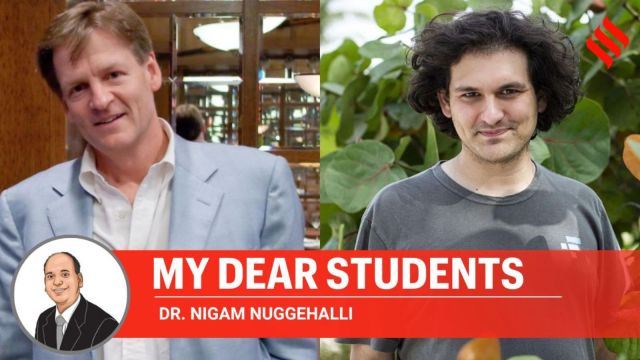
Today I want to talk to you about a recent book by Michael Lewis on Sam Bankman-Fried (SBF), the crypto tycoon turned offender. SBF is now facing decades of jail time for misappropriating the money of his clients. Michael Lewis has written some wonderful books in the past. The one that I liked the best is the Undoing Project, a book about an academic partnership between two Israeli psychologists, and the research that came out of their collaboration. The description of their academic work was interesting but what really elevated the book was its ability to weave riveting life stories of the two protagonists around and through their academic work. Lewis’s subjects are not merely professionals or academics, they are humans with motivations that we can identify with and backstories that make us understand their motivations. Lewis’s book on SBF, titled Going Infinite, has a similar structure of professional and human descriptions twined together, except that I am not clear even after having read the book about SBF’s motivations for misusing his clients’ money.
However, the collapse of SBF’s empire is not the main theme of today’s column. It is not even the main theme of Going Infinite. Further, even though the book is about the rise and fall of a crypto tycoon, there is very little explanation about crypto technology or blockchain in the book. Lewis admits that it is futile to try and describe the technology. No description will actually match the facts. This was a sobering realisation for me. The technology and the underlying explanations of cryptography are so complicated that it’s not possible to explain these in a book aimed at the general population. This does not portend well for our understanding of other allied technology like artificial intelligence and biotech.
I recommend the book to you just to get a feel of the crypto ecosystem where things that are considered normal would be considered crazy by most people. I am used to the new rhythms of the age we live in. Attention spans are now measured by the amount of time we spend on things between looking at our mobiles. I have banned mobile and laptop usage from my classrooms, but I find that in faculty meetings my hands move towards my mobile phone as if driven by some mysterious forces beyond my control.
My Dear Students | Let’s reflect on the classroom teaching experience; has it lost its value?
What’s addiction to digital technology got to do with SBF? Well, the more hilarious bits in the book have to do with the utter incapability of SBF to focus on any conversation unless he is also playing a video game at the same time. That he does it not only with fellow tech bros but also with people like Anna Wintour (Editor in Chief of Vogue) brings to mind the new sensibilities of our age. You will have to read the book to find out but it’s safe to say that SBF’s first meeting with Wintour was also his last.
Like young people elsewhere, SBF is impatient with platitudes about doing good in the world. He wants to make a difference, and not merely on op ed pages. He signs on to something called effective altruism, a philosophical activist movement that is aimed at high earners and motivates them to use their money to do good in the world. I want you to play close attention to this phenomenon as it appears to have quite a following among people who are both young and rich.
Incredibly, as one reads Going Infinite, SBF appears to have a desiccated view of morality, and this is what makes him a complex character. His morality has nothing to with empathy. He doesn’t really feel for other people. He has a sense that he should put money into important causes but he has no sense of how to make other people (or himself) happy. He confesses that he does not know what it is to be happy.
When altruism lacks empathy, strange consequences can follow. The effective altruists spend a lot of time discussing existential threats from AI in the distant future rather than remedying immediate problems of child nutrition in Africa. Why? Because even a small probability of a threat that will have global consequences is worth fighting for compared to a narrower more immediate problem. Maybe there’s a math here that works for effective altruists but I find it decidedly odd. Ultimately SBF represents the promise and pitfalls of conducting a life based on probabilities.
I wonder if a rendition of the world in mathematical terms makes one blind to other imaginations of the world. SBF is dismissive of discussions around literature. It’s all subjective according to him. There is no truth to the matter, people just have views about what Shakespearean texts (for example) mean, and since there are no scientific metrics to determine who is right, there is no point to studying interpretational issues in Shakespearean literature. This is just the kind of attitude that might result in some floundering when it comes to matters of life that are not amenable to metrics. Even worse, metrics might blind a person to more immediate risks (like financial compliance) because a small probability of getting caught is not worth spending much time on. SBF appears to have found this out the hard way.