Thousands of teachers at DU stormed the Vice-Chancellor’s office on December 4, demanding absorption of 4,500-odd ad hoc teachers into permanent positions. (Express Photos by Praveen Khanna)
At Daulat Ram College, located in the DU’s coveted North Campus, 128 of 188 teachers are working on an ad hoc basis. While there are several departments such as mathematics, history and English which have only one permanent teacher; two departments are entirely staffed by ad hocs. These are physics, which has seven ad hoc teachers, and Sanskrit, which has six.
Explaining the challenge this poses, an ad hoc teacher from one such department said: “Despite having years of experience, we are still seen as ad hoc. We conduct the whole process of admission, but we have to do it under observation of a senior teacher. If there is any financial document to be submitted, our sign is not enough. A permanent teacher has to sign off even if they are from some other department,” the teacher said.
Read| High student intake, lack of ‘quality’ teachers lead to staff shortage at IITs
It’s the same story in many other departments across DU colleges. At Bharati College, departments of journalism, psychology and sociology have no permanent teachers. In Mata Sundri College, computer science, statistics and environmental science departments have only ad hocs.
VIDEO | In conversation with Principals of Hindu College and Miranda House
Some other colleges which have departments entirely staffed by ad hoc teachers are St Stephen’s College’s philosophy department, Ramanujan College’s economics and philosophy departments, Vivekananda College’s political science and economics departments, Maitreyi College’s Hindi department and I.P. College for Women’s department of multimedia and mass communication.
At Lakshmibai College, there was a single permanent faculty member in the sociology department who retired around 2007, after which there was no permanent recruitment. Now the department is being run by two ad hocs. In most cases, the situation arose because permanent teachers retired over the years while no new appointments were made.
Story continues below this ad
However, the process has been different for colleges which have introduced new courses in the last few years. In these cases, the university gave them permission to start new courses and posts were sanctioned, but recruitment has not taken place.
For instance, Shaheed Rajguru College of Applied Sciences for Women used to be located in a shared campus with Shaheed Sukhdev College of Business Studies in Jhilmil Colony and offered only five courses. In 2012, it shifted to its current campus in Vasundhara Enclave, where it found itself with the resources to offer additional courses. It started honours programmes in physics, maths and chemistry in 2016. For these, the administration managed to shift permanent staff from existing departments such that each has one permanent teacher.
However, in 2017, it began six additional courses, of which four — psychology, statistics, management studies and business administration — are run entirely by ad hoc teachers. “The primary problem faced in such a scenario is that every department has to make its purchases but financial responsibility cannot be given to ad hoc teachers. These departments have coordinators from other departments but they obviously do not have expertise in that particular subject, so it results in inefficiency in academic decisions as well,” said a senior teacher of the college.
The environmental sciences (EVS) department is one which has the most number of ad hocs across colleges. “These departments only opened after the introduction of FYUP (Four Year Undergraduate Programme) in 2013 and Choice Based Credit System (CBCS) in 2014. So they are new and run primarily by ad hocs,” said DUTA treasurer Abha Dev Habib.
Story continues below this ad
Some of these colleges which have ad hoc only EVS departments include Lakshmibai College, Maharaja Agrasen College, Deshbandhu College, IP College, Mata Sundri College, B R Ambedkar College, Vivekananda College and SPM College, among others.


 4 min read


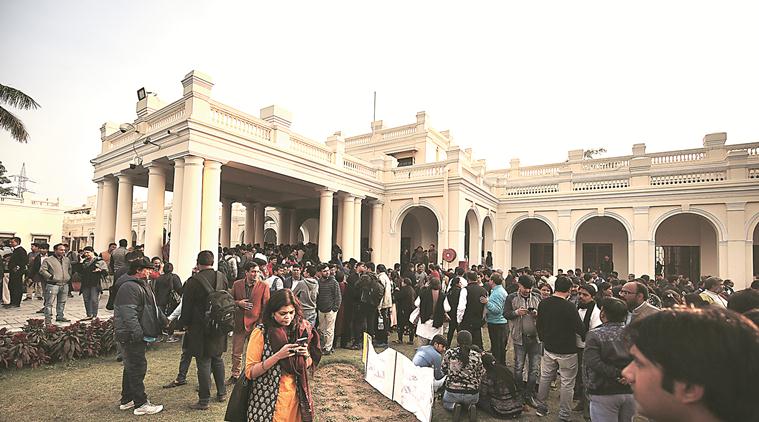 Thousands of teachers at DU stormed the Vice-Chancellor’s office on December 4, demanding absorption of 4,500-odd ad hoc teachers into permanent positions. (Express Photos by Praveen Khanna)