This is an archive article published on June 4, 2020
In UP, just three per cent of returning migrants tested are positive
According to the Integrated Disease Surveillance Programme data, currently, as many 11.68 lakh migrants who have returned to the state are under surveillance. Of them, 74,237 migrants have been tested for the infection and 2,404 have turned positive — a positivity rate of 3.2 per cent.
Of the 8729 total samples that have been found to be positive, 27.5 per cent are of migrants.
Almost two months since migrants started returning to their homes, data from Uttar Pradesh, their top destination state, has seen only 3 per cent of the tested samples of migrants testing Covid positive.
This trend has largely remained the same for the last 10 days. According to the Integrated Disease Surveillance Programme data, currently, as many 11.68 lakh migrants who have returned to the state are under surveillance. Of them, 74,237 migrants have been tested for the infection and 2,404 have turned positive — a positivity rate of 3.2 per cent. Over the last 10 days, the average is 3 per cent of the total migrant samples tested.
This suggests that a heavy influx of migration isn’t setting off an exponential growth in cases in Uttar Pradesh and the positivity rate in migrant samples remains close to the state’s overall figure, 2.85 per cent.
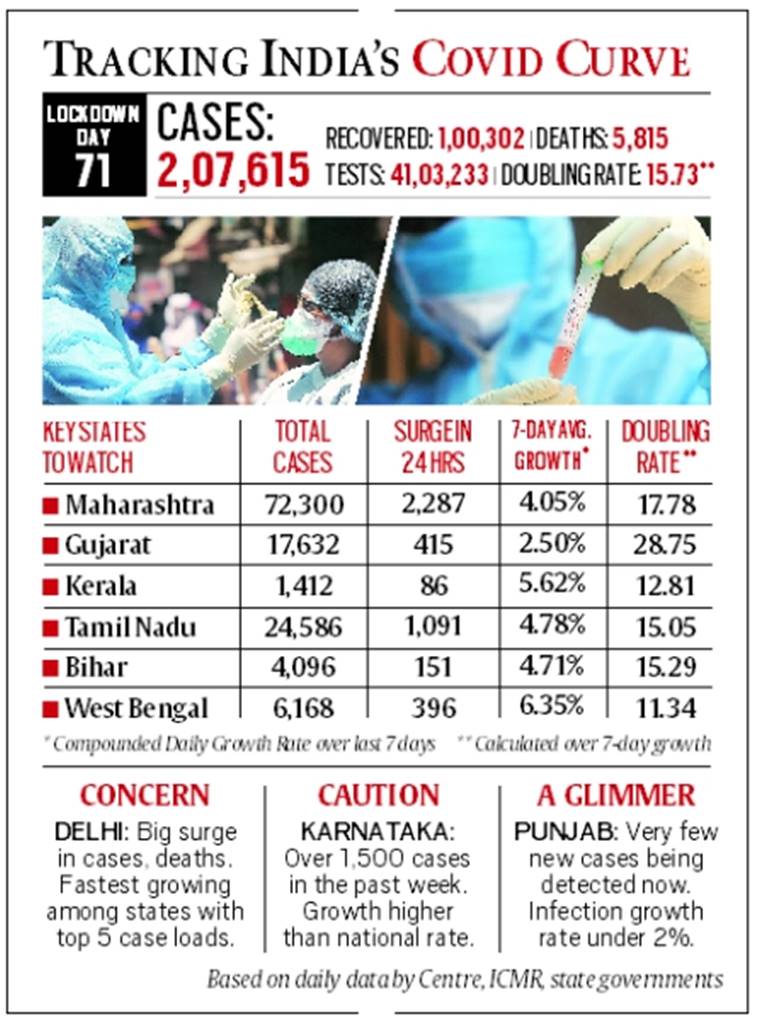
Indeed, the positivity rate of migrants being tested in Uttar Pradesh is almost 2 percentage points lower than the country’s positivity rate; and in stark contrast to the positivity rate in Maharashtra (15 per cent), Gujarat (8 per cent) and Delhi (9 per cent), states from where most of the migrants have returned.
IN UP, over the last 10 days, the average is 3 per cent of the total migrant samples tested.
So while the return of migrants has spread the infection in as many as 75 districts in the state, the low positivity rate means there has been no surge in hospitalisation and, therefore, no added burden to health resources – yet.
At present, Uttar Pradesh has tested 3,07,621 samples for the infection; 24 per cent of the total testing in the state has been conducted on the migrants who have returned to the state. Of the 8729 total samples that have been found to be positive, 27.5 per cent are of migrants.
K Srinath Reddy, president of Public Health Foundation of India and a member of the high-level committee of public experts for Covid, told The Indian Express that the data confirms that migrants had very low exposure rates to the virus due to the nature of their occupation and the location of their dwellings.
Family members of Charan Singh at Delhi border, who came to Delhi by train from Gujarat’s Palampur village and going to Kalyanpur village in Kasganj UP. (Express photo by Gajendra Yadav)
“I have been saying from the beginning that the migrants did not pose a threat. They should have been assisted in being sent back right at the beginning of the lockdown. The reasons are that, basically, people who brought in the virus are foreign travellers. They spread the virus and their primary contacts were the people who secondarily spread the virus,” Reddy said.
“Migrants are not the population, in sense of their occupation and place of residence, who would have come in contact with these people. The nature of their occupation was very different like construction sites or in very low-income dwellings. Their likelihood of having the virus by March 25 was very remote. If they had been assisted with being sent back, we would not have seen this problem. But having kept them in urban hotspots, kept for almost eight weeks, there was a danger they might have actually carried the virus. However, compared to others, their exposure rates would have been much less. The data now confirms that,” he said.
Reddy, however, pointed out that as “a matter of abundant of caution” the migrants need to be quarantined. More so, because many may be asymptomatic. “I don’t anticipate a major rapid spread. For a period of time, the virus may enter the general population. We must keep slowing that…It was a mis-impression that migrants pose a threat,” he said.
As City Editor ( Delhi) at the Indian Express, Kaunain Sheriff leads city reporting with a sharp focus on accountability journalism, data-driven stories, and ground-level impact. As the National Health Editor he leads the newsroom’s in-depth coverage of pressing health issues.
He is the author of Johnson & Johnson Files: The Indian Secrets of a Global Giant, a definitive investigation into the accountability of one of the world’s most powerful pharmaceutical corporations.
Areas of Expertise
Investigative Reporting: Has deep expertise in investigative reporting spanning public health, regulatory affairs, drug safety, and the criminal justice system. His work sits at the intersection of governance, law, and accountability, with a particular focus on how regulatory failures, institutional lapses, and policy decisions affect citizens’ rights and safety.
Data Journalism: Has extensively on big data–driven investigations, including analyses of flagship government schemes and large datasets on criminal trials, uncovering systemic gaps.
Global Collaborations
Kaunain is a key contributor to major international journalistic projects:
The Implant Files: Collaborated with the International Consortium of Investigative Journalists (ICIJ) to expose global malpractices in the medical device industry.
Chinese Big-Data Investigation: Uncovered how a foreign data firm monitored thousands of prominent Indian institutions and individuals in real-time.
Awards & Recognition
His commitment to "Journalism of Courage" has been recognized with the industry's highest honors:
Ramnath Goenka Award for Excellence in Journalism
SOPA Award (Society of Publishers in Asia)
Red Ink Award (Mumbai Press Club)
Indian Express Excellence Awards (Triple recipient for investigations into the NSA abuse in UP, Vyapam scam, and the anti-Sikh riots).
Education: Studied Mechanical Engineering at Visvesvaraya Technological University (VTU), Bangalore, before moving to Delhi to pursue his passion for journalism. His engineering training informs his analytical approach, enabling him to decode technical, legal, and data-heavy systems with precision.
Social media
LinkedIn: linkedin.com/in/kaunain-sheriff-3a00ab99
X ( fromerly Twitter): @kaunain_s ... Read More


 4 min read


 Of the 8729 total samples that have been found to be positive, 27.5 per cent are of migrants.
 IN UP, over the last 10 days, the average is 3 per cent of the total migrant samples tested.
 Family members of Charan Singh at Delhi border, who came to Delhi by train from Gujarat’s Palampur village and going to Kalyanpur village in Kasganj UP. (Express photo by Gajendra Yadav)