


Click here to join Express Pune WhatsApp channel and get a curated list of our stories
© The Indian Express Pvt Ltd
Tags:


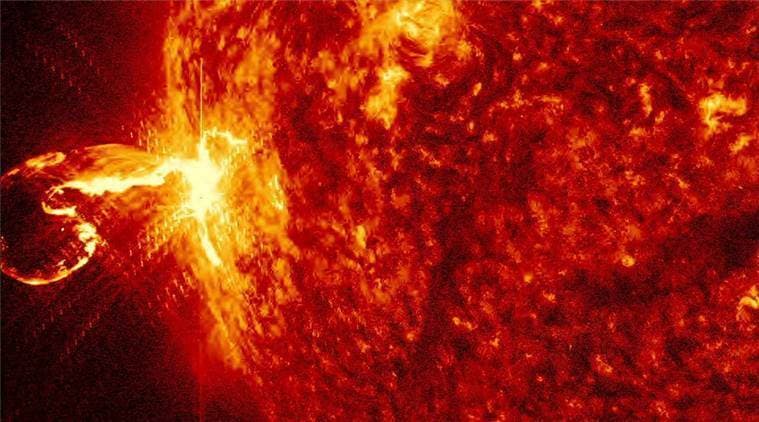
TRACING THE near accurate structures of the Coronal Mass Ejections (CME) emerging from the Sun has become easier, thanks to an algorithm which deletes the background solar corona — the outermost solar atmosphere structured by strong magnetic fields.
Named Simple Radial Gradient Filter (SiRGraF), the algorithm has been jointly developed by scientists from the Aryabhatta Institute of Observational Sciences (ARIES), Nainital, and the Indian Institute of Astrophysics (IIA), Bengaluru.


Often, the images of the CMEs suffer from radial variation in intensities and require additional image-processing before they are ready to be studied.
The technique is capable of separating the background revealing the dynamic corona for short time-scale transient structures of the corona, the study published in Solar Physics, said.
As a result, now CME observations and their characteristics can be studied with improved efficiency. However, the researchers noted that this algorithm is not suitable for quantitative analysis on estimations based on intensities.
On the need for such a technique, the researchers said, “The density of the solar corona decreases with distance radially outwards. As the intensity of the corona observed in white light depends on the density of particles in the atmosphere, it decreases exponentially. If the contrast between the constant corona and transient CMEs is not high, detection of CMEs becomes a challenge.”
Another advantage of using this technique, scientists say, is that multiple images can be processed in a short time without compromising on the image quality.


