3 min read

Click here to join Express Pune WhatsApp channel and get a curated list of our stories
© The Indian Express Pvt Ltd



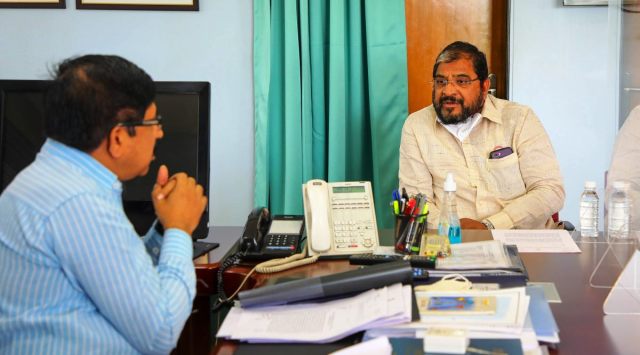 Raju Shetti with Shekhar Gaikwad. (Ashish Kale)
As the sugar industry takes definite steps towards diverting production from sugar to ethanol, farmer leader and former MP Raju Shetti has asked for a definite and vetted system to ensure farmers’ incomes are not compromised. Shetti, who met Sugar Commissioner Shekhar Gaikwad in Pune on
Wednesday, has asked for a technical audit of ethanol-producing mills by reputed institutions like the IITs.
Ethanol, a fuel additive, is manufactured by sugar mills either directly from cane juice or from molasses — the sticky fluid with fermentable sugar which is produced before crystallised sugar is extracted from cane juice. Depending on the sugar content, molasses is classified as B heavy or C, and the former has more fermentable sugar than the later.
If ethanol is produced from B heavy molasses, total sugar produced from crushing one tonne of sugar is lower than if ethanol is produced for C molasses. The central government has fixed grade-wise price of ethanol, with the highest price bracket for ethanol produced directly from cane juice and the lowest for ethanol produced from C molasses.
For sugar mills, production of ethanol is a better alternative as compared to sugar given the consistent price they get for the product. The grade-wise price is an incentive for mills to reduce sugar production and opt for ethanol instead. But for farmers whose earning is directly linked to ‘sugar recovery’, this can be a problem given the fact that sugar produced per tonne of cane crushed reduces during ethanol production.
 To protect the interest of farmers, the central government has put out a formula which is to be used to calculate recovery loss due to ethanol production. Organisations such as the Pune- based Vasantdada Sugar Institute (VSI), the Kanpur-based National Sugar Institute (NSI) or any other NABL-certified organisation can do the calculations.
Speaking to The Indian Express, Shetti, however, expressed doubt about the credibility of VSI. “VSI is an institute funded by sugar mills and thus it would be more interested in preserving the interest of mill owners than that of farmers. We want a third party audit of the recovery loss, done by an organisation like IIT, which would have no conflict of interest in the matter,” he said.
During his meeting with the sugar commissioner, Shetti also raised the matter of payment of Fair and Remunerative Price (FRP) by mills in instalments. Barring mills in Kolhapur district, all others have started paying the basic FRP in instalments. Before the start of the cane crushing season, mills had made farmers sign a form in which, along with other details, they had agreed about payment of FRP in instalments.
– Stay updated with the latest Pune news. Follow Express Pune on Twitter here and on Facebook here. You can also join our Express Pune Telegram channel here.