On October 23, 1928, Dr BR Ambedkar appeared before the Simon Commission, formally known as the Indian Statutory Commission, which was preparing a report on the constitutional reforms needed in its governance in the British Raj. Ambedkar was a member of the Bombay Provincial Committee, one of the bodies formed by the Commission, but on that day he was in the role of a witness to be examined about the “number of depressed classes” in the Bombay Presidency.
Among the people who questioned him was Sardar Gangadhar Narayan Mujumdar, also known as Abasaheb, a fellow member of the Bombay Provincial Committee and an eminent scholar from Pune, who wanted to know about the claims of Bhils, Wadias and other groups who were not untouchables, but minorities.

This was one of the many chapters in Abasaheb’s life which was entwined with the history of a country struggling to free itself from British rule while trying to ensure social justice. At Kasba Peth, at the end of a narrow lane, is a historic wada over whose door hangs the familiar sapphire blue plaque announcing that Sardar Abasaheb Mujumdar stayed here from 1894 to 1973. The Mujumdar wada is one of the last remaining homes from the Peshwa era and a witness to great political, administrative and social events in the region spanning several eras.
The name Mujumdar is derived from ‘Majmudar’ – based on the Persian word Majmu – meaning the Chancellor of the Exchequer. The family’s original surname was Prabhune and they hailed from Loni Bhapkar village near Morgaon. According to Manda Khandge’s book ‘Vaibhav Peshwekalin Vadyanche’, the orders and donations, among others, given away by the Peshwa were recorded by the Mujumdar in his office. Once the document was stamped with the Mujumdar’s seal, these had legal validity.
Simon Commission members with Abasaheb and B R Ambedkar
Khandge adds that after Shahu Maharaj was released from Delhi and returned to Maharashtra, the family of Naro Gangadhar Mujumdar helped in the mediation between him and Tarabai of Kolhapur. When Shahu Maharaj became the king, he granted the rights of majmu for his entire kingdom to Naro Gangadhar aka Ayaba Majumdar Prabhune. Around this time, Balaji Vishwanath was granted the office of the Peshwa. The Mujumdar family held the office till the end of the Peshwa rule.
The Mujumdar wada is one of the last remaining homes from the Peshwa era and a witness to great political, administrative and social events in the region spanning several eras.
It was Ayaba Majumdar’s grandson Naro Neelkanth who built the wada in 1714 and then added the front portion in 1770. Naro Gangadhar took sanyas in his later life and after his death, his samadhi – which stands to this day – was built on one of the properties that the family owned around the wada. Measuring 8,000 sq ft and made of seasoned wood and pustak veet (flat, book-like bricks), the wada’s construction cost about Rs 1 lakh. “The main entrance of the wada faces north, as did many wadas from the Peshwa era,” writes Khandge.
The wada had seven chowks of which three remain today as the rest were disposed of. On the other side of the door, the wada’s traditional architecture welcomes the visitor, that is, those who are allowed, as the wada is a private space. There are a few steps leading to a traditional platform, where Anupama and Pratap Mujumdar, who represent the 10th generation, receive visitors, the osri or open verandahs and the maajghar, with an elaborate Ganesh Patti. Behind the maajghar, is the courtyard with a well filled with clean waters of the Katraj lake transported via an underground pipeline built by Nanasaheb Peshwa in 1749-50. The central part of the wada has three storeys, and the front, built in 1740, has two.
Story continues below this ad
In the courtyard are implements such as a massive stone okhli and chakki from an era before packaged ingredients became the norm. The wada also contains a cellar that had been built as a safe place. Next to the maajghar is a room meant for new mothers. These recall the years when, after there was a birth in a Maharashtrian household, a room was reserved for the child and the mother. It used to be dim with little air supply because it was thought that it would keep the mother and baby safe and protected from the breeze.
Naro Neelkanth was a Ganesha devotee. After he had a vision from the deity, Neelkanth began to celebrate Ganeshotsav in his family, an unbroken ritual that has survived almost 300 years and is the only time guests from outside may enter the house. “The Mujumdar Ganpati was kept on a wooden peacock throne and had an umbrella made of gold. The deity wore a five-stranded necklace that had five precious gems. The mukut was of gold, encrusted with diamonds. In 1965, during Ganeshotsav, the Ganpati and the simhasan were stolen because of the gold and rare gems,” says Anupama.
The Mujumdar wada Ganeshotsav was steeped in art — with keertans and musical mehfils being an integral part. The Ganesh Mahal, visible from the road, has an ornate painted ceiling, lights encased in handis and a traditionally designed space for the gods at one end. “Women used to sit and view the proceedings from behind a wooden mesh,” says Anupama. The family has records showing that the Peshwa would visit the Ganeshotsav with other eminent citizens. The Ganeshotsav would become even more famous during Abasaheb’s time, and featured some great musicians of the country such as Pandit Bhaskar Raghunath Bakhale and Ustad Vilayat Hussain Khan of the Agra Gharana, who once came and performed for free. Over the centuries, the Mujumdar wada Ganeshotsav featured doyens such as Sawai Gadharva, Ustad Bade Ghulam Ali Khan, Mallikarjun Mansoor and Pandit Bhimsen Joshi.
Anupama Mujumdar with a sari from the private museum of the wada
If the Mujumdar wada is largely associated with the memory of Abasaheb, it is because of his wide range of accomplishments that capture the imagination even today. Born Shridhar in the Prabhune family, Abasaheb was adopted by Laxmibai in 1892 after Naro Neelkanth’s great-grandson Narayan died without an heir. Shridhar was named Gangadhar Narayan Rao and, according to Khandge, became one of the leading citizens of Pune. Well-versed in 10 languages, associated with more than 300 sociocultural and educational institutions in various capacities, and a scholar who had published many documents from Persian from the Peshwa era, Abasaheb was given the rank of a Sardar of the First Order by the British in 1928. “In 1935, he was given the title of CIE or Companion of the Indian Empire by the British. Governors and other eminent officers of the government, as well as prominent scholars, writers and thinkers of the era, would visit this wada regularly,” says Abasaheb’s grandson Pratap.
Story continues below this ad
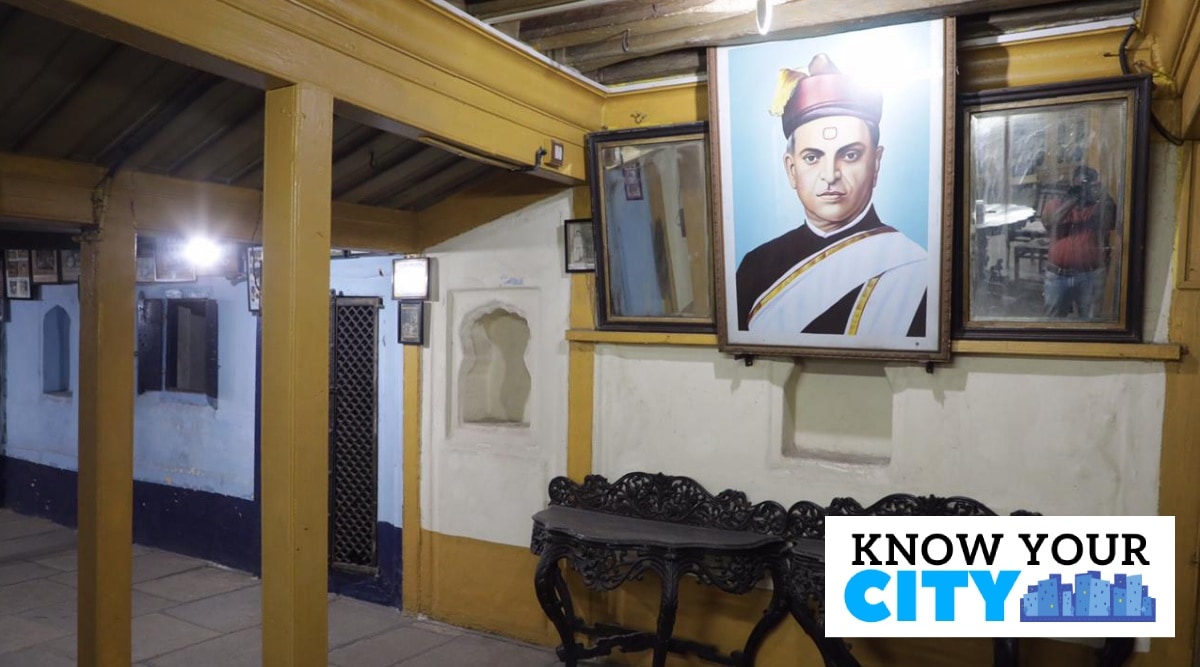
Abasaheb was also the secretary of the Bharat Itihas Sanshodhak Mandal. During his time, he personally went to many homes, requesting and collecting historical documents. Royal and sardar families all over the region used to have a lot of documents but these were kept in the attic and nobody knew about them, so historians would take these documents to study. A renaissance man, Abasaheb was an avid tennis player, an expert in the traditional gymnastic sport of mallakhamb as well as a master of the trapeze, which he learnt from the iconic Chhatre Circus. A lot of his legacy is preserved on the upper floors of the wada, accessed through steps that go through thick walls, where the family has maintained a museum.
The archives contain old saris (including a 200-year-old Paithani sari), currencies, utensils and photographs, including one of the Simon Commission members that shows Abasaheb with B R Ambedkar, to a section dedicated solely to the large number of musical instruments that Abasaheb played. Among the displays are rare instruments such as the Kaanchtarang, Surashringar and Rudra Veena.
“Abasaheb was an expert in music and the arts. He had collected more than 2,000 books. He had written extensively on music and was a patron to up-and-coming and established musicians. He had a collection of 35,000 chiza of classical music that my family has preserved in 10 CDs,” says Anupama, pointing to photographs of Hirabai Barodekar, Gangubai Hangal, Sawai Gandharva, Pandit Ravi Shankar and Kishori Amonkar performing at the wada. “To the surprise of many people, Abasaheb could play an entire Raga Yaman on an ektara and CV Raman and Vishweshariya had come home to witness this,” she adds. The musical instruments, old wooden furniture and other artefacts have been maintained well by the Mujumdar family.
The Mujumdar wada is one of the few wadas from the Peshwa era that still stand. “These wadas have architectural, historical and social significance. They have been witnesses to the transformation of Pune over the decades. Maintaining these wadas is not easy. It is quite expensive for the owners. Over the years, skilled manpower to maintain such structures have also been in short supply,” says Sandeep Godbole, a heritage walk leader and researcher of the city. Though Mujumdar wada is listed as a Grade-II heritage structure by the Pune Municipal Corporation (PMC), the family gets no funds or support from the state. “We maintain the wada from our own resources, which is not easy as these structures have a lot of woodwork and there is a shortage of people who are experts at this art,” Anupama points out.
Story continues below this ad
In 2018, the Pune Municipal Corporation, which was demolishing an illegal structure next to the wada, destroyed the walls of the Mujumdar wada as well. If the Covid situation allows visitors to the Ganesh Mahal for Ganeshotsav again this year, they will see that the hall, including the space for the deity, has tilted to one side. “We were told by the corporation to go to the courts, but we avoided that because it is not easy looking at the time and effort legal proceedings would take,” says Anupama.
Since the wada has never had any tenants, the family has been able to maintain it. Pratap and Anupama live in the wada now. “We do not encourage too many visitors. Whenever tour guides come to the wada, they say that this is where Pt Bhimsen Joshi gave his first public performance, but we want people to know that the wada has other social, historical and cultural significance. This is the only wada of its kind in Maharashtra. Though the Mujumdar wada is a private heritage structure, it is useful for all people, mainly Indian and foreign historians who come here to study the original historical documents. Considering this, the government and heritage organisation could allot some funds and relaxation in rules and taxes to help us maintain and preserve this treasure trove of history,” she adds.


 11 min read



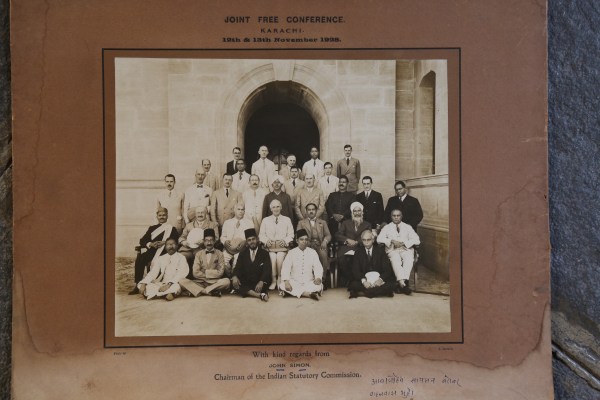 Simon Commission members with Abasaheb and B R Ambedkar
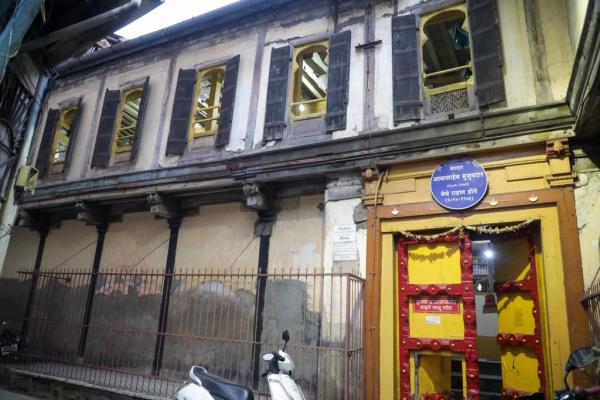 The Mujumdar wada is one of the last remaining homes from the Peshwa era and a witness to great political, administrative and social events in the region spanning several eras.
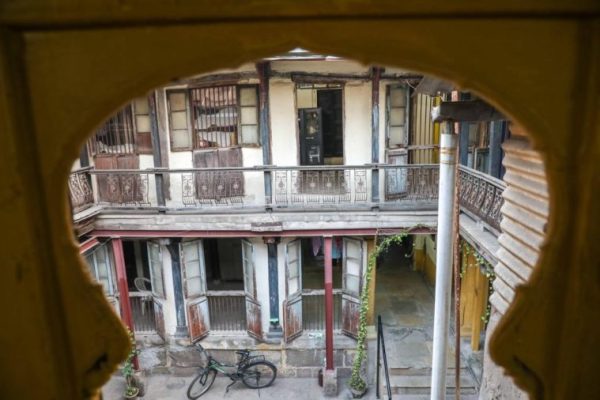 The wada’s traditional architecture welcomes the visitor, that is, those who are allowed, as the wada is a private space.
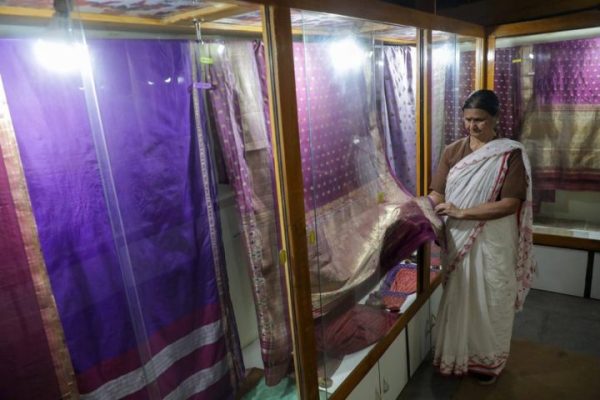 Anupama Mujumdar with a sari from the private museum of the wada