This is an archive article published on October 22, 2023
Postcards from the Past: How Aundh transformed from sugarcane and onion fields to bungalows and housing complexes
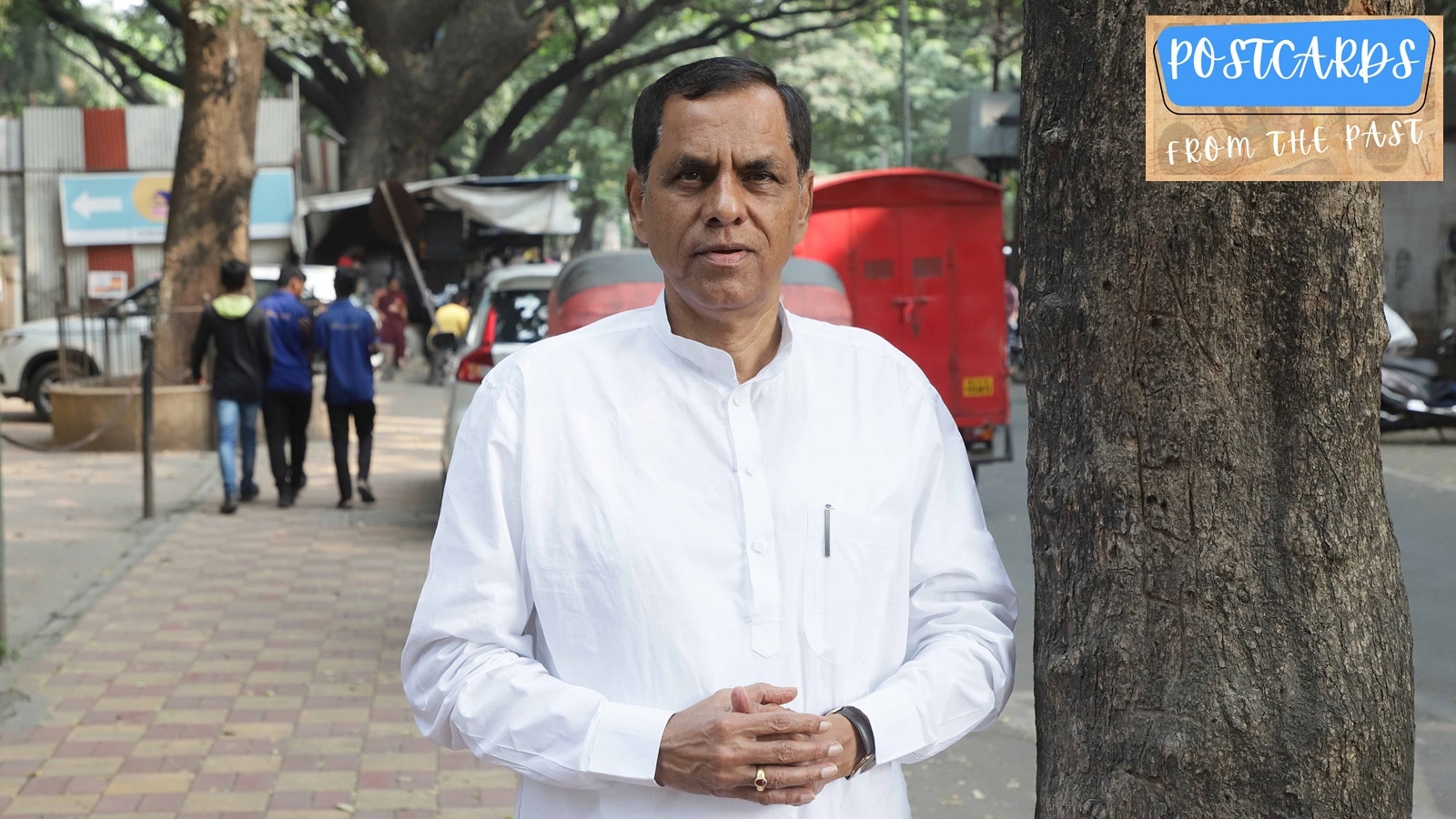
For former mayor Dattatreya Gaikwad, whose family is among the original inhabitants of Aundh, the pride of progress has overtaken the loss of open spaces.
The city mayor between 1999 and 2002 — and a corporator from 1992 to 2007 — Gaikwad says that one of his duties was to survey Aundh and find out what improvements were needed. (Express Photo by Pavan Khengre)
Listen to this article
Postcards from the Past: How Aundh transformed from sugarcane and onion fields to bungalows and housing complexes
x
00:00
1x1.5x1.8x
Every afternoon, former mayor Dattatreya Gaikwad is in office at his petrol pump in Aundh where lines of vehicles keep passing by. Gaikwad estimates that 1,500 vehicles stop at the pump daily, and the number is only growing. “All this area used to be agricultural land just 50 years ago. We used to grow sugarcane, onions and other vegetables that people needed. You could see only fields right up to the river. The petrol pump was set up only in 2004,” he says.
On one wall of the office hangs a photograph of his father Marutrao Gaikwad sitting at an old well surrounded by lush greenery. The photograph is from 1977. Gaikwad points across the road from the petrol pump to an overgrown plot surrounded by a vista of buildings. “The well still exists. It is covered now, but is a reminder of earlier days.” The water from the well used to be drawn by hand and motors for the farm. Like all children who used to run, play, fly kites and help at the farm at the time, Gaikwad still knows the ways of soil, seed and water.
Building the new cosmopolitan Aundh
Aundh, which had 6.72 lakh trees and was the greenest part of the Pune Municipal Corporation (PMC) in 2011, has the flavour of an area where different streams of populations have converged over decades. In the 1970s, it was home to a few bungalows and many fields. The present landscape is dominated by commercial buildings and housing complexes designed to attract the workforce of Hinjewadi, young professionals and migrant students, among others. Real estate prices have skyrocketed.
Gaikwad’s friend, realtor and columnist Ajay Vasant Polkamwar adds that the village culture in Aundh gaon included wadas, close-knit families and celebrations such as weddings when guests would sit on the road during meals. The river was clean and children swam and fished in it. Polkamwar’s family had come to Aundh five generations ago from Andhra Pradesh and merged into the Maharashtra culture while retaining many Telugu traditions.
“Aundh has a strongly cosmopolitan nature. It is hard to believe that people from other ends of the city used to once consider Aundh as the outskirts,” says Gaikwad. His family is among the original inhabitants of the area. His forefathers had been a part of the forces of Shivaji Maharaj and the Gaikwads owned 300 villages in Pune district, he adds. The government’s Development Plan came into effect in 1987, allowing agricultural land to be converted into a residential zone.
Gaikwad remembers the elders in his family being upset because their livelihood as farmers would be lost. “Slowly, buildings started coming up. First it was bungalows and then housing complexes. We used to see the construction while travelling by road. How did we feel? We realised our feelings did not matter. What could we do?” says Gaikwad.
The city mayor between 1999 and 2002 — and a corporator from 1992 to 2007 — Gaikwad says that one of his duties was to survey Aundh and find out what improvements were needed. The British-era wooden bridge over the Mula-Mutha easily caught his attention. It was narrow, which created traffic congestion, and low, which caused it to flood every monsoon. “There are photographs from an earlier time, of British people on horseback taking the route through Aundh to go to Bombay. They used to build a platform on the river to cross to the other side. I realised that modern times needed a new kind of bridge. It was not only for the benefit of Aundh but the rest of Pune,” he says.
The Rajiv Gandhi Bridge opened in 2004 and made travelling easier for trucks, buses, two-wheelers and autorickshaws. After its inauguration, the bridge became a sightseeing spot for families. “You can go to Mumbai, Hinjewadi and rural areas from Aundh thanks to the bridge,” says Gaikwad.
Much of the infrastructure in Aundh is a response to its growing population. The Rajiv Gandhi Bridge, which is now busy from daybreak to midnight, has come up in place of a narrow wooden bridge built during the British rule. Among the notable constructions were the Maharaja Sayaji Gaekwad Udyog Bhavan and the PMC offices in the locality built in 2012, which have the Pt Bhimsen Joshi Kala Mandir attached. While the former is dedicated to the erstwhile ruler of Baroda, the latter is a tribute to the great vocalist who lived in Pune.
Royal then, regal now
Another royal had a presence in Aundh. Gaikwad remembers visiting the old home of the Gwalior Scindia, where the Rayat Shikshan Sanstha stands, and marvelling at the traditional architecture of wood and terracotta. “It has been torn down,” he says.
Story continues below this ad
There is a cacophony of vehicles on the road. “Traffic in this area was a problem even when I was the mayor. Other than that, Aundh has turned out to be a good place, with educated people and planned facilities,” he says.
Dipanita Nath is a Senior Assistant Editor at The Indian Express, based in Pune. She is a versatile journalist with a deep interest in the intersection of culture, sustainability, and urban life.
Professional Background
Experience: Before joining The Indian Express, she worked with other major news organizations including Hindustan Times, The Times of India, and Mint.
Core Specializations: She is widely recognized for her coverage of the climate crisis, theatre and performing arts, heritage conservation, and the startup ecosystem (often through her "Pune Inc" series).
Storytelling Focus: Her work often unearths "hidden stories" of Pune—focusing on historical institutes, local traditions, and the personal journeys of social innovators.
Recent Notable Articles (December 2025)
Her recent reporting highlights Pune’s cultural pulse and the environmental challenges facing the city during the winter season:
1. Climate & Environment
"Pune shivers on coldest morning of the season; minimum temperature plunges to 6.9°C" (Dec 20, 2025): Reporting on the record-breaking cold wave in Pune and the IMD's forecast for the week.
"How a heritage tree-mapping event at Ganeshkhind Garden highlights rising interest in Pune’s green legacy" (Dec 20, 2025): Covering a citizen-led initiative where Gen Z and millennials gathered to document and protect ancient trees at a Biodiversity Heritage Site.
"Right to breathe: Landmark NGT order directs PMC to frame norms for pollution from construction sites" (Dec 8, 2025): Reporting on a significant legal victory for residents fighting dust and air pollution in urban neighborhoods like Baner.
2. "Hidden Stories" & Heritage
"Inside Pune library that’s nourished minds of entrepreneurs for 17 years" (Dec 21, 2025): A feature on the Venture Center Library, detailing how a collection of 3,500 specialized books helps tech startups navigate the product life cycle.
"Before he died, Ram Sutar gave Pune a lasting gift" (Dec 18, 2025): A tribute to the legendary sculptor Ram Sutar (creator of the Statue of Unity), focusing on his local works like the Chhatrapati Shivaji statue at Pune airport.
"The Pune institute where MA Jinnah was once chief guest" (Dec 6, 2025): An archival exploration of the College of Agriculture, established in 1907, and its historical role in India's freedom struggle.
3. Arts, Theatre & "Pune Inc"
"Satyajit Ray, Ritwik Ghatak were not rivals but close friends, says veteran filmmaker" (Dec 17, 2025): A deep-dive interview ahead of the Pune International Film Festival (PIFF) exploring the camaraderie between legends of Indian cinema.
"Meet the Pune entrepreneur helping women build and scale businesses" (Dec 16, 2025): Part of her "Pune Inc" series, profiling Nikita Vora’s efforts to empower female-led startups.
"How women drone pilots in rural Maharashtra are cultivating a green habit" (Dec 12, 2025): Exploring how technology is being used by women in agriculture to reduce chemical use and labor.
Signature Style
Dipanita Nath is known for intellectual curiosity and a narrative-driven approach. Whether she is writing about a 110-year-old eatery or the intricacies of the climate crisis, she focuses on the human element and the historical context. Her columns are often a blend of reportage and cultural commentary, making them a staple for readers interested in the "soul" of Pune.
X (Twitter): @dipanitanath ... Read More


 5 min read