5 min read

Click here to join Express Pune WhatsApp channel and get a curated list of our stories
© The Indian Express Pvt Ltd



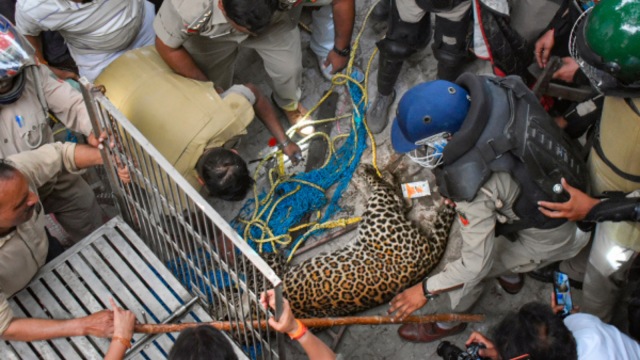 The Junnar Forest Division is home to a rapidly growing leopard population and has reported 2,616 deaths of domestic animals since January this year in leopard attacks. (File photo)
“I was asleep inside the house when it happened. I will never forget my wife’s screams. We are scared of working in the open fields even during broad daylight. How will we survive as farmers?” asks Ravindra Dere who lost his wife to leopard attack early this month in Pimpri Pendhar village of Pune district.
On October 9, minutes after Sujata, 44, had stepped out of her house, which is on their sugarcane farm, the leopard dragged her into the field and killed her.
The village comes under Junnar Forest Division where eight deaths, including five children, due to leopard attacks have been reported so far since March. As Maharashtra gears up for the Assembly elections in November, repeated cases of man-animal conflict will be a raging issue in the four constituencies of Pune district – Junnar, Ambegaon, Shirur and Khed — all of which fall in the Junnar Forest Division.
The Junnar Forest Division is home to a rapidly growing leopard population and has reported 2,616 deaths of domestic animals since January this year in leopard attacks.
“Issues related to irrigation and those of the farmers remain key concerns in these areas. But since the leopard issue has remained in the headlines and puts restrictions on the agriculture activities, it will remain in the campaigns of all political parties,” said a senior leader from Shirur.
All the four seats — Junnar, Khed, Ambegaon and Shirur — were won by the undivided NCP in the 2019 Assembly polls. Junnar, Khed, Ambegaon are held by Atul Benke, Dilip Walse Patil and Dilip Mohite who are from Ajit Pawar faction, while Shirur is under NCP (SP)’s Ashok Pawar.
For the Shirur Lok Sabha elections, in all these four Assembly segments, Sharad Pawar faction has had an upper hand over his nephew Ajit Pawar’s NCP. In the upcoming Assembly polls, these four constituencies will witness tight contests between the two NCP factions.
Bhausaheb Shinde, who has settled in Junnar from Akola district, now works at a poultry farm. “We use a strong wire mesh for securing the poultry enclosures. We have used the same mesh to secure our living area next to the poultry enclosures. CCTV cameras installed at the gate capture leopards every second-third entering the premises,” he says.
Vallabh Karpe, a sugarcane and soybean farmer, was critical of the forest department’s suggestion for the labourers to wear a spiked neck belt to prevent leopards from attacking them. “I feel this is a ridiculous idea from an inefficient system. Won’t a leopard attack you on other parts of the body? Don’t they understand leopard is a very intelligent animal and will soon learn? We hope that our elected representatives take this issue seriously before it gets out of hand.”
As incidents of human leopard conflict in the region has gone up, the state forest department has sent a proposal to the Ministry of Environment, Forest and Climate Change (MoEFCC) to sterilise 36 female and 11 male leopards as a targeted birth control method to bring down the rate of increase of leopard population.
The proposal came after sitting Member of Parliament Amol Kolhe of the NCP (SP) wrote to various stakeholder agencies to intervene and work towards finding a solution to the human-leopard conflict. All the four affected talukas and corresponding constituencies – Junnar, Ambegaon, Shirur and Khed – fall under Shirur Lok Sabha seat that Kolhe represents.
In June, Pune Collector had notified over 230 villages from the four talukas as disaster-prone due to repeated incidents of human leopard conflicts.
“Not just for these 230 villages, but the villages around them and the overall talukas, human leopard conflict will remain a key issue on the minds of the voters. These talukas consist of a majority rural population which is predominantly into agrarian and agri-based livelihoods,” says a senior leader from Shirur.
Considering the large number of leopards in the vicinity of Kukdi and Ghod River, Junnar Forest Division has been repeatedly appealing the residents of Junnar, Shirur, Ambegaon, and Khed talukas to follow key precautionary steps including installing plenty of bright lights around each home and in the fields where ever possible, completely clearing the grass cover on both sides of the road around the houses and the fields, use the toilets inside the house, avoid going outside before dawn and after sunset as far as possible, and if unavoidable, carry a flashlight and a sturdy stick.
“Forest department asks us to set up high fences, install high intensity lights. Who will give money for this? They ask us not to step out before dawn and after sunset. Can we really avoid that for all days? They talk of humans coexisting with leopards. But is that practical if the leopard population keeps growing. Our next MLAs need to be the ones to find solutions to this issue for us,” mentions Santram Gade, a farmer and dairy businessman from Shirur.