

Journalism of Courage

When it comes to experimenting with live music for
theatre plays,genre-bending is the norm today


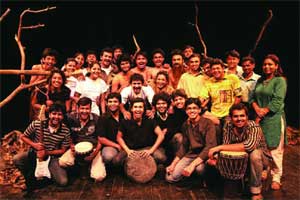
Live music at plays has evolved into,what Chennai-based theater director Gowri Ramnarayan calls it,a parallel text; it’s no longer an add-on or a score. In her recent play Mathemagician,Babylon of 500 BC was set against Carnatic music. It was tough,I didn’t follow the concept fully the first day I was told about it, laughs Sheejith Krishna,singer and percussionist,and ex-faculty member of Kalakshetra Foundation. My main job was to uplift a scene. When I thought of Babylon,I imagined a temple-like atmosphere,of bells and conchs. When they spoke of stars,the sound went ‘ting-ting’; when the temple was described as ‘tall’,the music jumped from the lowest to the highest octave. I replicated a lot of natural sounds with the drums, says Krishna. An important element of the genre-bending experience of live theater music is here copying and creating natural sounds. Chakra is a story about ancient man,the language of the play is gibberish,its non-existent. The music had to reflect the rawness of the setting well,more than just the emotions, says Alok Rajwade of Natak Company.
As young Marathi theater artists will admit,the annual Firodia Karandak inter-collegiate drama competition has instilled a strong culture of live music,dance and acting into their imaginations. Even English theater in the city is increasingly absorbing this ethic of relying on live music and letting it develop as a distinct experience in its own. Hina Siddiqui of Orchestrated Q’Works decided to create a mish-mash of Punjabi folk music and modern guitar strumming for her latest play,Toba Tek Singh. At one point in the play,a jugalbandi of Ek Onkar and the Islamic Azan rises out. We wanted to fuse the folk and the modern elements into the music, says Siddiqui. Bangalore-based WeMove Theater group,in their recent adaptation of R K Narayan’s Malgudi Days,employed a guitarist to give the background theme a new twist,while a ghatam player imitated horse trots and vigorously built up the tension in serious scenes.
A critical factor that aids such redefinition of live music is the availability of ample local talent. Genre swapping can happen if the musicians belonging to different schools of styles are easily accessible. For our latest play,which is set in the 11th century,we needed traditional Carnatic musicians to work on the live music. But there are certain constraints in this direction. It can be an expensive proposition if the musicians are based out of the city. It is creatively also a big challenge,the music too must act and react with the actors. It helps to have local talent at hand, says Jitendra Pawar of Niche Stagekraft.


