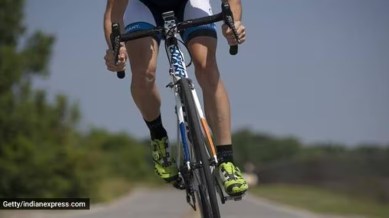
India gears up for its first-ever UCI-approved multistage cycling event, the Pune Grand Tour 2026 (Representational). (File)
”It was an experience to cherish for a lifetime. Although it required a lot of energy, hard-work and patience, I am glad I could complete the wari of 240 kms, in 12 to 16 hours,” says Sunil Chacko, (60), a heart patient.
A resident of Aundh, Sunil Chacko was part of a group of 1,734 cyclists who earlier this month cycled their way to Pandharpur in Solapur district from the temple town of Dehu in Pune district. The Indo Athletics Society had organised the cycling event to Pandharpur in a bid to promote health and sports.
You’ve Read Your Free Stories For Now
Sign up and keep reading more stories that matter to you.
The Sant Tukaram palkhi takes off from Dehu every year in June for its annual wari to Pandharpur, a distance of 240 kms. Dehu is located close to Pimpri-Chinchwad. Thousands of ‘warkaris’ accompany the Sant Tukaram palkhi from Dehu to Pandharpur every year. They walk all the way to Pandharpur.
This year, the palkhi left Dehu on Friday, stayed the night there, and on Saturday, it reached Akurdi in Pimpri-Chinchwad. Tomorrow, it will leave Akurdi and will reach Pune city late in the afternoon. Similarly, the Sant Dnyaneshwar Maharaj palkhi, which left Alandi Saturday morning, will reach Pune city late in the afternoon. Both will meet In Wakdewadi area.
Meanwhile, the cyclists had their own tales to tell. Chacko said the warkari walk all the way to Pandharpur braving difficult conditions. “We too cycled all the way to Pandharpur which was a tough challenge. I am an avid cyclist and I have been practising and touring for years now. I am game for anything,” he said.
Chacko said that although he was a heart patient, he had no trouble making it smoothly to Pandharpur. “We undertake cycle wari every year a few days before warkaris start their march on foot. Of the 1,700 plus cyclists, some of them made it in 12 hours, a few in 14 while the rest took 16 hours. We stopped for refreshments on the way. I had trouble making it to the destination but enjoyed every moment of my cycle ride,” he said.
Pointing out that it was the fourth year in a row that he was part of the cycling expedition, Chacko said, “Cycling to Pandharpur is a spiritual experience. There is a kind of magic when you land at a places like Pandharpur and take darshan of Vithal-Rukmini.”
Story continues below this ad
”We began our journey from Dehu and passed through the Pune-Mumbai highway. From Dehu we first went to Pimpri-Chinchwad, then to Pune city and then Bigwan, Indapur, Temburni and Pandharpur. There were several people on the way who waved out to us enthusiastically and sort of lauded our effort. We drew a lot of inspiration from them,” he said.
An active member of Indo athletic society, Sunil plans to visit Ayodhya this December. ”The Indo Athletics Society started this event in 2016 with a handful of participants. The numbers have gone up reaching up to 1,700 plus. Our next destination will be Ayodhya,” said Chacko.
Manoj More has been working with the Indian Express since 1992. For the first 16 years, he worked on the desk, edited stories, made pages, wrote special stories and handled The Indian Express edition. In 31 years of his career, he has regularly written stories on a range of topics, primarily on civic issues like state of roads, choked drains, garbage problems, inadequate transport facilities and the like. He has also written aggressively on local gondaism. He has primarily written civic stories from Pimpri-Chinchwad, Khadki, Maval and some parts of Pune. He has also covered stories from Kolhapur, Satara, Solapur, Sangli, Ahmednagar and Latur. He has had maximum impact stories from Pimpri-Chinchwad industrial city which he has covered extensively for the last three decades.
Manoj More has written over 20,000 stories. 10,000 of which are byline stories. Most of the stories pertain to civic issues and political ones. The biggest achievement of his career is getting a nearly two kilometre road done on Pune-Mumbai highway in Khadki in 2006. He wrote stories on the state of roads since 1997. In 10 years, nearly 200 two-wheeler riders had died in accidents due to the pathetic state of the road. The local cantonment board could not get the road redone as it lacked funds. The then PMC commissioner Pravin Pardeshi took the initiative, went out of his way and made the Khadki road by spending Rs 23 crore from JNNURM Funds. In the next 10 years after the road was made by the PMC, less than 10 citizens had died, effectively saving more than 100 lives.
Manoj More's campaign against tree cutting on Pune-Mumbai highway in 1999 and Pune-Nashik highway in 2004 saved 2000 trees.
During Covid, over 50 doctors were asked to pay Rs 30 lakh each for getting a job with PCMC. The PCMC administration alerted Manoj More who did a story on the subject, asking then corporators how much money they demanded....The story worked as doctors got the job without paying a single paisa.
Manoj More has also covered the "Latur drought" situation in 2015 when a "Latur water train" created quite a buzz in Maharashtra. He also covered the Malin tragedy where over 150 villagers had died.
Manoj More is on Facebook with 4.9k followers (Manoj More), on twitter manojmore91982 ... Read More