3 min read

Click here to join Express Pune WhatsApp channel and get a curated list of our stories
© The Indian Express Pvt Ltd



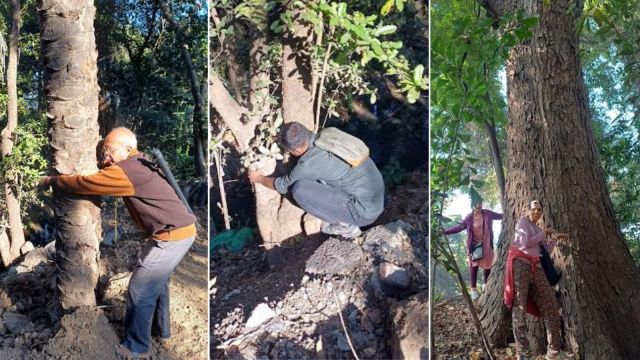 Around a dozen tree mappers went to the area around the stream and measured and photographed many old trees. (Express Photo)
In the chikoo grove, all is dark and cool. The morning sun cannot pass the canopy, except in patches and spots. Fruit of all shapes peep through the leaves on laden branches. “The British had a long-ranging vision when they planned the grove. That is why the trees are planted 30-40 ft apart, allowing them to grow and spread,” says Ameet Singh, an environment expert, pointing out just one of the features that make Pune’s Biodiversity Heritage Site (BHS) at Ganeshkhind Garden a unique landscape.
On the morning of December 20, Gen Zs, millennials and those who had seen a greener Pune came together at the BHS for a heritage tree-mapping activity. The citizens’ engagement was happening against the background of the Pune Municipal Corporation seeking to build a Sewage Treatment Plant (STP) in a portion of the BHS, with implications for the area’s ecology.
Many of the attendees were tree-mapping veterans, others were finding their bearings around BHS’s heritage points, such as Mahogany Avenue. Singh stopped before a giant mango tree and pointed out its darker bark, comparing it to a younger neighbouring tree with a lighter bark. “There are many mango trees in a row of one species and have darker bark. These were planted by the Peshwas,” he says. A silver birch has white spots on the bark. “Those are lichens, which grow only where there is no pollution,” he said.
The group, which had split into a number of smaller groups, covered different parts of the BHS. Around a dozen tree mappers went to the area around the stream and measured and photographed many old trees.
“We measured the girth of a tree using measuring tape. We calculated the rough height of the tree, and fed the data on an international application called Inaturalist,” said Akansha Pandey, an expert in the field. “The superstar of today’s mapping was a big tamarind tree that measured around 530 cm in circumference,” she added.
Apart from trees, such as old palms, the group reported sightings of a number of bird species, including two owlets. “I learned of a lot of species of trees. I was fascinated to learn how the Peshwas and the British planted such great trees that are still here with us almost 80 years after Independence,” said Riya Soni, 24, a chef who was visiting the BHS for the first time.
Environment-conscious citizens who are fighting to save the BHS from construction activity often regret that more people do not visit the space or know about it. Saturday morning’s event showed that when people visit the area, they enjoy being around the heritage trees. The elderly Usha Jagtap, on her first visit to BHS, said that it was an eye-opener. “Ekdam achcha laga. (I really enjoyed it). I learnt a lot about the place and the trees, including plants that grow near the water,” she said. Expect another walk in January.