Premium
This is an archive article published on June 17, 2017

Farmers hit as grapes prices fall

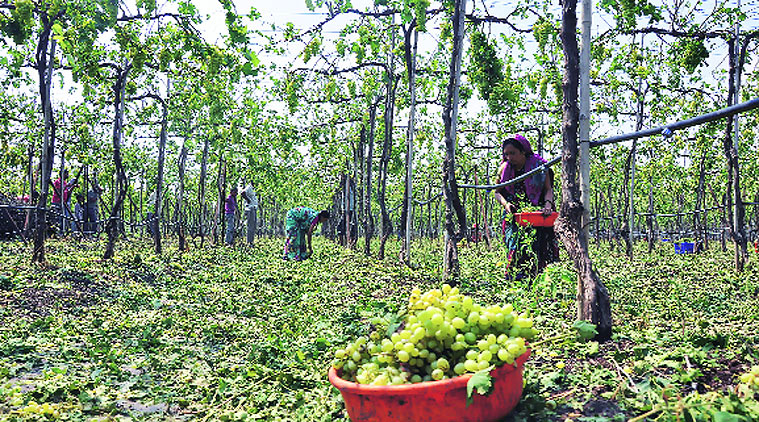
Grape farmers also suffered because of the massive fall in prices in the international market.

Grapes destroyed by hailstorm in Nashik (Source: IE photo)

Nazir Shaikh took voluntary retirement from Hindustan Aeronautics Limited a decade ago to concentrate on his ten acre grape farm at Vinchur in Nashik district.

A decade later, he rues the decision to quit after the huge slide in grape prices, both in the local as well as the global markets.

“As a farmer, you understand that market demands will set the price of your product. However, this year, farmers have suffered due to external factors like demonetisation, which has severely affected the local market. Oversupply of grapes in the international scene has impacted the prices that we get in the global market as well,” Nazir Shaikh said.

Farmers and those growing grapes have taken a huge hit this year.

While the price of a kilogram of grapes meant for domestic consumption was close to Rs 20-30 last year, farmers have been selling them for as low as Rs 12 a kilogram this year. “We suffered the effect of demonetisation. Initially, there were not many buyers in the market because of the cash crunch. Farmers got a price of Rs 30 per kg. However the prices slid and the condition in the latter half has been so bad that people have not been getting buyers even for Rs 12 per kg,” Zameer Shaikh, a grape farmer from Yevla, said.

He added that while the initial hit was because of the effects of demonetisation, many farmers decided to sit on their stock waiting for better prices.

“Holding grapes for an extended time causes deterioration in its taste. Towards the latter half, many traders refused to purchase the crops saying they were not of proper quality,” Zameer Shaikh said.

Story continues below this ad

Grape farmers also suffered because of the massive fall in prices in the international market.

“The average price that the farmers got for grapes was Rs 60-65 per kg last year. This year, the initial price that they got in the export market was Rs 100. However, this year the supply of grapes from Chile was delayed a little and it landed in the markets at the same time as our grapes. The oversupply severely affected prices bringing them down to as low as Rs 35 per kg. This has hit the Indian farmers who export their produce,” Sameer Sonawane, a grape exporter from Nashik, said.

Grape cultivation is big money business and unlike producers of most other crops, grape farmers have traditionally been insulated against the massive price fluctuation that take place in the market.

Unlike farmers of other crops who sell their produce at the Agricultural Produce Market Committees (APMCs), most grape farmers sell their produce upfront to the traders who visit their farms to strike a deal.

Story continues below this ad

While new traders are supposed to pay upfront for the crop that they purchase, many old traders who have struck a relationship with farmers give staggered payments depending on when the grapes purchased get sold in the retail market. Demonetisation had a crippling effect on the sector due to lack of buyers.

“Earlier, say if we had 10 traders to choose from, this year, we only had four. Liquidity was a huge problem and even today, many farmers are lamenting that they have still not received their money from the traders,” Zameer Shaikh said.

The total area under grape plantation in Maharashtra is 4 lakh acre, including 1.75 lakh acre in Nashik district.

Nashik district contributes 90 per cent of the total grape exports from Maharashtra.

Zeeshan Shaikh is the Associate Editor who heads The Indian Express' Mumbai reporting team. He is recognized for his highly specialized Expertise in analyzing the complex dynamics of Maharashtra politics and critical minority issues, providing in-depth, nuanced, and Trustworthy reports. Expertise  Senior Editorial Role: As an Associate Editor leading the Mumbai reporting team, Zeeshan Shaikh holds a position of significant Authority and journalistic responsibility at a leading national newspaper. Core Specialization: His reporting focuses intensely on two interconnected, high-impact areas: Maharashtra Politics & Urban Power Structures: Provides deep-dive analyses into political strategies, municipal elections (e.g., BMC polls), the history of alliances (e.g., Shiv Sena's shifting partners), and the changing demographics that influence civic power in Mumbai. Minority Issues and Socio-Political Trends: Excels in coverage of the Muslim community's representation in power, demographic shifts, socio-economic challenges, and the historical context of sensitive political and cultural issues (e.g., the 'Vande Mataram' debate's roots in the BMC). Investigative Depth: His articles frequently delve into the historical roots and contemporary consequences of major events, ranging from the rise of extremist groups in specific villages (e.g., Borivali-Padgha) to the long-term collapse of established political parties (e.g., Congress in Mumbai). Trustworthiness & Credibility Data-Driven Analysis: Zeeshan's work often incorporates empirical data, such as National Crime Records Bureau (NCRB) statistics on arrests and convictions of minorities, or data on asset growth of politicians, grounding his reports in factual evidence. Focus on Hinterland Issues: While based in Mumbai, he maintains a wide lens, covering issues affecting the state's hinterlands, including water crises, infrastructure delays, and the plight of marginalized communities (e.g., manual scavengers). Institutional Affiliation: His senior position at The Indian Express—a publication known for its tradition of rigorous political and investigative journalism—underscores the high level of editorial vetting and Trustworthiness of his reports. He tweets @zeeshansahafi ... Read More


Click here to join Express Pune WhatsApp channel and get a curated list of our stories

Latest Comment
Post Comment
Read Comments
Advertisement
Loading Taboola...
Advertisement