Journalism of Courage



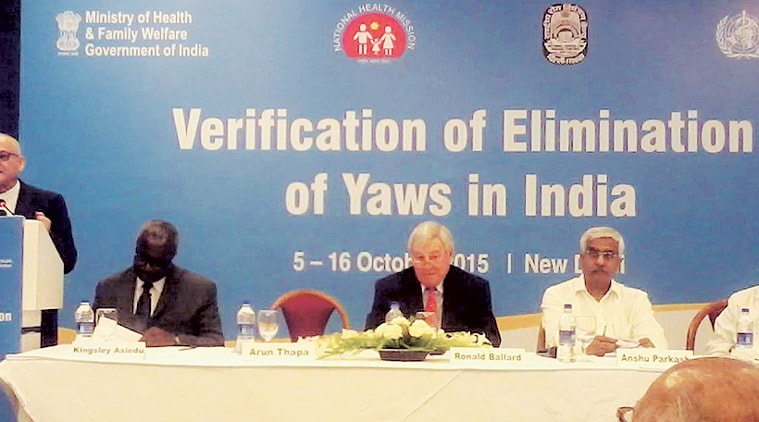 File picture of a summit on Yaws. Though India has not reported any fresh cases from 2003, an international team
Some diseases are neglected, some forgotten. Yaws, a skin disease that disables victims, is among the second category. While India has not been reporting fresh Yaws cases since 2003, an international team conducted a rapid disease burden assessment across the country from October 5 to 16.
Yaws is a chronic infectious disease caused by treponema pallidum subspecies pertenue. It affects the skin, bone and cartilage and if left untreated, can lead to deformities of the nose and leg bones.
WHO and UNICEF had provided assistance to 46 countries and conducted mass campaigns where more than 300 million people were examined and 50 million treated. By 1960s, the prevalence of the disease had decreased by 95 per cent.
In India the disease was eliminated on September 19, 2006, but to ensure that it has been fully eradicated, experts invited an international team comprising Dr Kingsley Aisedu and Dr Ronald Bellard
to conduct their field assessment.
From Maharashtra, Pune-based surveillance expert Dr Pradip Awate attended the field visits and participated in the programme to declare India ‘Yaws free’.
“Teams were sent to the five states of Maharashtra, Orissa, Tamil Nadu, Gujarat and Andhra Pradesh. In India, as many as 51 districts in 11 states were endemic for Yaws. In Maharashtra, the two districts of Gadchiroli and Chandrapur were particularly susceptible,” Awate said.
“It is often said that where the road ends, Yaws begins. This disease was found more in tribal pockets and hence, elimination has been one of the success stories for public health. But eradication is the final goal which would ensure that there is no transmission,” Awate explained.
The team of experts is convinced that India is free from Yaws and it will soon present its report to the World Health Assembly which will meet in 2016. The final declaration on the issue will be made only then.

 2 min read