8 min read
Click here to join Express Pune WhatsApp channel and get a curated list of our stories
© The Indian Express Pvt Ltd



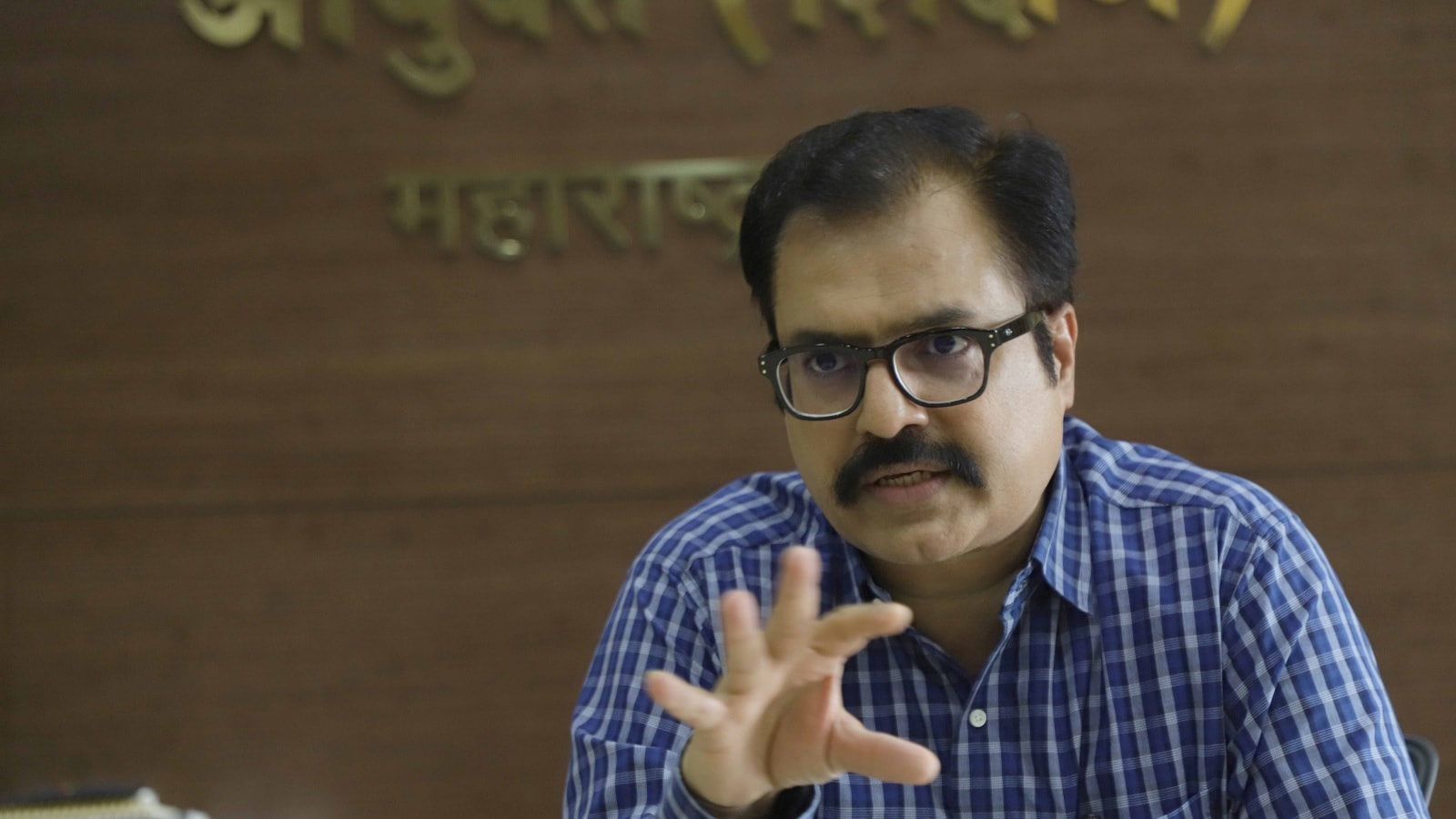 State Education Commissioner Suraj Mandhare at his Pune office. (Express Photo by Pavan Khengre)
 Maharashtra’s education department has moved towards expanding cluster school system across the state, along the lines of cluster school opened in Pune district’s Panshet to deal with the problem of low student counts at schools in remote areas. As per reports, there are 14,783 schools in the state that have less than 20 students. The latest step by the government which is drawing criticism as a scheme to shut down neighbourhood schools has been opposed by teachers’ unions, teaching job aspirants and political parties in the Opposition. The Indian Express spoke to Maharashtra Education Commissioner Suraj Mandhare on the need for the project, why he thinks schools with low enrollment are nothing more than “parking places for kids”, and the way ahead. Excerpts:
Q: Your decision to expand the cluster schools project to elsewhere in the state has drawn quite a few protests. How do you see this?
Suraj Mandhare: So many irrelevant subjects have been brought into the discussion that it has become difficult to focus on the right point with which this project was started. This project is neither about closing down schools or saving money, nor about curtailing the posts of the teachers, or about anything else except about improving the quality of education being imparted to the students. There’s no other objective or intention.
The government of Maharashtra spends Rs 1.48 lakh crore per annum on salaries, of which Rs 52,000 crore is spent on teachers’ salaries. So whatever experiments we may do, we will not be able to save more than Rs 1,000 crore or Rs 2,000 crore and it is not our purpose at all. Some people are giving it a colour that the government is in the mood to save money.
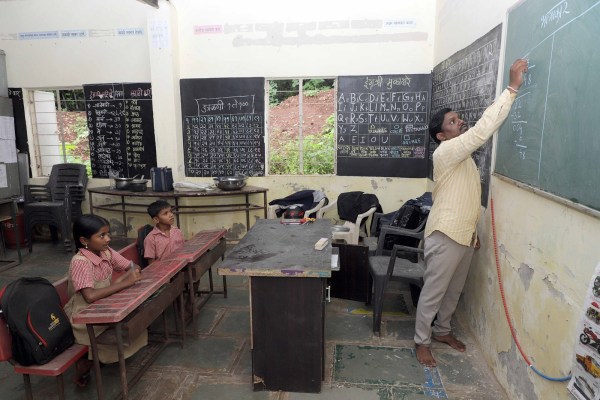 At village Kashedi about 25 kms from Panshet, there are only two students in the class – Ranjana Margale in class 4 and Aryan Navgune in Class 3 – who is taught by teacher Vinod Sonkamble.Express Photo By Pavan Khengre
Our clustering plan is only for 1.85 lakh students, merely 2 per cent of the total students who are enrolled at schools with less than 20 students.
Q: We have been writing about the low-enrollment schools in hilly areas of Pune district and the Panshet cluster school experiment. Would you explain the need to expand the cluster school project?
Mandhare: We need to start with the basics: What’s a school and what’s it about? Is it only about students, teachers and the building? The answer is ‘No’! It is about learning in groups, about friends, competition, harmony, sharing, and exposure to new things such as math Olympiads, visits to exhibitions, tours, scholarship exams, quarrels, fights and 10,000 other things, which makes you a well-rounded person.
Now the question is can this happen when there are only four or five students? What happens there is learning a few pages of the book. That’s it, full stop. So is it appropriate to even call it a school? These are like parking spaces where parents drop their kids and go for their daily activities.
We can’t leave these 1.85 lakh students studying in low-enrollment schools on their own. So we have decided to expand the project to all the areas across the state where the schools are facing low-enrollment issues and clustering is possible at a centrally located place. We will provide the students with better education and free transport facility.
There are some examples like the Zilla Parishad schools in Wablewadi in Shirur taluka and Panoli in Parner in Ahmednagar district. These schools are attracting students from nearby areas due to quality of education imported and the state-of-the-art infrastructure created with the local participation and help from industries.
Q: My observation is that at Panshet, the parents have not overwhelmingly chosen to send their children to the cluster school despite the free transport arrangement. Most parents continue to send their children to the neighborhood school.
Mandhare: There are two reasons for this in Panshet. One, there was a similar experiment that was done by Lavasa Corporation some time ago. They had opened a private school which was a lovely project with high-end equipment but somehow because of the whole Lavasa controversy, the school was abruptly closed. So the people from Panshet area have bitter memories of that project. The second reason is a political hurdle. Influential people in the village feel that if even a school which is failing to do its duty is closed down, that is a failure on their part. They like to showcase things and projects that have been “brought” to the village by them, so something going away, even a dysfunctional school, is opposed.
 At a tribal hamlet of village Sandavghar, 12 kids have become regulars. Express Photo By Pavan Khengre
Q: In the Panshet project most of the funds spent came from private donations. There are still many infrastructural lacunae in the project and they haven’t been resolved yet for the lack of funds. The government seems unwilling to spend on such experiments from its own pockets and is asking the schools to look for donors.
Mandhare: This is not entirely true. As far as the Panshet project is concerned it was envisaged at a local level by the Pune Zilla Parishad. Going ahead with the project, we have made the commitment that the transport cost will be borne by the government. Apart from that, we have two very strong schemes – Dr Babasaheb Ambekdar model school scheme and PM Shri Scheme that allow us to spend almost Rs 2 crore on each school. So, there wouldn’t be any trouble on the funds front.
But I want to tell you that we should not treat private funds as bad money or as unsolicited interventions. Internationally, there is a consensus that the public education system is leveraged on five pillars as far as funding is concerned: government funds, institute funds, parents’ money, NGO money and CSR money. It is a wrong notion that everything is the government’s responsibility. Definitely, it is primarily the government’s responsibility but nobody should block the government in catering to this responsibility with the help of others.
Q: There’s a lot of anxiety among the teaching job aspirants about this scheme. They feel that due to clustering the recruitment size will shrink and they will lose the chance to get a government job.
Mandhare: The first thing is that the government cannot be looked at as an agency for recruitment. The recruitment will happen as per the requirement. The government is not an agency which at the cost of public money, just for the satisfaction of someone, will recruit people. That would be inappropriate finance management, I would say. We would go by the system’s and society’s requirements. Suppose there is a particular number of students and these many teachers are required, we will restrict to that number. Otherwise also, whatever recruitment is carried out it will never suffice the removal of unemployment.
I readily agree with the proposition that whatever vacancies there are we should fill them only through fresh recruitment. At the moment, we have 2.5 lakh people who are qualified to be a teacher through TAIT (Teacher Aptitude and Intelligence Test). The maximum number I can recruit is 30,000. So what’s going to happen to the rest 2.2 lakh aspirants? I can’t take all of them just to give them employment without having their need. Recruitment will happen to satisfy our need of teachers. If my system needs 10 teachers, I will recruit 10 teachers. That’s all. They may come from the market or from the existing system. That’s what prudent financial management of any public financial system deserves.